
- News
- Health News
- Knee pain in your 30s? Doctors warn that pain while using stairs could be an early red flag
Knee pain in your 30s? Doctors warn that pain while using stairs could be an early red flag
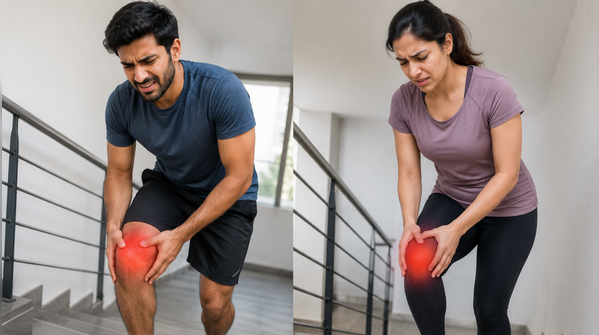
Knee pain is no longer an old age problem
You're sitting through a conference call. Two hours in, you stand up and your knee feels stiff. Or you're running up the stairs at home, and coming down is worse than going up. Maybe you've noticed a clicking sound when you move, nothing dramatic, just there. For most people in their 30s, these moments pass without much thought. Chalk it up to age, sitting too much, not exercising enough. But according to Dr. Parag Sancheti, Orthopedic Surgeon and Chairman of Sancheti Institute of Orthopedics and Rehabilitation, these aren't minor annoyances. They're signals.
"Knee pain is no longer an old-age problem," Dr. Sancheti says. "I see it often in patients in their 30s. Most of them are working professionals. Long sitting hours. Low activity. Sudden weekend workouts. This pattern is common. And it puts stress on the knees." What makes this concerning isn't that knee pain exists in younger people—it always has. What's different is that early symptoms are being ignored, and that's where the real problem begins.
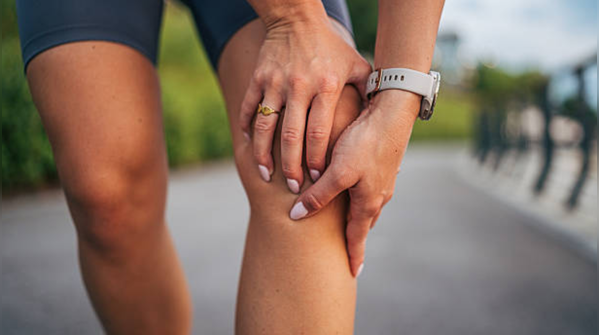
Image: AI
The stair descent red flag
The first warning sign Dr. Sancheti watches for is pain on stairs, particularly going down. Many people assume that going up stairs would be harder, but that's often not the case with early knee problems. Going down puts different—and sometimes more problematic—stress on the knee joint.
Taking supplements every day? Doctor warns they may be doing more harm than good
The HbA1c blind spot: Conditions that distort your results
"Stair pain is the first red flag," Dr. Sancheti explains. "Many patients report discomfort while going down stairs—not just up. This is clinically significant. It often indicates early cartilage stress behind the kneecap, a condition we call patellofemoral syndrome."
This matters because patellofemoral pain syndrome is incredibly common in younger adults. The incidence of PFPS in the United States is between 3% and 6%, with females accounting for 55% of cases. But here's what's critical: there is growing evidence that patellofemoral pain and patellofemoral osteoarthritis form a continuum of disease, meaning what starts as simple stair pain in your 30s can progress to serious joint damage in your 50s if ignored.
The insidious part? Patellofemoral pain often worsens with prolonged sitting or descending stairs, and plain radiographs of the knee are not necessary for diagnosis. So you won't see it on an X-ray. Dr. Sancheti notes that "it may not show on MRI or X-rays initially. But in over 30 years of practice, I have seen this pattern precede more serious damage when left unaddressed."
Stiffness after sitting
The second warning sign is stiffness after you've been sitting for a while. This isn't the same as general body stiffness. It's a specific, localized tightness in the knee that lasts more than a few steps.
"Stiffness after sitting is the second warning sign," Dr. Sancheti says. "You sit through a long meeting. Then you stand. The knee feels tight or stiff for the first few steps. This is early joint irritation—and in a large proportion of cases, it is directly linked to weak quadriceps muscles."
This is where biomechanics get interesting. When your quadriceps are weak, the knee joint doesn't have adequate muscular support. So the joint surface itself has to compensate. Over time, that compensation causes damage. Quadriceps weakness predicted whole knee and medial tibiofemoral cartilage loss after 3 years, according to a study published in The Journal of Rheumatology—and this was in people aged 40-79. In younger people with weak quadriceps, the risk trajectory is likely even longer, but the damage compounds over decades.
Clicking, swelling, and other signals
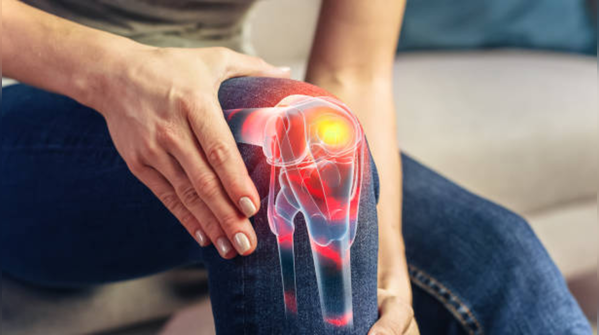
Then there's the clicking. Dr. Sancheti doesn't dismiss every click, not every click means something's wrong. But he does pay attention when clicking comes with pain or a catching sensation.
"Clicking sounds deserve attention. Not every click is a problem. But when clicking is associated with pain or a feeling of something catching, it needs evaluation. In my arthroscopy practice—over 800 procedures annually—I routinely find early cartilage irregularities and alignment issues in young patients who dismissed clicking sounds for months or years."
Swelling is another signal people too often ignore. "Never ignore swelling. Even mild swelling means inflammation is present. It may be due to overuse, a minor injury, or early degeneration. Many patients continue to exercise through swelling, believing they can train through it. They cannot. Swelling is the knee's distress signal. Continuing activity without treatment worsens the underlying condition."
Pain after activity
There's a specific pain pattern that's particularly diagnostic: pain that comes after activity, not during. Your run feels fine. Your workout feels fine. But an hour later, the ache sets in.
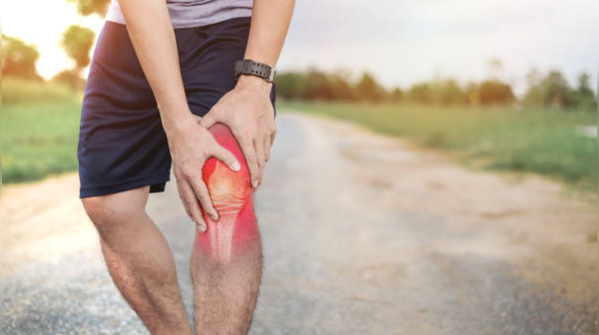
"Pain after activity—not during—is a key diagnostic clue," Dr. Sancheti explains. "The knee feels fine while you run or work out. But an hour later, the ache begins. This is a pattern I see frequently in young patients, and it points to joint overload. The tissue tolerates the activity at the moment but cannot recover from it."
Muscle weakness
The common thread running through all of this is muscle weakness, particularly in the quadriceps. These muscles are the primary shock absorbers for the knee. Adequate knee extensor and flexor muscle strength is important for the knee joint since these have a stabilizing and shock-absorbing function that may protect the cartilage from microtrauma and high peak loads during gait and physical activity.
Dr. Sancheti has seen the consequences firsthand. "The root cause in most young patients is muscle weakness. Specifically, the quadriceps. These muscles are the primary shock absorbers for the knee. When they are weak, load is transferred directly to the cartilage and joint surface. I have seen patients in their mid-30s with cartilage wear patterns more consistent with someone a decade older—not because of disease, but because of years of inadequate muscle support. This is reversible if caught early. It is not reversible if ignored until the damage is advanced."
The weight multiplier effect
Body weight plays an outsized role in knee stress. Obesity significantly influences knee joint mechanical reaction, increasing muscle activations, ligament loading, and articular cartilage contact stresses, particularly during key instances of the gait cycle. The biomechanical relationship is sobering: every kilogram of body weight translates to roughly three to four kilograms of force through the knee during walking, and up to seven to eight times that force during stair descent.
Dr. Sancheti is direct about this: "Weight is a multiplier. Every kilogram of body weight translates to approximately three to four kilograms of force through the knee during walking, and up to seven to eight times during stair descent. Even a modest weight gain significantly accelerates joint wear. This is not about aesthetics. It is biomechanics."
The exercise execution problem
Then there's improper exercise, which Dr. Sancheti sees increasingly in younger, motivated patients. Deep squats without technique. Sudden high-intensity training. Running on hard surfaces without adequate conditioning. These aren't failures of effort—they're failures of execution.
"Improper exercise is a growing problem. Sudden high-intensity training. Deep squats without proper technique. Running on hard surfaces without adequate conditioning or footwear. These are among the most common triggers I see in young patients who are otherwise motivated and health-conscious. The intention is right. The execution causes damage."
The early intervention window
Here's what makes all of this important: early-stage knee problems are reversible. Late-stage ones aren't. Dr. Sancheti has the numbers to prove it. "At Sancheti, we perform over 1,000 knee replacements every year. A significant number of those patients first noticed symptoms a decade or more before seeking proper care. Replacement is a good outcome. It is not the only outcome that was available to them."
The management window is open now, in your 30s. Physiotherapy isn't optional—it's essential. Painkillers don't fix anything; they just mask the problem while damage continues underneath. Weight management, proper exercise technique, and quadriceps strengthening can genuinely reverse early knee damage.
"When to seek evaluation immediately: if pain persists beyond two weeks, if swelling is present, if the knee feels unstable, or if there is any sensation of locking or giving way. These are not symptoms to monitor. They are symptoms to act on."
Dr. Sancheti's final message is as direct as his diagnosis: "Knee pain in your 30s is not a nuisance to manage. It is a signal from your body that something in the joint's load, alignment, or support needs correction. The window for non-surgical intervention is open. It will not stay open indefinitely. Act early."
Featured In Health

