
- News
- lifestyle
- soul-search
- 5 timeless lessons from the Shiv Purana which are the ultimate spiritual guide
5 timeless lessons from the Shiv Purana which are the ultimate spiritual guide

5 timeless lessons from the Shiv Purana which are the ultimate spiritual guide
In the immense constellation of Hindu sacred literature, the Shiv Purana occupies a distinctive orbit. It is not merely a compendium of divine exploits; it is also a meditation on solitude and society, loss and rebirth, discipline and devotion. Through stories of gods, sages, and ordinary devotees, the text asks questions that feel strikingly modern: How should one live with uncertainty? What does true renunciation look like in a world of responsibilities? How does destruction make room for renewal? Across centuries, poets and storytellers returned to Shiva’s world to grapple with those questions. What survives in the Shiv Purana is not rigid dogma but a set of enduring attitudes toward life that remain surprisingly relevant today. Here are five of its most timeless lessons.

Balance is not weakness; it is mastery
One of the Shiv Purana’s most arresting portraits is Shiva as a figure of balance, holding opposites together. He is the ash-covered ascetic and the devoted householder, the quiet meditator and the cosmic dancer, the destroyer and the healer. These are not problems to fix but tensions to accept and live with.
In a culture often caught between relentless ambition and total withdrawal, the Shiv Purana offers a third path. It encourages fulfilling worldly duties while staying inwardly detached, pursuing excellence while knowing when to step back. Balance here is not passive but a daily practice, a steady way of moving through desire, anger, love, and loss without being ruled by any of them.

Destruction can be a form of compassion
Shiva’s terrifying side unsettles first-time readers: worlds crumble, egos break, illusions fade. Yet the Shiv Purana often frames destruction not as cruelty but as cleansing. What is swept away is stagnation, rigid pride, moral rot, cosmic imbalance.
Read this symbolically, and the lesson is strikingly relevant. Change often comes in unsettling forms: layoffs, endings, public reckonings, private failures. The Purana invites readers to ask what those ruptures might be making room for. In Shiva’s cosmos, collapse is seldom the final act. It is the clearing of the stage for rebirth.
Devotion outweighs status
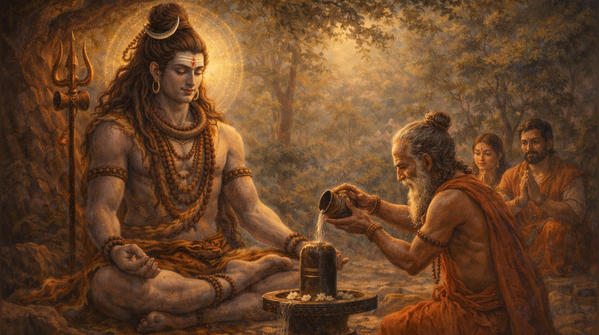
Again and again, the Shiv Purana elevates unlikely heroes: forest dwellers, wandering ascetics, devoted spouses, and humble worshippers whose sincerity eclipses royal pomp. Their offerings may be simple, leaves, water, a whispered mantra but their faith is uncalculating.
The message cuts across hierarchies. Spiritual worth is not inherited or purchased; it is practised. In an age that measures value in followers, wealth, and visibility, the text quietly insists on a different metric: intention. What matters is not how grand the ritual looks but how fully the heart is in it.

Stillness is a radical act
Shiva’s long meditations in remote mountains are not decorative flourishes. They are central to his power. Before action comes attention; before transformation comes silence. The Shiv Purana treats inwardness as a force capable of reshaping worlds.
Ascetic stillness in forests and caves becomes a technology of focus, stripping distraction until awareness turns razor-sharp. Mountains isolate him from noise, status, and urgency, letting observation deepen into insight, and insight harden into force that can later erupt outward through dance, destruction, or blessing for the waiting world beyond.
This emphasis feels almost countercultural now. We inhabit a landscape of alerts, feeds, and ceaseless commentary. Against that backdrop, the Purana’s praise of withdrawal reads like a prescription: step away regularly, sit with your breath, interrogate your impulses. Stillness, it suggests, is not an escape but a form of preparation. It reframes solitude as discipline rather than retreat, urging practitioners to cultivate inner clarity before engaging the world. In that quiet furnace, ego softens, perception sharpens, and resolve forms, readying the seeker not for disappearance, but for deliberate, conscious return.

Relationship is the heart of the cosmos
Despite its many images of solitude, the Shiv Purana is also filled with relationships between gods and humans, teachers and students, partners and families. Shiva is never only alone but shaped as much by connection as by renunciation. Love, loyalty, disagreement, and reconciliation are all part of the cosmic order.
Parvati’s partnership tempers his austerity, devotees redirect his fury into protection, and sages draw insight from his silence. These bonds complicate the archetype of the isolated ascetic, revealing a deity constantly negotiated through dialogue, obligation, and affection, where withdrawal and engagement remain intertwined rather than opposed within sacred narrative tradition.
This relational view challenges the idea that spirituality is purely individual. The Purana suggests that growth is rarely a solo effort. We learn patience through others, humility through conflict, and generosity through care. The divine, here, is not distant from daily life but deeply present within it.
Featured In lifestyle

MORE FROM ETIMES
life & style