NEW DELHI: Chandigarh has had a rich history of producing world-class all-rounders.
Kapil Dev, the captain of the 1983 World Cup-winning team, changed the trajectory of cricket in India. Then came Yuvraj Singh, who played a pivotal role in India’s World Cup triumphs in 2007 (T20) and 2011 (ODI). In 2025, the city found its third in Amanjot Kaur, an integral member of the Harmanpreet Kaur-led side that lifted India’s first piece of silverware in women’s cricket.
Hailing from Chandigarh, coach Nagesh Gupta calls the ‘Haryana Hurricane’ his childhood hero and once had a single dream -- to give India at least one genuine all-rounder. Instead, he has delivered two world-class all-rounders in Amanjot Kaur and Kashvee Gautam. The latter has now earned a national call-up for India’s tour of Australia in February-March.
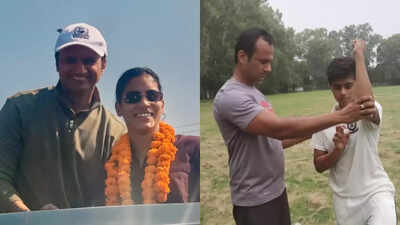
Just after the squad announcement, a proud Nagesh Gupta shared a post on his Instagram handle with pictures of Kashvee and Amanjot, captioned, "Two all-rounders. One standard."
"Kapil Dev is like a hero for me. When we started watching cricket, there were only two names that even our parents used to talk about - Kapil Dev and Sunil Gavaskar," Nagesh told
TimesofIndia.com in an exclusive conversation.
Kashvee has been picked for the ODIs, while Amanjot has been selected for all three formats.
Planting the seed
Kashvee and Amanjot started practising under Nagesh in 2016. "Both came to me within a space of four to five days and were my first two female students," Nagesh said. While Amanjot was referred to Nagesh by his friend Deepinder Singh, Kashvee was referred to by former Punjab Ranji Trophy player Sanjay Dhull.
While both Kashvee and Amanjot began as bowlers, coach Nagesh Gupta soon realised the significant role batting could play in their careers. "We realised over time that batting is very important. At that time, India did not have many all-rounders, so the perspective was to develop the all-round game that would help them in the long run. Thereafter, we did a lot of work on the batting of both Amanjot and Kashvee," he added.

The work behind the scenes
Amanjot and Kashvee have both been injury-prone, as being fast-bowling all-rounders puts significant pressure on the body. Amanjot suffered a back stress fracture before the start of the 2025 WPL and was again sidelined for two months due to a back niggle before the World Cup.
On the other hand, Kashvee suffered a knee injury during her debut ODI series in Sri Lanka last year and was out of action for seven to eight months.
After completing her rehabilitation at the BCCI Centre of Excellence in Bengaluru, Kashvee met her coach, Nagesh Gupta, ahead of the Women’s Premier League 2026 season. In the ten days they trained together before the tournament, Nagesh ensured Kashvee was ready for the marquee event.
"I used to call her at a different time than the usual academy hours so that I could fully focus on her," Nagesh asserted. "We started gradually, bowling with a short run-up and low intensity. As she got comfortable, the intensity and number of overs were increased. By the end, she was bowling four to six overs at full intensity, which is required in the WPL."
Working on skills
While Amanjot used to bat in the top order, Kashvee has always been a lower-order batter.
T20 cricket is the reality of modern times and while coach Nagesh Gupta has ensured that both his trainees have improved their power-hitting, he has not compromised on the basics.
"When Kashvee and Amanjot started playing, women’s T20 cricket was not such a big thing. During the initial years, we worked on making both of them technically strong. Over time, Amanjot’s back-foot game became very strong," Nagesh recalled.
Whenever there were shortcomings, coach Nagesh stood by his trainees. "In one season, Amanjot struggled to rotate the strike against spinners. To overcome that, we developed her game square of the wicket, including sweep shots."
The rise of T20s brought a new challenge, which Nagesh addressed head-on. "Power-hitting is very important in T20s because scores of 180 to 200 are being made frequently in women’s cricket. So we worked extensively on their power-hitting. Both Kashvee and Amanjot do a lot of power-hitting drills whenever they train here."
Hitting the deck, hitting it hard
Kashvee has always possessed a strong inswinger, which has been her stock delivery with the new ball. Earlier, she would simply release the ball and let it do the work. Now, she hits the deck hard, making her even more lethal.
Five years ago Kashvee created history by bagging all the 10 wickets against Arunachal Pradesh in the Women’s U-19 One-Day Trophy in Kadapa, Andhra Pradesh.
Hitting the deck requires the bowler to sharply flex the wrist in the final milliseconds before release to create backspin, which makes the ball skid off the surface. Nagesh worked closely with Kashvee to add this weapon to her bowling.
"If you just release the ball, the batter gets more time to react and the ball is pitched up more often, making it easier to hit boundaries. If you hit the deck hard, the batter has less time to react," Nagesh explained.
Nagesh also plans to make changes to the bowling actions of both Amanjot and Kashvee to reduce injury risks. "We have plans to make some biomechanical changes, but for that we need at least a month. Both remain busy due to a tight schedule, but if we get time, we will try to implement them."
Kashvee has made a comeback after missing most of the 2025-26 season due to a knee injury. Amanjot became a World Cup winner on November 2 last year and etched her name in Indian cricket folklore by taking the match-turning catch to dismiss South Africa captain Laura Wolvaardt in the ODI World Cup final in Navi Mumbai.
Quality seam-bowling all-rounders remain one of the most sought-after skills in Indian cricket, and Nagesh’s protégés Amanjot Kaur and Kashvee Gautam could go the distance over the next decade.
Nagesh is optimistic about their future. "Kapil Dev is a hero for them too. If their careers reach even 60 to 70 per cent of what Kapil achieved, it would be great," Nagesh concluded.