
- News
- Relationships News
- Love quote of the day by Karl Marx: “If you love without evoking love in return..."
Love quote of the day by Karl Marx: “If you love without evoking love in return..."
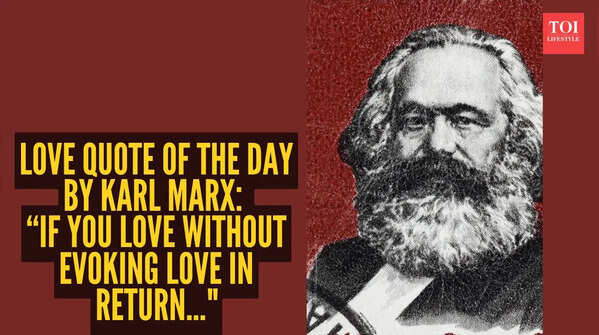
Karl Marx on love
“If you love without evoking love in return—that is, if your loving as loving does not produce reciprocal love; if through a living expression of yourself as a loving person you do not make yourself a loved person, then your love is impotent— a misfortune.”
— Karl Marx, Economic and Philosophic Manuscripts of 1844
Most people associate Karl Marx with political theory and class struggle. But this powerful line by him on love reveals a surprisingly different side of his thinking about human relationships. In it, Marx doesn’t define love as a feeling alone; he defines it as a mutual, lived reality. For him, love is not just something you pour out; it must also be something that is received, reflected, and returned.
He’s describing a painful, almost tragic situation: the experience of loving deeply while that love goes unanswered, unmet, or unreciprocated. In such a context, love begins to feel powerless—a “misfortune”—not because the person who loves is flawed, but because the relationship has become one‑sided and unbalanced.

Love that is not reciprocated
When Marx talks about love that “does not produce reciprocal love,” he’s pointing to a very human experience. Many of us have loved someone who couldn’t, or wouldn’t, love us back in the same way. That imbalance can show up in romantic relationships, friendships, or even family bonds.
In those moments, love can start to feel like an internal burden. You may keep giving affection, effort, or emotional energy, but over time it feels like you’re building a relationship on your own. The other person remains emotionally distant, inconsistently present, or quietly absent, and your love is left echoing in the void.

What Marx means by “love as loving”
Marx writes that love becomes misfortune when “loving as loving” doesn’t transform you into “a loved person.” In other words, the act of loving—which is generous, vulnerable, and expressive—should ideally be met with recognition, warmth, and care. It should not leave you feeling invisible, taken for granted, or emotionally drained.
He’s suggesting that love is not just about the intention to care; it’s also about the impact. A healthy relationship is one where both people feel seen and loved, where giving love doesn’t mean losing yourself. When love feels one‑sided, it stops feeling like connection and starts feeling like sacrifice.

The loneliness of unreciprocated love
Marx’s description resonates with anyone who has stayed in a relationship long after realizing it was no longer mutual. You may still feel affection, loyalty, or hope, but you’re no longer met with the same intensity or presence. The other person may be physically present, but emotionally distant.
In that space, love can harden into something painful—a kind of quiet suffering. It’s a “misfortune” not because you loved, but because your love was treated as if it were optional. Over time, that imbalance can erode self‑worth, making you question whether you’re worthy of being loved at all.

Rethinking our relationship with love
Marx’s quote makes us think how we treat love in our own lives. It’s a reminder that love is not a performance to win someone over, nor is it a punishment to endure. It’s a bond meant to be shared, not carried alone.
Healthy love is dynamic: it moves back and forth. When love is not reciprocated, the most courageous thing we can sometimes do is to step back, reevaluate, and care for ourselves with the same tenderness we extend to others.
In that sense, Marx’s words are not just a critique of unreciprocated love; they’re also a quiet call to build relationships that feel mutual, alive, and human—where the act of loving someone doesn’t leave you feeling broken, but more deeply connected and more wholly yourself.
Featured In Relationships

