
- News
- etimes
- work-career
- Young adults are setting higher standards than ever—and it's fueling a rise in perfectionism: Psychologists reveal the hidden pressures behind the trend
Young adults are setting higher standards than ever—and it's fueling a rise in perfectionism: Psychologists reveal the hidden pressures behind the trend
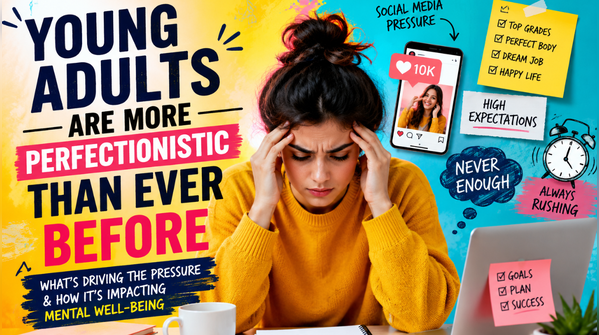
Researchers at the London School of Economics and York St. John University have found something shocking
Something's been quietly building for decades inside the minds of young adults, and a sweeping new analysis published by the American Psychological Association has finally put hard numbers to it. Researchers at the London School of Economics and York St. John University reviewed 35 years of data from more than 82,000 college students across the United States, Canada, and the United Kingdom, and found that self-reported perfectionism has climbed consistently from 1989 through 2024. This search spanned the period from January 1989 to June 2025. That's not a blip. That's a generation-long shift in how young people see themselves, measure their worth, and fear getting things wrong.
Image: AI

Three types of perfectionism — and one is rising fastest
The researchers classified perfectionism into three types: self-oriented, which is an irrational desire to be perfect; socially prescribed, which involves perceiving excessive expectations from others; and other-oriented, which means placing unrealistic standards on the people around you. All three have risen. But it's the socially prescribed kind, the feeling that the world expects flawlessness from you, that's shown the sharpest climb. Between 1989 and 2016, socially prescribed perfectionism rose by 33%, the largest increase of the three, and it's also the form most closely linked to serious mental health disorders. And that number has only continued upward since.

Fear of failure is outpacing ambition
Here's where the new research gets especially revealing. Since the early 2000s, different aspects of perfectionism have increased at different rates. Perfectionistic concerns — which include fear of failure, indecisiveness, and fear of being negatively judged by others — have risen far faster than perfectionistic strivings, which reflect the motivation to set high standards and work hard to meet them. In plain terms: young people aren't just trying harder. They're becoming more afraid. The drive isn't purely ambition — increasingly, it's anxiety wearing ambition's clothes.

The economy has more to do with it than social media
Most conversations about perfectionism in young adults go straight to Instagram and comparison culture. And while social media is clearly part of the picture, the APA-published research points to something deeper. Slowing GDP per capita was associated with higher rates of perfectionistic striving, while rising economic inequality was linked to steeper increases in perfectionistic concerns. Lead author Thomas Curran, PhD, of the London School of Economics, explained it directly: "When there's a lack of economic opportunity, young people seem to compensate with striving. And when inequality grows, what you see is that fear and worry about making mistakes and other people's opinions starts to become a more central feature of young people's psychology." So it's not just filtered selfies doing the damage — it's the sense that the margin for error in life has genuinely shrunk.

Public health problem
Curran has been explicit about the stakes: "Perfectionism is a public health risk — it's associated with increased depression and anxiety. If we want to tackle the youth mental health crisis, we need to focus on these cultural and economic factors." Because for years, the response to perfectionism has been individually focused — therapy, mindfulness, learning to accept imperfection. The pressure young adults feel is being built into the systems around them — the universities, the job markets, the social structures that keep telling them that good enough is never quite enough.
Featured In etimes

