

Tanks
Explore the world's complete defence inventory of tanks, with detailed specifications.
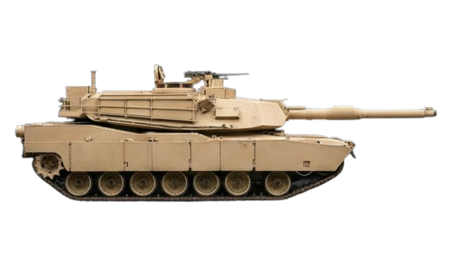
 USA
USAThe M1A2 Abrams SEPv3 is the most advanced variant of America's main battle tank. Featuring upgraded armor, improved fire control systems, and enhanced situational awareness, it remains the backbone of U.S. armored forces.
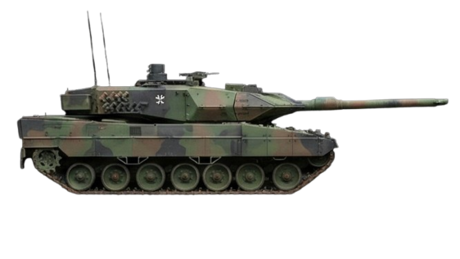
 Germany
The Leopard 2A7V represents the pinnacle of German tank engineering. This heavily upgraded version features state-of-the-art modular armor, the L55A1 120mm gun, and advanced electronics for networked warfare.
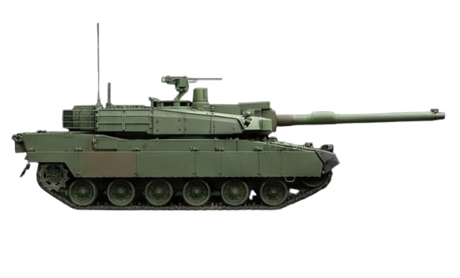
 South Korea
The K2 Black Panther is a fourth-generation main battle tank featuring an autoloader, advanced in-arm suspension, and sophisticated fire control. It represents South Korea's bid to become a major defense exporter.
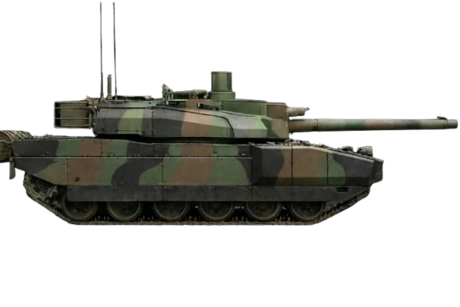
 France
The Leclerc XLR is a fourth-generation modernization of France's main battle tank under the SCORPION program. It features enhanced networked capabilities, improved protection, and integration with other SCORPION vehicles.
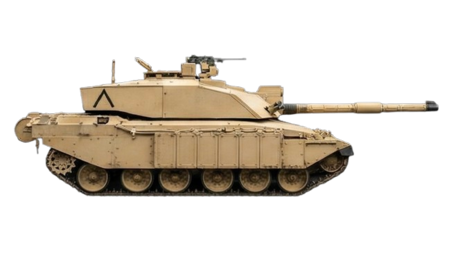
 UK
UKThe Challenger 2 is the British Army's main battle tank, renowned for its exceptional armor protection and accurate rifled gun. It remains the only NATO tank using a rifled main gun.
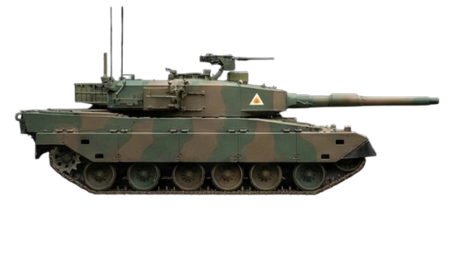
 Japan
JapanThe Type 90 is Japan's third-generation main battle tank featuring an autoloader, advanced fire control, and composite armor. It was designed specifically to counter Soviet T-72 and T-80 tanks.
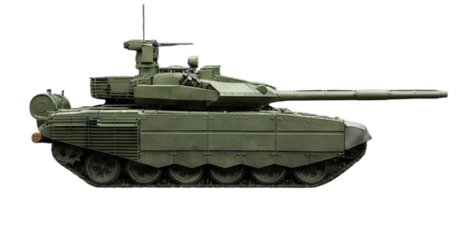
 Russia
The T-90M Proryv-3 is the most advanced variant of Russia's T-90 main battle tank. It features a redesigned turret, the 2A82-1M gun from the T-14 Armata, and Relikt explosive reactive armor.
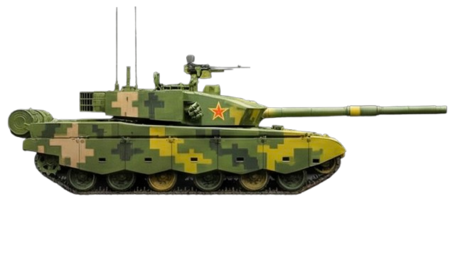
 China
ChinaThe Type 99A2 (ZTZ-99A) is China's most advanced third-generation main battle tank, developed by Norinco. Weighing approximately 54-58 tons, it features a 125mm ZPT-98 smoothbore gun with autoloader (10 rounds/min), 1,500hp 150HB-2 diesel engine derived from German MB871 technology, and advanced modular composite armor with third-generation ERA. Maximum speed is 80 km/h on road, 65 km/h cross-country. Features include GL5/GL-XX active protection system, Kalina-type fire control system, 3rd generation thermal imaging, commander's panoramic sight for hunter-killer capability, millimeter-wave radar for IFF, and capability to fire 9M119 Refleks ATGMs through main gun (5 km range). Length 11m (gun forward), width 3.5m, height 2.35m.
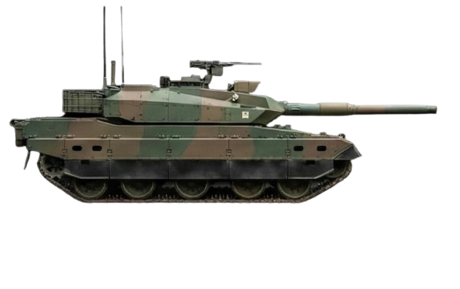 Japan
JapanThe Type 10 (10式戦車 Hitomaru-shiki sensha) is Japan's fourth-generation main battle tank manufactured by Mitsubishi Heavy Industries for the JGSDF. Weighing 40-44 tons (base) to 48 tons (combat loaded with modular armor), it features a 120mm L44/L55 smoothbore gun with autoloader (3.5 second reload), 1,200hp Mitsubishi 8-cylinder diesel engine, and continuously variable transmission (CVT) enabling 70 km/h forward and reverse. Length 9.4m, width 3.2m, height 2.3m. Crew of 3. Features C4I battlefield management system (10NW), hydropneumatic active suspension for hull posture control, and modular ceramic/composite armor with nano-crystal steel. Designed to cross 84% of Japanese bridges vs 65% for heavier Type 90.
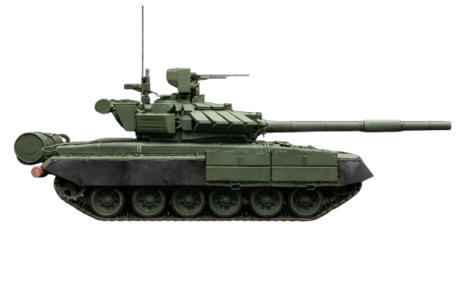 Russia
The T-80BVM is Russia's modernized gas turbine-powered main battle tank, upgrading the 1985-era T-80BV to near-T-90M standards. Weighing approximately 46-48 tons, it features a 125mm 2A46M-4 smoothbore gun with autoloader (capable of Svinets-1/Svinets-2 depleted uranium/tungsten APFSDS), GTD-1250TF gas turbine engine (1,250hp, upgradeable to 1,400hp boost), and Relikt third-generation ERA. Length 9.65m (gun forward), width 3.6m, height 2.2m. Crew of 3. Features Sosna-U gunner's sight with thermal imaging, 9M119M Refleks-M ATGM capability (5km range), 360° camera system, and Kord 12.7mm RWS. Maximum speed 70 km/h, range 500km. First publicly revealed at Zapad 2017 exercise.
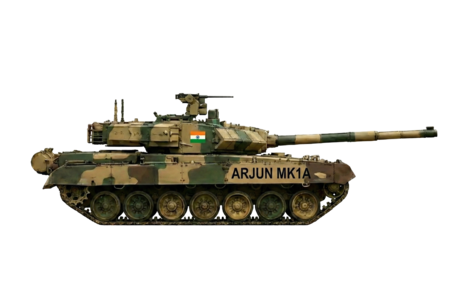
 India
IndiaThe Arjun Mk1A is India's upgraded indigenous third-generation main battle tank developed by DRDO's CVRDE. Weighing 67-68 tons, it features a 120mm rifled gun with improved barrel, MTU 1,400hp diesel engine (to be replaced by indigenous DATRAN 1,500hp), and improved Kanchan composite armor with ERA Mk-II. Length 10.64m (gun forward), width 3.86m, height 2.32m. Crew of 4. Features 72 improvements over Mk1 including COAPS commander's sight for hunter-killer capability, SAMHO gun-launched ATGM (4km range), automatic target tracking, laser warning receivers, and containerized ERA on turret/hull/skirts. 118 units ordered in 2021 for ₹7,523 crore (~$907 million). Deliveries now expected 2028-2029 due to engine supply issues.
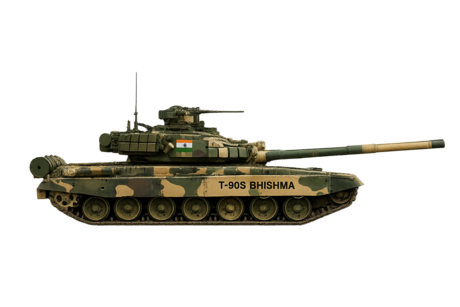 India
IndiaThe T-90S Bhishma (named after Mahabharata warrior) is India's license-produced version of the Russian T-90S MBT, forming the backbone of Indian armored forces. Weighing 46.5 tons (T-90S) to 50.7 tons (Mk-3), it features a 125mm 2A46M-5 smoothbore gun with autoloader, V-92S2 diesel engine (1,000-1,130hp), and Kontakt-5 ERA. Length 9.53m (gun forward), width 3.78m, height 2.23m. Crew of 3. Features French Thales Catherine-FC thermal sights, Shtora countermeasures (early batches), and 9M119 Refleks ATGM capability (5km range). Over 1,657 planned; approximately 1,300 in active service as of 2024-2025. Produced at Heavy Vehicles Factory, Avadi.
 India
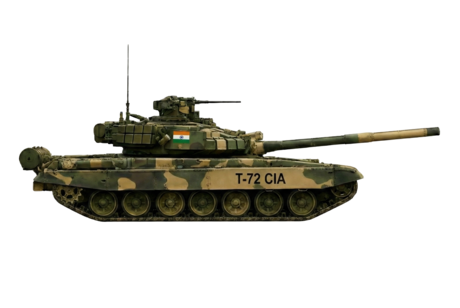
IndiaThe T-72 Combat Improved Ajeya (CI Ajeya) is India's modernized version of the license-produced Soviet T-72M1 main battle tank. Weighing approximately 44-46 tons, it features a 125mm 2A46 smoothbore gun with carousel autoloader, V-46-6 diesel engine (780hp), and upgraded ERA, fire control, and electronics. Length 9.53m (gun forward), width 3.59m, height 2.23m. Crew of 3. CI Ajeya upgrades include Polish SKO-1T fire control system with thermal imaging, DRDO-developed ERA, Integrated Fire Detection and Suppression System (IFDSS), GPS navigation, and 81mm smoke grenade launchers. Approximately 1,900 T-72M1 Ajeya produced at HVF Avadi; ~2,400 in total inventory including upgrades. Phaseout planned as T-90 fleet expands.
 India
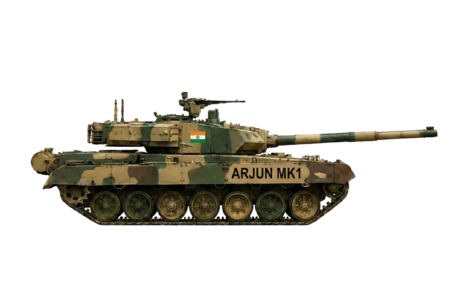
IndiaThe Arjun Mk1 is India's first indigenous third-generation main battle tank developed by DRDO's Combat Vehicles Research and Development Establishment (CVRDE). Weighing 62-62.5 tons, it features a 120mm rifled gun, German MTU MB 838 Ka-501 1,400hp diesel engine, and Kanchan composite armor. Length 10.19m (gun forward), width 3.86m, height 2.32m. Crew of 4 (commander, gunner, loader, driver). Features include integrated fire control system (IFCS) with automatic target tracking, laser rangefinder, day/night thermal sights, and NBC protection. 124 units in service with 43rd and 75th Armoured Regiments. Development began 1974; first production deliveries 2004.
 India
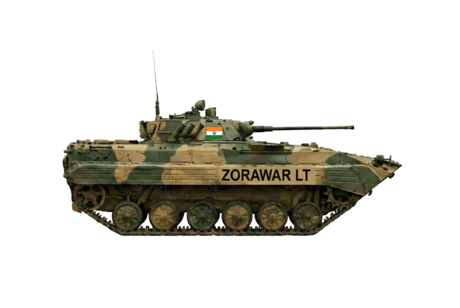
IndiaThe Zorawar is India's indigenous 25-ton light tank jointly developed by DRDO's CVRDE and Larsen & Toubro for high-altitude operations in Ladakh and mountain warfare. Weighing 25 tons (±10%), it features a 105mm John Cockerill 3105 rifled gun with autoloader (12-16 ready rounds), Cummins VTA903E-T760 engine (760hp, planned 1,000hp ACE upgrade), and modular composite armor with titanium body. Length 8.5m, width 3.2m, height approximately 2.3m. Crew of 3. Features include Safran Paseo electro-optical systems for hunter-killer capability, active protection system, laser warning receivers, C-UAS capability, and amphibious capability via water jets. Initial order for 59 units; total requirement 354 tanks at ₹17,500 crore (~$2.1 billion).
 India
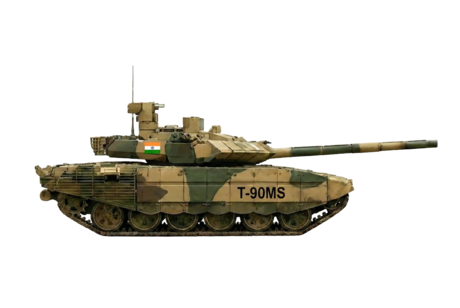
IndiaThe T-90MS (also known as T-90SM) is Russia's latest export variant of the T-90 main battle tank, representing significant improvements over the T-90S. Weighing 48 tons, it features a 125mm 2A46M-5 smoothbore gun with improved autoloader, V-92S2F diesel engine (1,130hp), and Relikt third-generation ERA. Length 9.63m (gun forward), width 3.78m, height 2.23m. Crew of 3. Features include Kalina fire control system, Sosna-U gunner's sight with thermal imaging, PK PAN commander's panoramic sight for hunter-killer capability, UDP T05BV-1 remote weapon station (7.62mm), GLONASS/inertial navigation, automatic transmission with steering wheel control, and removable turret bustle for 8 additional rounds. India approved procurement of 464 T-90MS (designated Bhishma Mk-3) in 2019.
 India
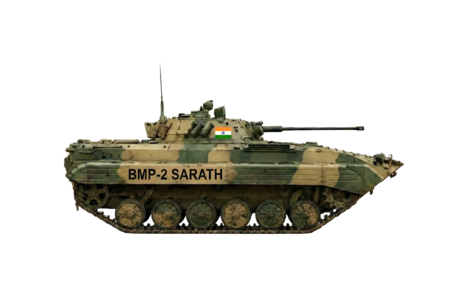
IndiaThe BMP-2 Sarath ('Chariot of Victory') is India's license-produced version of the Soviet BMP-2 infantry fighting vehicle manufactured by Ordnance Factory Medak. Weighing 14.3 tons, it features a 30mm 2A42 autocannon with dual-feed system, 7.62mm PKT coaxial MG, and AT-5 Spandrel (9K113 Konkurs) ATGM launcher with 4km range. Powered by UTD-20/3 300hp diesel engine providing 65 km/h road speed and 7 km/h amphibious capability via water jet. Length 6.74m, width 3.15m, height 2.45m (with turret). Crew of 3 plus 7 infantry. Approximately 2,500 Sarath produced with 90%+ indigenous content. BMP-2M upgrade program underway for 693+ vehicles.
 India
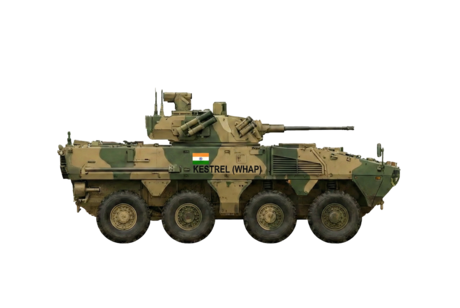
IndiaThe Kestrel (officially DRDO WhAP - Wheeled Armoured Platform) is India's indigenous 8x8 amphibious armored personnel carrier jointly developed by DRDO and Tata Advanced Systems. Weighing 25 tons, it features modular weapon configurations including BMP-2 turret (30mm 2A42 + 7.62mm PKT + ATGM), Kongsberg MCT-30R RWS, or Elbit UT30MK2 turret. Powered by Cummins ISX 600hp diesel engine with automatic transmission providing 100 km/h road speed, 40 km/h off-road, and 10 km/h amphibious via water jets. Length 7.85m, width 3.0m, height 2.3-3.25m (depending on turret). Crew of 2-3 plus 10 infantry. Features double-V hull for mine/IED protection, modular armor, NBC protection, and run-flat tires with CTIS.
 India
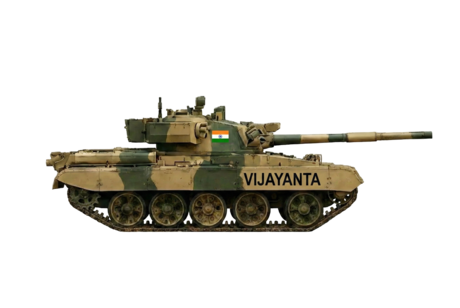
IndiaThe Vijayanta ('Victorious') was India's first indigenously produced main battle tank, a license-built version of the British Vickers Mk.1. Weighing 38.6-40 tons, it featured a 105mm L7A1 rifled gun with 44 rounds, Leyland L60 multi-fuel diesel engine (535hp), and welded rolled homogeneous armor (80mm turret front). Length 9.79m (gun forward), width 3.17m, height 2.44m. Crew of 4. Features included Marconi all-electric gun control and stabilization system, 12.7mm ranging MG (later replaced by laser rangefinder on upgraded marks), and 7.62mm coaxial and AA MGs. Approximately 2,200 built at Heavy Vehicles Factory Avadi from 1965-1983. Fully phased out 2008; some turrets remain as static defenses along LoC.
 India
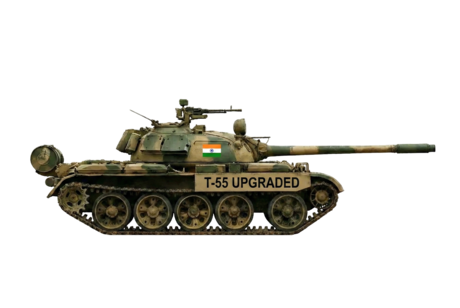
IndiaThe T-55 in Indian service was a Soviet-origin medium tank acquired in large numbers (1,700+) and upgraded under Project Gulmohar. Original specifications: 36-40 tons, 100mm D-10T rifled gun (later upgraded to 105mm L7A1 on some), V-55 520hp diesel engine, maximum speed 48 km/h, range 510-600 km with long-range tanks. Length 9.0m (gun forward), width 3.27m, height 2.35m. Crew of 4. Gulmohar upgrade included 105mm L7A1 gun (from Vijayanta), improved fire control (Yugoslav SUV-T55A), night vision equipment, and extended service life. Approximately 700-800 upgraded by late 1990s. Last T-55 phased out from active service 2011; some remain in storage/static defense.