
Why 'ghee' slugging is the ultimate desi fix for cracked winter lips
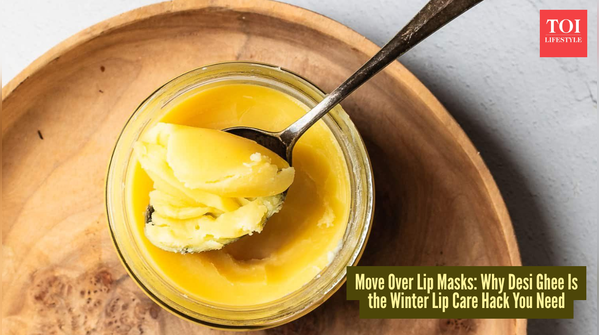
Why Desi Ghee is the Best Lip Mask?
We’ve all been there. It’s mid-January, the air is dry enough to crack a wooden beam, and your lips feel like sandpaper. You reach for that trusty tub of petroleum jelly, slathering it on until you look like you’ve just eaten a greasy paratha. But an hour later? Dry again.
Enter the K-beauty world’s favorite trend: "Slugging." The concept is simple—sealing your skincare with an occlusive layer (usually petrolatum) to prevent water loss. But while the internet is busy buying expensive tubs of refined jelly, Indian grandmothers are likely rolling their eyes. They’ve had the superior "slugging" agent in their kitchens all along.
It’s time to talk about Desi Ghee. And no, it’s not just for your dal.

The Problem With Your Petroleum Pot
Here is the cold, hard truth about that little blue tub in your purse: it’s lazy. Petroleum jelly is hydrophobic and inert. It sits exclusively on top of your lips. Think of it like a plastic wrap; it keeps the wind out, but it doesn't actually put anything in. If your lips are already parched and peeling, Vaseline is simply trapping the dryness against your skin. It seals, but it doesn't heal.
Research shows that for true repair, you need something semi-occlusive—a barrier that breathes and, crucially, penetrates. This is where the golden elixir wins.
(Image Credits: Pinterest)
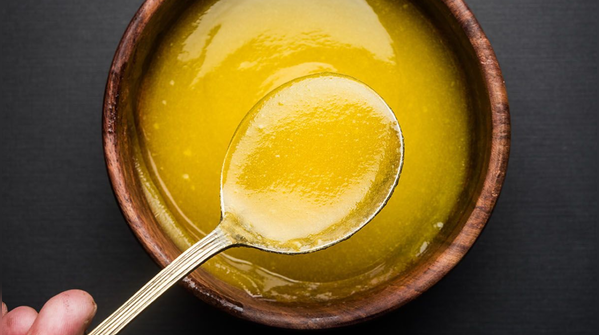
Liquid Gold: The "Bio-Identical" Difference
Unlike synthetic waxes that just sit there, ghee is what scientists call "bio-identical." Its lipid structure mimics your skin’s natural oils so closely that it tricks the stratum corneum (the outer layer of your skin) into letting it pass through.
When you apply ghee, you aren't just frosting a cake; you’re feeding the sponge. It slips past the surface cracks and hydrates the cellular matrix from within. This is "active" skincare. While commercial balms are playing defense, ghee is playing offense, actively repairing the tissue while maintaining that crucial protective seal.
(Image Credits: Pinterest)

More Than Just Fat
If you looked at ghee under a microscope, you’d see it’s actually a complex suspension of skincare heavyweights. It’s packed with Butyric Acid, a short-chain fatty acid that acts as a powerful anti-inflammatory. Those painful, throbbing cracks that appear after a windy day? Butyric acid brings the swelling down almost instantly—something a wax balm can never do.
Then there’s the cocktail of Vitamins A and E. Vitamin A (nature’s retinol) encourages faster cell turnover, helping those peeling flakes heal quicker, while Vitamin E fights the oxidative stress that can make winter lips look dark and dull.
(Image Credits: Pinterest)
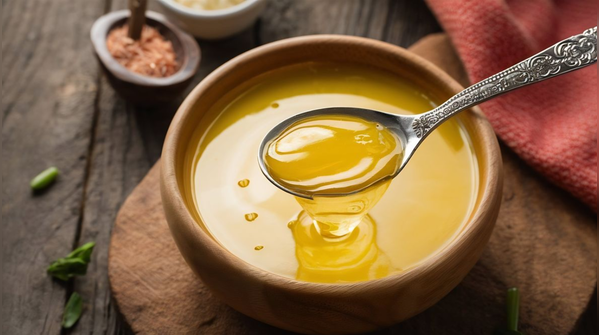
The "Melt" Factor
Have you ever noticed how cold lip balm drags across your skin? That friction can actually micro-tear fragile winter lips. Ghee has a melting point of roughly 37°C—exactly human body temperature. The moment it touches your lip, it transforms from a solid to a silky liquid, flowing deep into microscopic fissures that solid waxes simply bridge over and miss.
(Image Credits: Pinterest)

The Nighttime Ritual: How To Slug Desi-Style
To get the most out of this, you need to follow the proper protocol. Since your lips have no oil glands of their own, they rely entirely on external moisture.
1. The Wet Step: Splash your lips with a little water. This is non-negotiable. Ghee locks moisture in, so you need to provide the water first.
2. The Coat: Apply a generous layer of ghee. Don't rub it all the way in; you want a visible, glossy layer sitting on top.
3. The Sleep: Let it work overnight.
In Ayurveda, dry lips are a classic sign of excess Vata (air energy). Ghee is the ultimate Vata-pacifier, grounding and soothing the skin. So tonight, skip the chemicals. Dip a clean finger into the kitchen jar, and wake up to the kind of soft, healed lips that no store-bought tube can promise.
(Image Credits: Pinterest)
Featured In lifestyle

