
- News
- India News
- Air drill & Agni-V test: India signals to China
Trending
This story is from December 16, 2022
Air drill & Agni-V test: India signals to China
In two-pronged strategic signalling to China on Thursday, India tested its most formidable nuclear-capable missile Agni-V, even as the Indian Air Force (IAF) kicked off an exercise with frontline fighters like Rafales and Sukhoi-30MKIs to fine-tune its combat readiness in the eastern sector.
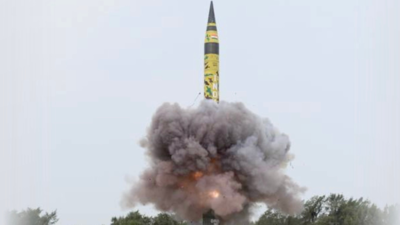
NEW DELHI: In two-pronged strategic signalling to China on Thursday, India tested its most formidable nuclear-capable missile Agni-V, even as the IAF kicked off an exercise with frontline fighters like Rafales and Sukhoi-30MKIs to fine-tune its combat readiness in the eastern sector.
The Strategic Forces Command (SFC) in collaboration with DRDO conducted the test of the over 5,000-km range Agni-V ballistic missile, which brings even the northernmost part of China within its strike envelope, from the APJ Abdul Kalam Island off the Odisha coast at 5.45 pm.
"The three-stage solid-fuelled Agni-V, in its full operational configuration, was successfully tested for its entire range. The missile incorporated some new technologies to make it lighter as well as enable it to go to a longer distance," a source told TOI.
The Agni-V is operationally better than earlier Agni variants because it is a canister-launch missile to ensure less maintenance as well as swifter transportation and firing. It provides India with stronger deterrence against China, which has a huge nuclear arsenal and missiles like the Dong Feng-41 (12,000-15,000-km) that can hit any Indian city.
Earlier on Thursday, the Shillong-based Eastern Air Command launched the two-day consolidated air combat training exercise in Assam and Arunachal Pradesh, which also included C-130J 'Super Hercules' aircraft and drones, Apache attack and Chinook heavy-lift choppers.
IAF said it was a "pre-planned exercise" and not connected to the major physical clash between Indian and Chinese soldiers at Yangtse in the Tawang sector of Arunachal Pradesh on December 9.
But it does come at a time when the People's Liberation Army-Air Force (PLAAF) has cranked up deployments of aircraft, helicopters and drones along the Line of Actual Control (LAC) across Arunachal Pradesh.
Similar heightened air activity by PLAAF has been taking place across eastern Ladakh since mid-June, with Chinese fighters sometimes violating the 10-km no-fly zone confidence-building measure.
In the eastern sector, the IAF has also had to scramble Sukhoi fighters at least "two-three times over the last two-three weeks" as a precautionary air defence measure after "radar pick-ups" of Chinese aircraft near the LAC, as was reported by TOI.
China has systematically upgraded all its major air-bases facing India like Hotan, Kashgar, Gargunsa and Shigatse with extended runways, hardened shelters and fuel storage facilities for additional fighters, bombers, drones and reconnaissance aircraft.
Apart from other measures, the IAF in turn based a squadron of its latest omni-role Rafale jets at the Hasimara air base in West Bengal, which is close to the Sikkim-Bhutan-Tibet tri-junction on the eastern front with China, from July 2021 onwards.
Though China has more than four times the number of fighters and bombers as compared to India, the high-altitude and rarefied air at its air-bases severely limits the weapon and fuel-carrying capacity of aircraft. IAF, with a distinct "terrain advantage", can deploy fully-loaded Rafale and Sukhoi fighters from bases like Hasimara, Tezpur and Chabua for strike missions across the frontier.
The Strategic Forces Command (SFC) in collaboration with DRDO conducted the test of the over 5,000-km range Agni-V ballistic missile, which brings even the northernmost part of China within its strike envelope, from the APJ Abdul Kalam Island off the Odisha coast at 5.45 pm.
"The three-stage solid-fuelled Agni-V, in its full operational configuration, was successfully tested for its entire range. The missile incorporated some new technologies to make it lighter as well as enable it to go to a longer distance," a source told TOI.
The SFC had last tested the Agni-V in October 2021, which the defence ministry had then stated was in conformity with India's stated policy to have "credible minimum deterrence that underpins our commitment to no first-use".
The Agni-V is operationally better than earlier Agni variants because it is a canister-launch missile to ensure less maintenance as well as swifter transportation and firing. It provides India with stronger deterrence against China, which has a huge nuclear arsenal and missiles like the Dong Feng-41 (12,000-15,000-km) that can hit any Indian city.
Earlier on Thursday, the Shillong-based Eastern Air Command launched the two-day consolidated air combat training exercise in Assam and Arunachal Pradesh, which also included C-130J 'Super Hercules' aircraft and drones, Apache attack and Chinook heavy-lift choppers.
IAF said it was a "pre-planned exercise" and not connected to the major physical clash between Indian and Chinese soldiers at Yangtse in the Tawang sector of Arunachal Pradesh on December 9.
But it does come at a time when the People's Liberation Army-Air Force (PLAAF) has cranked up deployments of aircraft, helicopters and drones along the Line of Actual Control (LAC) across Arunachal Pradesh.
Similar heightened air activity by PLAAF has been taking place across eastern Ladakh since mid-June, with Chinese fighters sometimes violating the 10-km no-fly zone confidence-building measure.
In the eastern sector, the IAF has also had to scramble Sukhoi fighters at least "two-three times over the last two-three weeks" as a precautionary air defence measure after "radar pick-ups" of Chinese aircraft near the LAC, as was reported by TOI.
China has systematically upgraded all its major air-bases facing India like Hotan, Kashgar, Gargunsa and Shigatse with extended runways, hardened shelters and fuel storage facilities for additional fighters, bombers, drones and reconnaissance aircraft.
Apart from other measures, the IAF in turn based a squadron of its latest omni-role Rafale jets at the Hasimara air base in West Bengal, which is close to the Sikkim-Bhutan-Tibet tri-junction on the eastern front with China, from July 2021 onwards.
Though China has more than four times the number of fighters and bombers as compared to India, the high-altitude and rarefied air at its air-bases severely limits the weapon and fuel-carrying capacity of aircraft. IAF, with a distinct "terrain advantage", can deploy fully-loaded Rafale and Sukhoi fighters from bases like Hasimara, Tezpur and Chabua for strike missions across the frontier.
End of Article
FOLLOW US ON SOCIAL MEDIA










Hot Picks
TOP TRENDING
Trending Stories
In India
Entire Website
- GK for students: Top 8 Largest Mammals in the World
- Arvind Kejriwal Resignation Live Updates: 'Kejriwal will be back', says Atishi after staking claim; BJP questions CM-designate's 'background'
- India vs China Highlights, Asian Champions Trophy 2024 Final: Jugraj Singh stars as India beat China 1-0 to clinch record fifth title
- Kolkata Murder Supreme Court Hearing Live Updates: Court extends ex-RG Kar principal Ghosh, cop's custody by 3 days
- Maharashtra schools closed on Sep 18: Here’s why
- Communal tension hits Karnataka towns over Palestinian flags at rallies
- 'If any shame left ... ': AAP slams Swati Maliwal's remark on Atishi, says she should seek RS ticket from BJP
- Work on bridges gains pace to ease Ghodbunder jams
- NMDC Steel Plant Seeks 100 Officers of Vizag Steel Plant
- UGC NET Result 2024 Live Updates: NTA expected to announced final answer key, scorecards shortly
- 9 killed, over 2,700 hurt after 1000s of pagers explode across Lebanon; Hezbollah blames Israel
- ‘Kheer brought back …’: PM gets emotional remembering mother on b'day
- Rs 15cr gold crown from the Ambanis: Meet Mumbai’s richest Ganeshas
- J&K returns to polling booth after a decade; Phase 1 of voting tomorrow
- Was Israel behind pagers exploding across Lebanon?
- Undertrial in Pulwama terror attack case shifted to Jammu GMCH from Kishtwar jail
- Cow vigilantes killing a Brahmin is the wake-up call India needed
- Intel CEO announces major restructuring, tells employees: 'We need to fight for …'
- What are pagers? Devices that led to a wave of blasts in Lebanon
- Polls show Harris edging ahead of Trump with 61% chances of winning

Popular Categories
Hot on the Web
Top Trends
Dominique PelicotUS Fed Rate CutIndia vs China Champions TrophyUPI Transaction LimitWhere to Watch India vs China Final Hockey MatchUPS vs NPS CalculatorKolkata Commissioner Manoj VermaNEET UG Admission CriteriaAtishiKolkata Doctor Rape CaseArvind Kejriwal Resignation LiveAli Khamenei TweetSuryakumar YadavVince McMahonTech LayoffsDonald TrumpLive Cricket Score
Trending Topics
Munawar FaruquiLuxury BrandCancer CauseKhatron Ke Khiladi 14Chinas EggAtishi Marlena Singh QualificationSunita AhujaGoat CollectionSalman Khan FarmhousePitra Paksha 2024CheetahsKangana RanautAditi Rao HydariDalljiet KaurHoliday DestinationVikas SethiReliance Jio DownApple iPhone 16 ProVirat KohliWordle Answer
Living and entertainment
Latest News
Lava Blaze 3 5G with 50MP camera, MediaTek chipset launched in India4 types of tea to improve gut health and ease digestive issuesAdam Zampa acknowledges slim Ashes hopes as milestone 100th ODI nearsKitchen Tips: How to elevate home cooking to Michelin levelAnother Mpox suspected case in India: Man showing symptoms admitted to hospitalSelena Gomez recreates practiced applause she learnt from TV show Friends after losing at Emmys 2024Beyond Paychecks: Job satisfaction, work-life balance more important than salary for Gen Z workforce‘You is sleep or you can sleep’: Students prank Benglauru’s ‘pookie professor’ in viral videoHow ‘Oxford returnee’ Atishi became chief minister of DelhiThese are the most toxic fresh produce of 2024"They haven't done a good job”- Wrestling veteran highlights a significant problem with The BloodlinePolice detain Rajasthan govt school principal for passing lewd comments on girlCentre forms Ashvini, JV of nuclear and thermal power plantsWas Aamir Khan actually drunk during 'Tere Ishq Mein Naachenge' song in Raja Hindustani? Archana Puran Singh REVEALSNagarani Steel Plant wishes to induct 100 VSP officers on deputation in the first phaseMurray stuns Goa with stoppage time winner for JamshedpurGovernment removes windfall tax on crude petroleumAlia-Diljit's 'Chal Kudiye' is a power-packed track for every woman
Copyright © 2024 Bennett, Coleman & Co. Ltd. All rights reserved. For reprint rights: Times Syndication Service