
- News
- City News
- delhi News
- Delhi: DTU transplants trees to build facilities but activists sceptical about survival rate
Trending
This story is from September 29, 2019
Delhi: DTU transplants trees to build facilities but activists sceptical about survival rate
Delhi Technological University (DTU) in Rohini has undertaken a massive task of transplanting 111 trees of different species to their sports complex in order to build a new academic block and hostels for students. Delhi government had announced a tree transplantation policy under which 80% of the trees being felled for an approved project would have to be mandatorily transplanted.
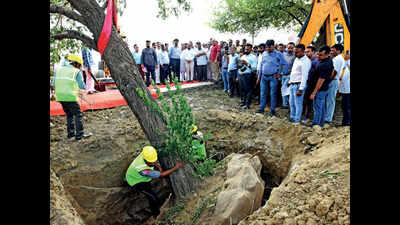
To make way for a new academic block, the Delhi Technological University, Rohini, has transplanted 85 out of 111 fully grown trees to its sports complex.

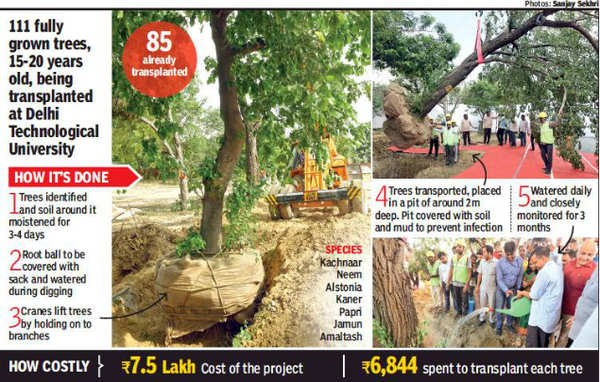
“So far, around 80 trees have already been transplanted and we are hopeful that all will survive,” said DTU vice-chancellor Yogesh Singh. “The university is also planting more than 1100 trees.” The private contractor carrying out the process at a total cost of over Rs.7 lakh claimed that they have 90% success rate. The area from where the trees are being uprooted is spread across 5600 square metres.
Kejriwal and deputy chief minister Manish Sisodia turned up on Saturday to witness the process of transplantation. The covered roots of the trees, which include the soil, were lifted along with the branches by a crane. The trees were taken to the area around the sports complex where trenches had been dug. These were then dropped into the pits.
However, the entire process is mired in controversy. The trees being transplanted by the university include neem, amaltash and jamun. Tree expert and author Pradip Krishen it is very difficult for these species to survive. “It is very very hard to transplant such species unless there is specialized equipment and huge expertise. They have to carry out this process around January and not in this season. In our climate and conditions, the success rate is 10-12%. There are some species like ficus which have shallow roots. These can be transplanted but only if people who are doing it know what they are doing,” said Kishen.
When DMRC shifted trees to Asola, very few survived. At Pragati Maidan, only 36 of 1713 trees had been found by an audit survey to be healthy enough to survive. And the entire exercise is quite costly with meagre gains, green activists have pointed out.
However, contractor Ashok Kumar claims they have been quite successful earlier. “When working with PWD on construction of a hospital at Rani Bagh, 30 trees were transplanted. At another project in Ballabgarh, 125 trees were transplanted and the survival rate was 90%,” he said. NDMC, too, has transplanted 17 trees out of which 16 have survived.
End of Article
FOLLOW US ON SOCIAL MEDIA








Photostories

Hot Picks
TOP TRENDING
Popular Categories
Hot on the Web
Top Trends
IND vs NZ Live ScoreMohammad HarisBen DuckettRishbah PantNayab Singh Saini OathJustin TrudeauPakistan Bomb BlastJharkhand Election ScheduleVaranasi Rail Road BridgeMaharashtra Election Full ScheduleBengaluru FloodBaba SiddiqueAshes ScheduleRBI Summer InternshipMaharashtra Election ScheduleJharkhand Election ScheduleLive Cricket Score
Trending Topics
Diwali WishesValmiki Jayanti WishesFake PaneerLiam PayneVettaiyan CollectionVicky Vidya Ka Woh Wala Video CollectionLawrence BishnoiCow GheeBigg Boss 18Salman KhanShraddha KapoorRatan Tata Passed AwayNana PatekarSharad Purnima Moonrise TimeSwatantrya Veer SavarkarSharad Purnima 2024Top Load Washing MachinesBest Premium LaptopsNonstick Cookware SetsWordle Answer
Living and entertainment
Latest News
Nimrat Kaur joins Manoj Bajpayee's 'The Family Man 3' as second villain after Jaideep Ahlawat: Report'Most Special': Examining Andrew Garfield and Amelia Dimoldenberg past embracing conversations amid buzzing chicken shop date promotionBigg Boss OTT fame Adnaan Shaikh and wife Ayesha embark on their first umrah amid family controversyIs Lawrence Bishnoi to India what Dawood Ibrahim is to Pakistan?Entry into Puri Jagannath temple restricted for Kartik month congregation'Vettaiyan' box office collection day 7: Rajinikanth-Amitabh starrer crosses Rs 118 crore in first weekFour students win inter-school literary festLiam Payne’s death sparks hate comments toward ex Maya Henry: You should be so happy nowWhat Kamala Harris said when asked about Biden's mental fitness during Fox interview: He's not ...Jennie of BLACKPINK performs 'Mantra' on Jimmy Kimmel live!Bikers gun down TMC man in BengalBhopal to witness power cuts today; check details hereNew Sebi norms to improve FPI, bond investors' liquidityActivist saves snake with mouth-to-mouth resuscitationReady for internet services in India: Elon MuskOdisha to install statues of 21 personalities, unsung heroesRG Marathon: Akshay, Ankitaben steal the show'Usko akal nahi hai': Mohammad Haris gets bashed by Basit Ali for 'ban on India talks' comment
Copyright © 2024 Bennett, Coleman & Co. Ltd. All rights reserved. For reprint rights: Times Syndication Service