
- News
- City News
- chennai News
- The fame in our stars
Trending
This story is from February 23, 2023
The fame in our stars
Old Madras has several ‘firsts’ to its credit. Among them is the first astronomical laboratory, and the first Indian to be recognised by the Royal Astronomical Society — Chinthamani Raghunathachary (also known as Ragoonathachary).
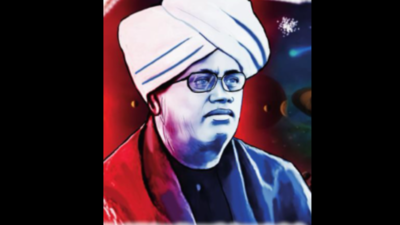
Chinthamani Ragoonathachary wrote a book on the transit of Venus in six Indian languages; a drawing of the inside of the Madras Observatory
Towards the end of the 18th century, a technical school was established in Madras (the forerunner of what is the Guindy Engineering College today), by the efforts of Michael Topping (1747-1796), the chief marine surveyor of the East India Company who was instrumental in establishing this facility as well.

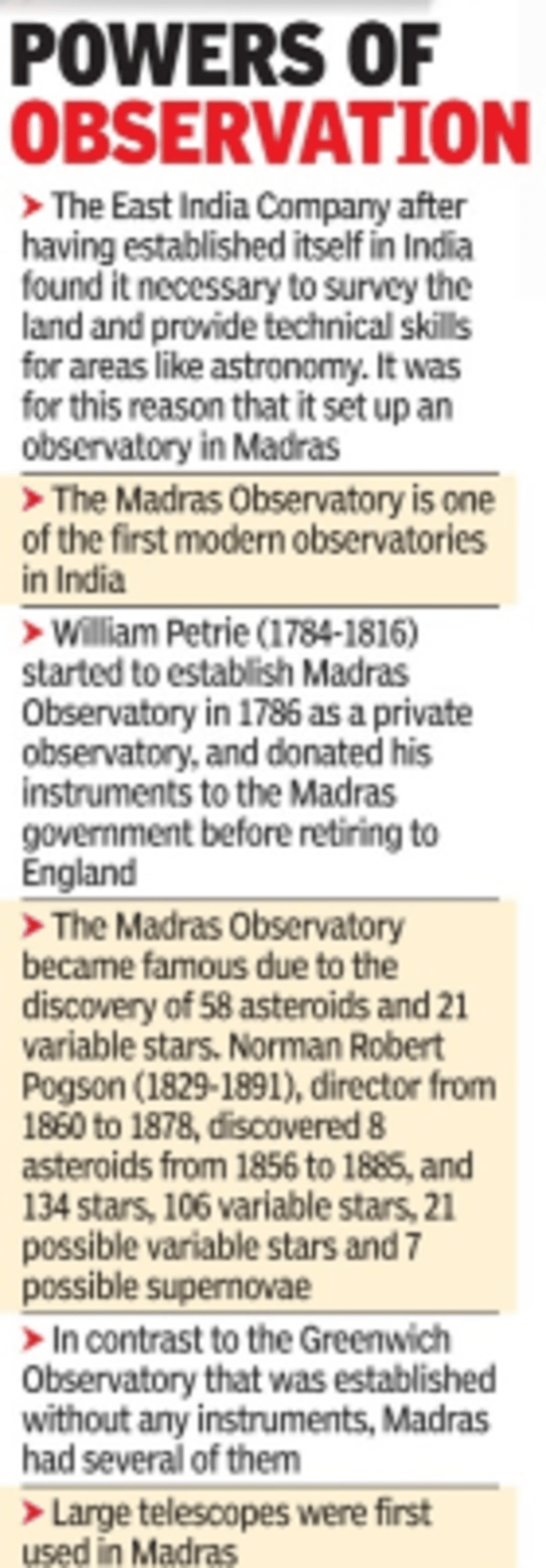
William Petrie, a British officer of the company had an 11-acre residence in Egmore, and in 1786, owing to his interest in astronomy, set up his own observatory, and furnished it with his own instruments. He had an assistant, a Dane named John Goldingham,help him in his efforts. Having witnessed this facility and its resourcefulness, Topping wrote to the council for it to be transferred to the company. Incidentally, it was Goldingham who first calculated the velocity of sound in Madras, again the first such effort in India.
For more than a century, the Madras Observatory was the only one of its kind in India engaged in systematic work on stars. Later, astronomer Norman Robert
Pogson took over, and with the new eight-foot Cooke equatorial telescope, he made many discoveries of stars. The asteroid Asia (the first astronomical find made from this part of the world), was discovered on April 17, 1861, followed soon after by the discovery of the star, R Reticuli.
This is where an even greater Madras connection happens. Chinthamani Ragoonathachary was the key figure in locating this star and its nature in 1867.
Ragoonathachary was the son of a water carrier – a class IV employee in the system – and interested in astronomy from a very young age. By virtue of his father being in service, Ragoonathachary was closely associated with astronomical observation and recruited in the lowest rung of the department.
A paper published by four authors — N Kameswara Rao, A Vagiswari, Priya Thakur and Christina Birdie — in the journal of Astronomical History and Heritage, says, “Joining the Madras Observatory as a young ‘coolie’ at the age of 18, he rose to the position of first (and head) assistant to the government astronomer through sheer hard work and dedication. ”
Pogson said Ragoonathachary possessed sufficient skill and energy to make additional observations worthy of building the reputation of the observatory and benefit science at large. During this period, the Madras Observatory participated in observations of total solar eclipses that were visible in India in 1868 and 1871. It is recorded that the most important of these, was the eclipse that occurred on August 18, 1868, observed by both the British and French teams along with the Madras team. Similarly, the observatory also observed the annular lunar eclipse that occurred on June 6, 1872.
According to reports, Pogson included variable stars and minor planets in the main observational programmes. During his time in Madras, he published annual variable star ephemerides, (a table giving the coordinates of a celestial body at a number of specific times during a given period), in monthly notices of the Royal Astronomical Society.
He also prepared a catalogue of observations he had made of 31 different variable stars (these are stars whose brightness changes regularly or irregularly). The most important was the discovery of the variability of the star, R Reticuli. Pogson says the detection of this new red giant star far south was due to the “first native assistant”, Ragoonathachary, who observed it on January 16, and established its variability. Another observation by Ragoonathachary was the second variable star, U Cephei, as mentioned in his obituary note in the Madras Mail on February 7, 1880.
His observation of the solar eclipse in 1868 is also recorded in the same journal: “The eclipse of 18 August 1868, often called as the ‘The Great Indian Eclipse’, and described as a ‘watershed event’, took place at a time when what can be called as ‘old eclipse studies’ were fading, and the era of solar physics, using spectroscopy, photography and polarimeter was starting to bloom.
It was also a notable event in 1868 when the Madras Observatory organised an eclipse expedition, and for the first time an Indian astronomer led a modern astronomical eclipse expedition. Ragoonathachary, the first (head) assistant at the observatory, led a team of astronomy enthusiasts to observe the eclipse from Vanpurthy (near Kurnool) situated near the central line of the path of totality,” it said.
Recommended by Pogson, Ragoonathachary was elected Fellow of the Royal Astronomical Society on January 12, 1872. Two years later, Chary wrote a book on the transit of Venus in English and six Indian languages, in the form of a vivada or dialogue between two individuals. He prepared the Thriganita Panchangam (nautical almanac) for the year 1880.
He had published three papers in the monthly notices of the Royal Astronomical Society, even before he was elected as a fellow. In an obituary, The Madras Mail wrote: “His ready skill as an observer combined with accuracy and speed in calculation and a fair and useful amount of self-acquired mathematical knowledge, rendered him invaluable to the Observatory. ”
Ragoonathachary died on February 5, 1880.
End of Article
FOLLOW US ON SOCIAL MEDIA




Photostories

Hot Picks
TOP TRENDING
Popular Categories
Hot on the Web
Top Trends
IND vs NZ Live ScoreMohammad HarisBen DuckettRishbah PantRohit SharmaNayab Singh Saini OathJustin TrudeauPakistan Bomb BlastJharkhand Election ScheduleVaranasi Rail Road BridgeMaharashtra Election Full ScheduleBengaluru FloodBaba SiddiqueAshes ScheduleMaharashtra Election ScheduleJharkhand Election ScheduleLive Cricket Score
Trending Topics
Diwali WishesValmiki Jayanti WishesFake PaneerLiam PayneVettaiyan CollectionVicky Vidya Ka Woh Wala Video CollectionLawrence BishnoiCow GheeBigg Boss 18Salman KhanShraddha KapoorRatan Tata Passed AwayNana PatekarSharad Purnima Moonrise TimeSwatantrya Veer SavarkarSharad Purnima 2024Top Load Washing MachinesBest Premium LaptopsNonstick Cookware SetsWordle Answer
Living and entertainment
Latest News
Nimrat Kaur joins Manoj Bajpayee's 'The Family Man 3' as second villain after Jaideep Ahlawat: Report'Most Special': Examining Andrew Garfield and Amelia Dimoldenberg past embracing conversations amid buzzing chicken shop date promotionBigg Boss OTT fame Adnaan Shaikh and wife Ayesha embark on their first umrah amid family controversyIs Lawrence Bishnoi to India what Dawood Ibrahim is to Pakistan?Entry into Puri Jagannath temple restricted for Kartik month congregationSun Transit in Libra 2024: Its impact on your zodiac sign'Vettaiyan' box office collection day 7: Rajinikanth-Amitabh starrer crosses Rs 118 crore in first weekFour students win inter-school literary festLiam Payne’s death sparks hate comments toward ex Maya Henry: You should be so happy nowWhat Kamala Harris said when asked about Biden's mental fitness during Fox interview: He's not ...Jennie of BLACKPINK performs 'Mantra' on Jimmy Kimmel live!Bikers gun down TMC man in BengalBhopal to witness power cuts today; check details hereNew Sebi norms to improve FPI, bond investors' liquidityActivist saves snake with mouth-to-mouth resuscitationReady for internet services in India: Elon MuskRG Marathon: Akshay, Ankitaben steal the show'Usko akal nahi hai': Mohammad Haris gets bashed by Basit Ali for 'ban on India talks' comment
Copyright © 2024 Bennett, Coleman & Co. Ltd. All rights reserved. For reprint rights: Times Syndication Service