
- News
- World News
- Rest of World News
- In a distant corner in South America, war brews between Guyana and Venezuela
Trending
This story is from December 7, 2023
In a distant corner in South America, war brews between Guyana and Venezuela
The United States is supporting Guyana in its dispute with Venezuela, which could escalate into a conflict. US Secretary of State Antony Blinken expressed support for Guyana's sovereignty and emphasized security and economic cooperation. The US Southern Command will conduct flight operations in Guyana to enhance the security partnership and regional cooperation. The conflict between Guyana and Venezuela revolves around energy resources in the Essequibo region. Guyana, with a large Indian-origin population, has historical ties to the US, including a troubled past due to its former leader's leftist orientation and friendship with Fidel Castro
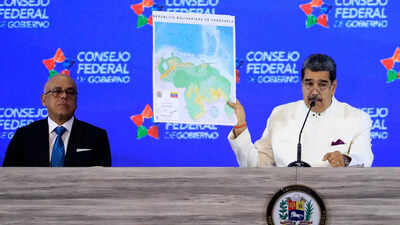
Venezuela's President Nicolas Maduro (R) speaking next to Bolivarian National Assembly President Jorge Rodriguez (AFP)
WASHINGTON: The United States is throwing its weight behind Guyana — a country with a large Indian-origin population which the CIA tried to subvert in the 1960s — in its ongoing spat with neighboring Venezuela that threatens spill into another conflict.
Amid raging wars in Ukraine and Gaza, US Secretary of State Antony Blinken spoke to Guyana's President Irfaan Ali "about our support for Guyana's sovereignty and our robust security and economic cooperation," the US State Department said on Thursday.
Separately, the US Embassy in Guyana announced that the US Southern Command will conduct flight operations within Guyana on December 7 "to build upon routine engagement and operations to enhance security partnership between the United States and Guyana, and to strengthen regional cooperation."
US officials did not directly invoke Venezuela in the flurry of announcements, but the Latin American country has been at odds with the Anglospheric Guyana, once part of the British Commonwealth over energy resources in a region called Essequibo, which Guyana regards as its domain.
The US had a tortured history with Guyana mainly on account of Jagan's leftist/ communist/ marxist orientation, and his friendship with Fidel Castro. In 1962, President Kennedy approved a covert CIA political campaign to rig national elections to keep Jagan out of power, telling Britain that the notion of an independent state led by Jagan “disturbs us seriously,” and asserting, “We must be entirely frank in saying that we simply cannot afford to see another Castro-type regime established in this Hemisphere."
The US and Jagan eventually reconciled before he died in 1997 after heart surgery at the Walter Reed Military Hospital in Washington DC, a city where he had studied in the 1930s (at Howard University, later to be Kamala Harris' alma mater.) He was later succeeded as President of Guyana by his wife Janet Jagan, a white student nurse he married while earning a degree in dental science in Chicago.
US interference largely resulted in a schism between Indo-Guyanese, who constitute about 40 per cent of the country's population, and African/multi-racial/and indigenous Guyanese, who make up the rest. Washington also backed Venezuela in its dust-ups with Guyana. The tables have now turned, and Venezuela and its leader Nicolas Maduro are in US' bad books.
India also has close ties with Guyana mainly on account of the diasporic connection, and also cricket. Over the years, several Indo-Guyanese, notably Rohan Kanhai, Alvin Kallicharan, Shivnaraine Chanderpaul, Ramnaresh Sarwan, and Devendra Bishoo, have played for the West Indies.
Amid raging wars in Ukraine and Gaza, US Secretary of State Antony Blinken spoke to Guyana's President Irfaan Ali "about our support for Guyana's sovereignty and our robust security and economic cooperation," the US State Department said on Thursday.
Separately, the US Embassy in Guyana announced that the US Southern Command will conduct flight operations within Guyana on December 7 "to build upon routine engagement and operations to enhance security partnership between the United States and Guyana, and to strengthen regional cooperation."
US officials did not directly invoke Venezuela in the flurry of announcements, but the Latin American country has been at odds with the Anglospheric Guyana, once part of the British Commonwealth over energy resources in a region called Essequibo, which Guyana regards as its domain.
Over 40 per cent of Guyanese population is of Indian ethnicity, originating from emigration of indentured labor from UP and Bihar in pre-independence days. Son of an emigrating couple, Cheddi Jagan, became the first person of Indian descent to be a head of government outside of the Indian subcontinent. He later returned to power to serve as President of Guyana from 1992 up until his death in 1997. Jagan's parents were kurmis who emigrated as indentured labourers from Basti district in Awadh region of UP.
The US had a tortured history with Guyana mainly on account of Jagan's leftist/ communist/ marxist orientation, and his friendship with Fidel Castro. In 1962, President Kennedy approved a covert CIA political campaign to rig national elections to keep Jagan out of power, telling Britain that the notion of an independent state led by Jagan “disturbs us seriously,” and asserting, “We must be entirely frank in saying that we simply cannot afford to see another Castro-type regime established in this Hemisphere."
The US and Jagan eventually reconciled before he died in 1997 after heart surgery at the Walter Reed Military Hospital in Washington DC, a city where he had studied in the 1930s (at Howard University, later to be Kamala Harris' alma mater.) He was later succeeded as President of Guyana by his wife Janet Jagan, a white student nurse he married while earning a degree in dental science in Chicago.
US interference largely resulted in a schism between Indo-Guyanese, who constitute about 40 per cent of the country's population, and African/multi-racial/and indigenous Guyanese, who make up the rest. Washington also backed Venezuela in its dust-ups with Guyana. The tables have now turned, and Venezuela and its leader Nicolas Maduro are in US' bad books.
India also has close ties with Guyana mainly on account of the diasporic connection, and also cricket. Over the years, several Indo-Guyanese, notably Rohan Kanhai, Alvin Kallicharan, Shivnaraine Chanderpaul, Ramnaresh Sarwan, and Devendra Bishoo, have played for the West Indies.

About the Author
Chidanand RajghattaEnd of Article
FOLLOW US ON SOCIAL MEDIA




Hot Picks
TOP TRENDING
Trending Stories
In World
Entire Website
- 'Osama's 'dead son' is alive, leading al-Qaida in Afghanistan and has terrifying plans'
- Diljit Dosanjh’s Dil-Luminati India Tour: Check dates, venue, how to book concert tickets online
- Hamster Kombat Daily Cipher Codes and Combo Cards for September 13, 2024: Unlock up to 1 million coins
- Narayana Murthy faces backlash for parenting remarks on social media; users say, "after working 72 hours a week, there’s barely time left to have babies…”
- Shreyas Iyer comes out to bat wearing sunglasses, falls for a duck in Duleep Trophy
- iPhone 16 will be available for Rs 54,900 on Apple website; here's how you can grab the deal
- iPhone 16 to go on pre-order today: Pre-booking details, time, sale date and more
- Vande Metro launch date, schedule: PM Modi to flag off Bhuj-Ahmedabad Vande Metro train; check timings, stoppages of new Indian Railways train
- Why around 40,000 TCS employees have received tax demand notices for Rs 50,000 to over Rs 1 lakh
- Bill meant to usurp Waqf land, JPC told
- Preschools turn nursing homes, retirement age raised: China's demographic crisis explodes
- 'Osama's 'dead son' is alive, leading al-Qaida and has terrifying plans'
- 'I was molested in ambulance in which my husband was fighting for life'
- Despite debate win, Kamala Harris makes no dent in battleground states
- Assam CM reveals how his 'doubt' unearthed multi-crore trading scam
- 'CBI must dispel notion of being a caged parrot': SC during Kejriwal bail hearing
- Actor dies in his sleep. Why sudden heart attacks are killing Indians
- Jhumka Gira Re ...: American woman's Instagram post on India goes viral
- 'Vow to fight anti-national forces': Kejriwal after walking out of jail
- Vande Metro first look: Top 10 features of new train for common man

Popular Categories
Hot on the Web
Top Trends
Vande MetroAadhaar Card UpdateTech LayoffsArvind Kejriwal BailShannon SharpeAdani HinderburgUPSC Mains Admit CardKristina JoksimovicTCS Employee Tax NoticesWay Chatgpt can be your Study PartnerAir Taxi IndiaAyushman Bharat SchemeKolkata Doctor Rape CaseDonald TrumpShreyas IyerDiljit DosanjhLive Cricket Score
Trending Topics
Alia BhattMalaika Arora Father DeathArbaaz KhanNatasa StankovicMr Bachchan OTT ReleaseNational Parks In IndiaSelena GomezGOAT CollectionVikas Sethi DeathMalayalam ProducersIndia's Best Dancer 4Simi GarewalDilli BabuIndian National ParksLaung BenefitsVikas SethiApple iPhone 16SpaceXAadhar Card Update By Sept 14Wordle Answer
Living and entertainment
Latest News
7. Hindi becomes officialJulie Chen to miss Big Brother live eviction for first time, taps Jerry O'Connell to hostTragic road accident on Mogili ghat road claims seven lives in Chittoor districtRaveena Tandon apologizes to fans for not photo snub in London: "It was not my intention to offend"Bonedi baris hope for a peaceful start to PujoPreschools turn nursing homes, retirement age raised: China's demographic crisis explodesTovino Thomas praises Prithviraj Sukumaran as director: "One of the brilliant directors I have ever worked with"Man shot near Delhi's Greater Kailash-I gym, gang war suspected8 animals that reproduce without mating'Cops stood as mute spectators': Protesting doctors write to President over RG Kar impasseFatal crash in Australia's Netherby claims life of ToddlerNASA to establish New Lunar Time Standard with Coordinated Lunar Time (LTC) initiativeDivya Bansal explores themes of human resilience, love and positive transformation in debut poetry bookWWE Superstar Cody Rhodes and his Wife Brandi Rhodes Share Special Messages on Their 11th AnniversaryAnupamaa: Anuj and Anu to go legal against Ankush and Barkha'Dead cat hanging from a tree': Origin of Haitian immigrants row. Everyone heard itTop 5 least private zodiac signsPerfect comfort foods for every zodiac sign
Copyright © 2024 Bennett, Coleman & Co. Ltd. All rights reserved. For reprint rights: Times Syndication Service