
- News
- Relationships News
- Love quote of the day by Rabindranath Tagore: "Love does not claim possession, but..."
Love quote of the day by Rabindranath Tagore: "Love does not claim possession, but..."
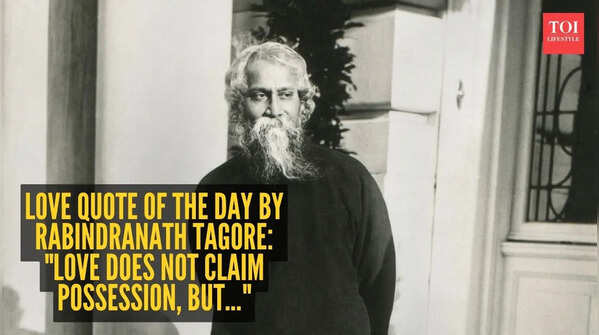
Rabindranath Tagore love quote
The poet, philosopher and Nobel-prize winner Rabindranath Tagore has written a line that quietly redefines what love is like at its purest: “Love does not claim possession, but gives freedom.”
It sounds simple at first glance. But if you sit with it for a moment, it starts to feel like an emotional compass, a gentle guide of how love should move, not just in grand gestures but in everyday choices. Tagore reminds us that the deepest kind of love isn’t about holding on tightly, it’s about letting go gently. It’s less about control and more about trust. It’s the quiet opposite of “You’re mine” and the quiet echo of “You’re free.”

Love that does not claim possession
When someone “claims” another as their own, there’s a subtle line crossed. Love can start feeling like ownership—a tight grip that forgets to breathe. “You’re mine,” “You belong to me,” or “I can’t live without you” may sound romantic, but they can quietly become cages.
Tagore’s line cuts through that. He doesn’t say love avoids closeness; he says it avoids claiming. A genuinely loving person doesn’t treat their partner like a trophy, a prize, or something to be guarded. Instead, they feel thankful to share a life with them, while still respecting their separate identity, dreams, and inner world.
That’s a powerful shift. Love becomes less about “keeping” someone and more about honouring them for who they are, even when that means letting them grow beyond you.

Love that gives freedom
The second half of the quote—“but gives freedom”—is where the real magic lies. Love that is free is also the strongest, because it survives not from pressure, but from choice.
When someone gives you freedom, they allow you to change, to explore, to make mistakes, to have thoughts they might not fully understand. They don’t constantly check your phone, question your friendships, or demand that you fit into a narrow box. Instead, they trust that if you choose to stay, it’s because you truly want to, not because you feel trapped.
Freedom in love also means space: the freedom to be alone, the freedom to rest, the freedom to say “this is important to me” even when it doesn’t perfectly align with your partner’s plans. A relationship built on this kind of quiet liberty doesn’t feel suffocating; it feels like a safe harbour where both people can sail.

Why this quote is timeless
In today’s world, social media, insecurities, and fast‑paced relationships can blur the lines between love and obsession. But Tagore’s words feel calming.
They remind us that love that is worth keeping is not the one that clings the hardest. Instead, it holds on lightly. It lets you come back, not because you have to, but because you want to.
When someone truly loves you, they don’t shrink your world to fit theirs. They quietly expand it, making space for your dreams, your quirks, your messiness, and your freedom.

A quiet test of your own love
Based on the quote, you can also reflect inward: “Do I love in a way that gives freedom, or in a way that claims?”
It’s the little things that reveal the answer:
- Do you get stressed when they don’t reply fast enough, or do you give them space?
- Do you celebrate their friendships and interests, or quietly resent them?
- Do you feel jealous of their growth, or quietly proud?
If your love is suffocating more than it’s nurturing, Tagore’s line becomes a gentle mirror. It’s not a blame. It’s a gentle reminder to loosen your grip and let love flow easily.
Love, at its best, is not a cage built of fear; it is a space built of trust.
Tagore’s line—“Love does not claim possession, but gives freedom.”—is less about romance and more about respect. It’s a reminder that the deepest love is the kind that lets the other person fly, while they still choose to stay.
Featured In Relationships

