
Indian dishes astronauts took to space and why they chose them
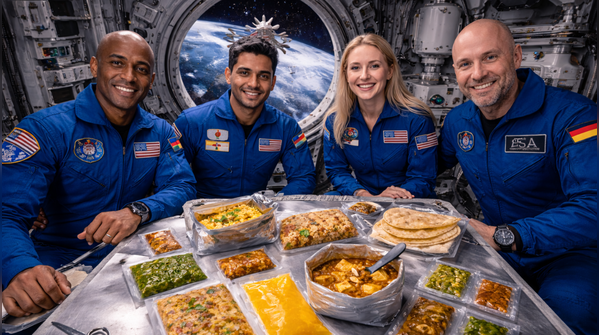
Indian dishes astronauts took to space and why they chose them
Space food is often imagined as sterile tubes, bland pouches and strictly engineered nutrition designed only to keep astronauts functioning. Yet India’s journey into space has carried something more familiar along the way. Scientists and food researchers have quietly adapted traditional dishes so they can survive launch, storage and the unusual conditions of microgravity. The challenge is not only preserving flavour but also ensuring the food is lightweight, safe and easy to eat in orbit. Over the years, a few distinctly Indian preparations have travelled beyond Earth with astronauts. Scroll down to read more.
The first bite of India in orbit
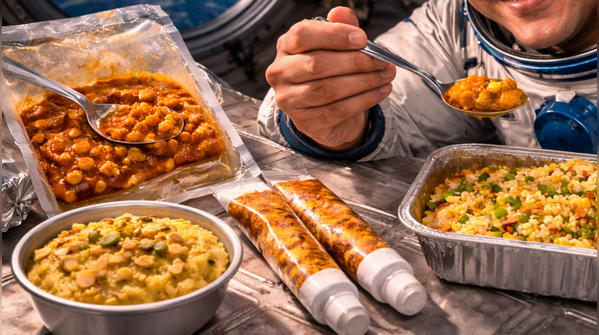
The story begins with Rakesh Sharma, who became the first Indian citizen in space when he flew aboard Soyuz T-11 on 3 April 1984 and spent 7 days, 21 hours and 40 minutes aboard Salyut 7. Official Indian space records describe him as the only Indian citizen to travel in space, and later accounts note that the food onboard included Indian dishes packed by the Defence Food Research Laboratory in Mysore.
For India, this mission was not just a scientific milestone but a moment of national pride unfolding far beyond Earth. It carried the weight of representation, curiosity and identity, making even the smallest details, like food, part of a much larger story about belonging in space.
Preparing food for space is a delicate science: meals must be lightweight, nutritionally balanced and stable in microgravity, which makes familiar flavours both technically challenging and emotionally meaningful. Those dishes were suji halwa, aloo chole and vegetable pulao, simple, familiar and remarkably well suited to the mission’s symbolic weight.
That menu mattered because it was more than a snack list. It was a small piece of cultural continuity in an environment built for survival, not comfort. In space, every item has to earn its place, and those early Indian dishes did exactly that: they offered calories, familiarity and a quiet reminder of where the astronaut came from.
Idli learns to float
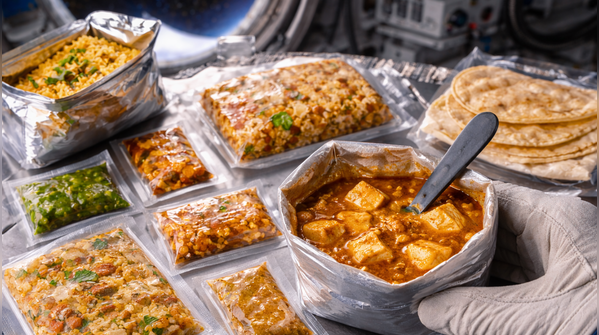
By the time India began preparing for crewed missions of its own, the food story had become more systematic. For Gaganyaan, the country’s first crewed space mission, the menu developed by the Defence Food Research Laboratory included around 30 dishes, among them idli sambar, upma, vegetable pulao, egg rolls, veg rolls, chapatis, chicken curry, spinach and paneer.
Designing food for space is a meticulous balancing act. Taste matters, but so do weight limits, shelf life and the strict safety standards required for human spaceflight. Each dish has to survive launch vibrations, months of storage and the strange eating conditions of orbit, where gravity no longer behaves as expected.
Behind this menu lay years of careful food science. Researchers had to ensure the meals were lightweight, nutritionally balanced, safe for long storage and easy to eat in microgravity, where crumbs, spills and floating particles can become serious problems.
The food was designed to be packed in ready-to-eat form, with water added where needed, and astronauts were also to be given food heaters and special liquid containers.
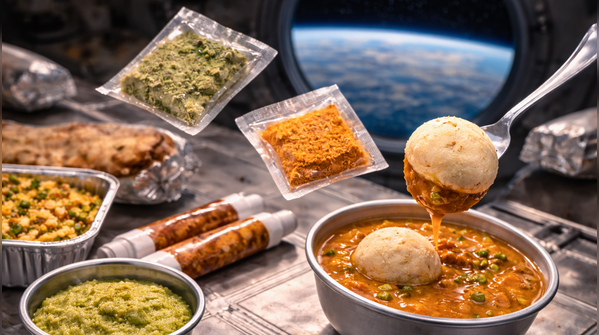
Idli was especially interesting because it had to be reimagined for space rather than merely packed for it. Reports on the DFRL work say the idlis were made small, dried with infrared radiation and then further dehydrated, while the accompanying sambar and chutney were turned into powder-based sides that could be revived later. In other words, the dish was preserved, but not stripped of its identity. It was still idli, just one that could survive the physics of orbit.

A sweeter menu for a newer generation
The newest chapter in this culinary journey came with astronaut Shubhanshu Shukla’s Axiom-4 mission to the International Space Station. Indian Space Research Organisation officials said he would have Indian food on board, including varieties of rice, moong dal halwa and mango nectar.
Behind that menu lies careful planning by food scientists and mission teams, who must adapt familiar dishes to survive launch vibrations, long storage and the unusual conditions of microgravity. Ingredients are selected not only for taste, but also for stability, nutrition and ease of consumption in orbit.
That matters because these dishes were not chosen at random. They sit at the centre of everyday Indian eating: rice as a staple, halwa as a festival dessert, mango in its most beloved summer form. Carried into orbit, they do something space travel often struggles to do on its own: they preserve texture, memory and pleasure in a place that can otherwise feel chemically and emotionally distant.
Why these dishes keep travelling
The deeper story is not simply that Indians have taken familiar food into space. It is that the food itself has had to evolve into something compact, stable and safe enough for microgravity.
This transformation is not just technical but cultural as well. Recipes that once relied on texture, aroma and fresh preparation have to be reimagined without losing their identity, turning everyday meals into carefully designed systems that can travel far beyond Earth. This often means stripping a dish down to its essentials, then rebuilding it in a form that can endure extremes without losing the comfort and familiarity it once offered.
In orbit, even a small crumb can float into equipment and become a hazard, while liquids behave unpredictably without gravity. Every bite has to be engineered to stay contained, easy to consume and nutritionally dense, making space food as much about safety as sustenance.
Scientists and food technologists have spent years adapting traditional recipes so they can survive launch vibrations, long storage periods and the unusual conditions of orbit without losing flavour or nutritional balance.
Space station dining is constrained by limited room, expensive cargo and the need to pack a lot of nutrition into very little volume. That is why Indian mission menus have leaned toward dehydrated, rehydratable and carefully packaged dishes rather than anything loose, oily or crumbly.
Featured In Food

