
- News
- lifestyle
- fashion
- celeb-style
- How Rhea Kapoor is bringing traditional Indian weaves back into fashion
How Rhea Kapoor is bringing traditional Indian weaves back into fashion

Rhea Kapoor Is Bringing Back Heritage Indian Weaves
The red carpet has always been a predictable playground for crystals, tulle, and heavy sequins. But if you’ve been paying attention lately, there’s a quiet revolution brewing. And sitting right at the helm of it is celebrity stylist and producer Rhea Kapoor.
Instead of chasing fleeting global trends, Kapoor has been digging deep into India's textile archives. She isn't just putting celebrities in traditional clothes; she’s completely rewriting how heritage handlooms are perceived in high fashion.
By stripping away the outdated styling usually associated with these fabrics, she’s bringing some of the country’s most labor-intensive, forgotten weaves back into the flashing lights. Here are five indigenous weaves Rhea Kapoor has brilliantly dragged out of the history books and onto the red carpet.

The Banarasi Kadhwa: A Dark, Regal Masterpiece
Banarasi is hardly a secret, but the Kadhwa technique is a whole different ballgame. It’s an incredibly intense handloom process from Varanasi where every single motif is woven separately rather than cut from a larger design.
The result? A highly textured, razor-sharp pattern that lasts for generations. Kapoor proved the sheer power of this textile when she styled Sonam Kapoor in a dramatic, pitch-black Banarasi saree. A collaboration between Swadesh and Abu Jani Sandeep Khosla, this wasn't your standard maternity wear. By pairing the heavy, dark drape with an intricate zardozi border and keeping the accessories strikingly minimal, she shifted the narrative. It wasn't just a saree; it was a modern, artisanal luxury statement.
(Image Credits: Pinterest)

Begumpuri Cotton: The Edgy Makeover
When you think of pure cotton handlooms from Bengal, you probably picture breezy daytime wear. Begumpuri, recognizable by its lightweight drape and bold contrast borders, has always been comfortable. It just hasn't been considered "couture."
Rhea changed that entirely. She pulled Begumpuri handlooms right into the fusion space by breaking all the traditional rules. By throwing sharp, structured jackets over the soft fabric, cinching the waist with heavy belts, and anchoring the whole look with boots, she gave a humble, everyday weave serious global runway energy.
(Image Credits: Pinterest)
Chanderi Silk: The Anti-Lehenga Wedding Look
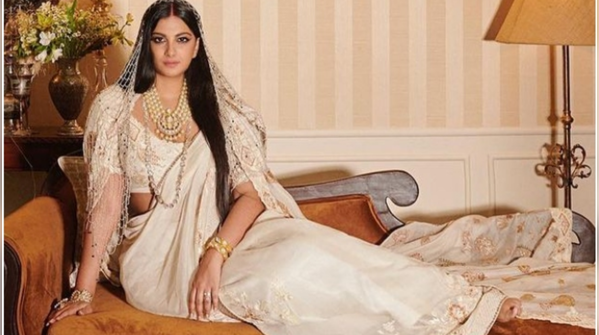
Chanderi silk—a centuries-old weave from Madhya Pradesh—is famous for its sheer, feather-light texture and fine zari work. It's delicate. It's historic. But is it enough for a high-profile celebrity wedding?
For her own intimate wedding, Kapoor skipped the expected 20-kilo embellished lehenga. Instead, she chose a breathtaking off-white Chanderi silk saree by Anamika Khanna. She paired the lightweight thread work with a vintage, sculptural pearl veil by Birdhichand Ghanshyamdas.
It was a massive styling flex, proving that you don't need heavy velvet to deliver high-fashion maximalist drama.
(Image Credits: Pinterest)

Vidarbha Khadi & Double Ikat Patola: The Ultimate Quiet Luxury
Khadi usually gets a bad reputation for being coarse, but modern treatments of Vidarbha Khadi (like Magtha) create a fluid, luxurious fabric. Then there's Patola—a GI-certified double ikat from Gujarat with a 750-year-old history of insane mathematical precision.
Through deep collaborations with designers like Anamika Khanna, Kapoor has treated these time-consuming fabrics as the ultimate iteration of "quiet luxury." Whether she’s using Swadesh-sourced double Ikat Patola as a base to experiment with lace, or championing structured separates made from textured Khadi, she’s showing that hand-spun Indian textiles can easily rival international luxury labels.
(Image Credits: Pinterest)
The Manipuri Loin Loom: Honoring the Northeast
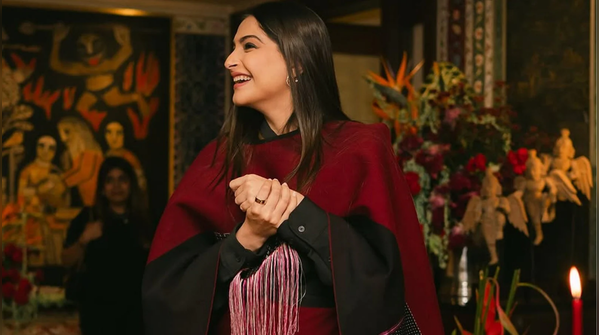
Perhaps her most striking move has been shining a massive spotlight on marginalized textiles from Northeast India. The Kashan is a traditional wrap woven on a backstrap loin loom by the Tangkhul Naga tribe. It’s thick, incredibly durable, and loaded with geometric cultural history.
Kapoor brought the Manipur-based label East into the mainstream fashion conversation. By featuring the brand's ĀKHA set—a stunning wrap-style skirt layered casually over a crisp, black collared shirt—she respected the indigenous craft while giving it a fiercely modern silhouette. It was a masterclass in proving that traditional loin loom weaves belong perfectly in the modern fashion ecosystem.
(Image Credits: Pinterest)
Featured In lifestyle

