
- News
- India News
- Talks delayed, but on track; India hails Pakistan action on Jaish-e-Mohammed
Trending
This story is from January 15, 2016
Talks delayed, but on track; India hails Pakistan action on Jaish-e-Mohammed
Amid growing signs of Islamabad moving against Maulana Masood Azhar and other leaders of Jaish-e-Mohammed who plotted the terror attack on Pathankot, India-Pakistan talks appear to be on track though they have been pushed back by a few days.

India announced on Thursday that both countries had decided to reschedule the foreign secretary talks “in the very near future”, heaping praise on Pakistan for its actions against the JeM as an “important and positive first step”.

With growing evidence that Pakistan had placed Azhar and other key Jaish figures under detention, India also committed to provide all help to Pakistani investigators who want to come to Pathankot.
Foreign ministry spokesperson Vikas Swarup said, “We look forward to the visit of the Pakistan SIT and our investigative agencies will extend all necessary cooperation to bring the perpetrators of this attack to justice.”
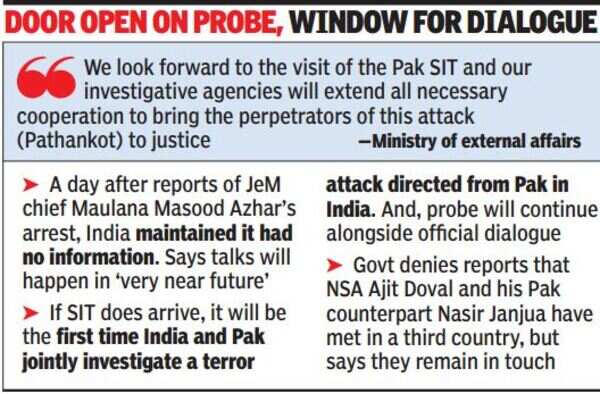
If it happens, it will be the first time India and Pakistan will jointly investigate a terror attack from Pakistan into India. The important part of all this is the terror investigation will continue alongside the official dialogue. The action against Jaish and India’s public praise for Pakistan has freed up a lot of political capital on both sides.
For the second day running, Pakistani media was thick with reports about Azhar’s detention, with persistent speculation that the detention was not made public to ward off the possibility of protests by legions of Jaish supporters in Punjab province and to get around the legal requirement to intimate the court about the action, a stipulation which would also bring lawyers in play.
Referring to the statement issued by Pakistan on Wednesday where it vowed not to let its soil be used for terrorism “anywhere” and to work on the information provided by India about the terror attack on Pathankot air base, India said considerable progress had been made in the investigations by the neighbouring country.
The foreign ministry said the decision to reschedule the talks had been arrived with “aapsi sahmati” (mutual consent). While the ministry denied reports that the NSAs had met in a third country, it said the two officials were and would continue to remain in touch. Interestingly, Pakistan’s foreign office announced the rescheduling of the foreign secretary talks in the morning, adding it had been done in agreement with India.
They also stated that they had “no information” that Azhar had been arrested or detained. On Wednesday, media reports about Azhar’s “arrest” appeared to link the fate of the talks to a person. This meant India would have been under pressure to call off the talks if Pakistan set Azhar free from whatever “detention” he was in.
Going by the history on Hafiz Saeed and Zaki-ur-Rehman Lakhvi, no one in India expects any real action against big ticket terror leaders inside Pakistan. Given its keenness to test Nawaz Sharif’s claim that their establishment, army and ISI included, were backing the peace initiative, it did not want to publicly impose conditions that would cramp the Pakistani PM’s position.
However, the government would not like to go out on a limb either, and there are indications that the decision to reschedule talks shortly and the praise for Pakistan were prompted by the assurance conveyed by Islamabad that Azhar remained in detention. The public appreciation is intended to be an encouragement.
India will not wait for too long before scheduling the foreign secretary dialogue. New Delhi wants to support actions that Sharif is taking, and giving it too long a gap would make him vulnerable to criticism inside Pakistan, where he is also charting an unprecedented course. Moreover, after Pathankot, the government believes there may be more such attacks intended to derail the peace process. It doesn’t want those to dominate the narrative.
The biggest takeaway from the past few days has been the NSA channel that has been active off-stage. Although the MEA spokesperson denied the NSAs had met (there was some talk they had met in Dubai), he confirmed that they had been in touch constantly. In fact, Ajit Doval and Naseer Janjua were instrumental in charting a roadmap for the two sides to work together on terror investigation while keeping the official track going.
End of Article
FOLLOW US ON SOCIAL MEDIA









Photostories

Hot Picks
TOP TRENDING
Popular Categories
Hot on the Web
Top Trends
Women T20 World Cup ScenarioHaryana Election Exit PollAmethi Murder CaseJ&K Election Exit Poll ResultIsrael Iran WarRishabh PantTravis KelcesHulk HoganMohammad KaifUGC NET ResultNima Hospital Doctor MurderDiddyWomen's T20 World CupTop MBA Colleges of IndiaT20 WC ScheduleWomen T20 World Cup Points TableLive Cricket Score
Trending Topics
Samantha Ruth PrabhuNavratri Colours 2024Navratri Day 2 ColourTMKOC New SonuNaga ChaitanyaDevara CollectionGOAT OTT ReleaseRajinikanthDeepika PadukoneGovindaDevaraGovinda NewsDevara Movie ReviewHealthy RaitasSwatantrya Veer SavarkarColdplay India tour 2025Maa Durga 108 NamesNavratri JewellerySony Bravia 55 inch 4k Ultra HD TVWordle Answer
Living and entertainment
Latest News
Trump promotes fake JPMorgan endorsement, then denies involvement: 'I don't know'Per capita income to nearly double in 5 years: Finance minister Sitharaman5 must follow rules of Ayurveda to lose 5kg in 30 daysMarshawn Lynch heaps praise for Aaron Rodgers as he leads the Jets after his decades long NFL careerNFL has denied the 49ers appeal of changing their red home jerseys to white amid heatwave hitting the Santa Clara areaHaryana assembly elections: BJP MP Naveen Jindal reaches polling station on horseHarnaaz Sandhu's breathtaking golden gown appearance after incredible weight loss!SmackDown Tease Points to Possible Motor City Machine Guns WWE DebutBigg Boss Tamil 8: Contestant Aishwariya Bhaskaran—Here’s what you need to know about the Aaru actress'Ideology not right': Rahul Gandhi slams BJP over Shivaji's statue collapse in MaharashtraVadodara airport receives bomb threat emailMindy Kaling: It still never gets old being in glamFormer Pakistan PM Imran Khan's sisters arrested in IslamabadWorld Wide Web foundation announces to ‘wind down’ and close ‘virtual doors’: Here’s what it said in the letterBrazil's top court says Elon Musk’s X paid fines to wrong bankWomen's T20 World Cup scenario: What India must do to qualify for semifinals after heavy defeat in opener against New ZealandMicrosoft admits log data failure for key cloud servicesMan being treated for anxiety jumps from Delhi hospital terrace, dies
Copyright © 2024 Bennett, Coleman & Co. Ltd. All rights reserved. For reprint rights: Times Syndication Service