
- News
- India News
- SC commends Centre's proactive steps in securing Indians in Iran during Covid-19
Trending
This story is from April 1, 2020
SC commends Centre's proactive steps in securing Indians in Iran during Covid-19
The Supreme Court on Wednesday commended external affairs ministry's strenuous efforts to secure nearly 6,000 Indians, including Shia pilgrims, students and fishermen, who were stranded in Iran at a time when the country was badly hit by Covid-19 pandemic.
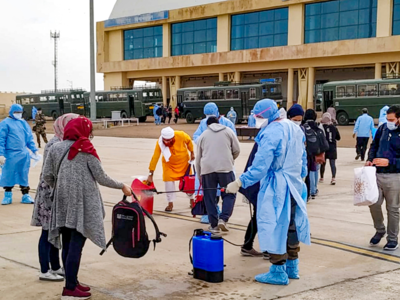
After going through a detailed status report about Indian government's relentless efforts to bring back asymptomatic Indians from Iran and securing plea of stay, food and water for those who tested positive or voluntarily decided to stay there, a bench of Justices D Y Chandrachud and M R Shah refused to direct the government, on the basis of a PIL, seeking immediate repatriation of stranded Indian pilgrims and others from Iran to India.

"Solicitor general Tushar Mehta assured on behalf of the Union Government that so long as the pilgrims continue to be in Qom, steps would be taken by the Indian Embassy to ensure that they receive such assistance as is required for their safety and welfare. We would expect that the issue of repatriation of these pilgrims would be actively considered by the government at appropriate stages in terms of the assurance provided in the status report. The proactive steps taken by the Indian Embassy in Iran under the auspices of the Ministry of External Affairs need to be commended," it said.
"In view of the assurance which has been placed on the record of these proceedings, we dispose of the Writ Petition at the present stage. However, we grant liberty to the petitioner and to any other aggrieved person, should the need arise in future, to move this Court afresh," the bench said.
Perusing the status report, the bench said, "The Union Government has been seized with the safety and welfare of the two hundred fifty pilgrims as, indeed, of other Indian nationals in Iran. The report indicates that nearly 750 persons out a batch of 1000 pilgrims who had proceeded to Qom have been brought back to India pursuant to arrangements made by Union Government."
The bench also said, "Steps were taken for drawing samples of remaining pilgrims for testing. The samples were brought to India for being tested at the
National Institute of Virology, Pune. While Indian citizens who are presently stranded in Qom would have to be repatriated, the stages in which repatriation takes place would have to depend upon the prevailing circumstances which will be evaluated on a case to case basis."
The status report submitted to the SC presented interesting facts. "Of the 6,000 Indian nationals in various provinces of Iran, 1,100 pilgrims mainly from Ladakh and Jammu and Kashmir and Maharashtra; 300 students primarily from Jammu and Kashmir; 1,000 fishermen from Tamil Nadu, Kerala and Gujarat, together with other persons who were granted long term visas in Iran for pursuing their livelihood and religious studies." The pilgrims were mainly residing in Qom city; students in Tehran, Shiraj, Esfahan and Kish cities; and fishermen in Asaluyeh, Chiruyeh and Kish cities of Iran.
"Given the large number of Indians in Iran, India sought to sequence their return, taking into account their age, nature of residency, location and exposure. Initial focus was on visiting pilgrims. This was particularly so as they were predominantly elderly who were mostly in Qom, where COVID-19 incidence had been strong; and the nature of their residency also increased the risks of exposure. Following them, focus was on Indian students. Many of the students were studying medicine and were fully aware of precautions to be taken in this difficult situation. The region where most fishermen are located has not been affected so severely. These factors guided the approach," the Centre said.
India has already facilitated return of 1142 Indians (787 pilgrims, 219 students, 136 others), who are currently quarantined at various locations in India, it said. "Indian Embassy, with cooperation of Iran has made elaborate arrangements for 24/7 medical care and monitoring of Indians who have tested positive. Embassy has arranged a well equipped quarantine facility to care for about 250 pilgrims who tested positive. Besides, there are about 70 pilgrims, who tested negative, but have voluntary chosen to stay back to be alongside their fellow group members or their family members who have tested positive. Embassy has made arrangements for their boarding and lodging along with medicines for those in need.
A dedicated team of senior officers of the Embassy has been working closely with several Indian volunteer students in Qom to ensure well being of these Indians. This team has already undertaken several visits and continues to visit Qom for coordination of arrangements and is continuously monitoring progress. Indian patients are being treated by the Iranian doctors arranged by the Indian Embassy. Most of the pilgrims who tested positive are recovering well," it added.
"The Embassy has arranged essential food items and water to nearly 1000 Indian fishermen in Iran’s southern provinces of Bushehr (in Asaluyeh port city) and Hormozgan (in Bustaneh, Charak, Chiruyeh, Moqam & Lavan island). These include 744 fishermen from Tamil Nadu, 215 from Gujarat and 70 from Kerala. These places are spread over large distances and have poor connectivity. Place like Lavan Island do not have ferry services. Bustaneh, the nearest place, is at least 200 kms from the Indian Consulate in Bandar Abbas. Asaluyeh, the farthest, is about 500 kms from Bandar Abbas. The logistical difficulties are compounded by inter-provincial lock down in Iran. Embassy engaged the services of a local supplier to procure and supply essential food items and water on 20-21 March 2020," the status report said.
End of Article
FOLLOW US ON SOCIAL MEDIA






Photostories

Hot Picks
TOP TRENDING
Popular Categories
Hot on the Web
Top Trends
IND vs NZ Live ScoreBengaluru Collages Bomb ThreatSteve SmithNEET PG SC HearingMohammad KaifShailaja PaikHaryana Election ResultUGC NET ResultRishabh PantNima Hospital Doctor MurderTaylor SwiftThe RockWomen's T20 World CupTop MBA Colleges of IndiaT20 WC ScheduleWomen T20 World Cup Points TableLive Cricket Score
Trending Topics
Samantha Ruth PrabhuNavratri Colours 2024Navratri Day 2 ColourTMKOC New SonuNaga ChaitanyaDevara CollectionGOAT OTT ReleaseRajinikanthDeepika PadukoneGovindaDevaraGovinda NewsDevara Movie ReviewHealthy RaitasSwatantrya Veer SavarkarColdplay India tour 2025Maa Durga 108 NamesNavratri JewellerySony Bravia 55 inch 4k Ultra HD TVWordle Answer
Living and entertainment
Latest News
Kolkata’s Ganga ghats transform into a hub of rituals with the arrival of DurgaNavratri Will Be Luckiest for These Signs5 corporate employees share their workplace horror storiesISL: Borja’s left foot to Goa’s rescueNeelam Kothari speaks out against ageism says 'aunties' label is uncoolYouTube Shorts extends duration to 3 minutesWill join NCP (SP) with supporters, says BJP leader Harshvardhan PatilManju Pavagada gets engaged in a close affair; pictures go viral on social mediaCommunity Connect: Hungry for connectionInsider Claims Nick Sirianni Plays 'Madden' with Eagles, While AJ Brown Is Celebrated as Jalen Hurts' SaviorTDP welcomes SC's ruling on SIT to probe Tirupati laddu adulterationKolkata shoppers flood markets ahead of Durga Puja weekend rushCongress leader urges West Bengal governor to act against politicians for polarizing votersWWE Throwback: Shawn Michaels retires with a heartfelt speech after losing the “Career vs Streak” matchMysuru all set for a glittering DasaraSupreme Court dismisses pleas seeking review of sub-classifications in SC reservation judgment'Disappointing, condemnable but not ... ': India on fugitive Zakir Naik's Pakistan visitTechnological advancements have revolutionized cancer treatment, say doctors
Copyright © 2024 Bennett, Coleman & Co. Ltd. All rights reserved. For reprint rights: Times Syndication Service