- News
- entertainment
- hindi
- bollywood
- Exclusive Pics: Check out Randeep Hooda's adventures in the wild!
Trending
This story is from January 30, 2021
Exclusive Pics: Check out Randeep Hooda's adventures in the wild!
The avid wildlife photographer captured tigers on camera during his recent trip to Ranthambore National Park
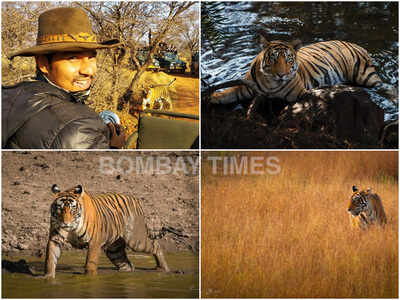
Randeep Hooda and his wildlife shots
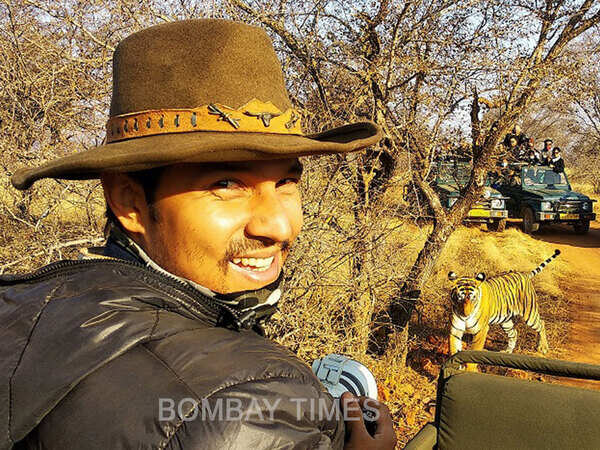
Randeep Hooda travel blog
Since the COVID siege opened up a little, I completed a film in Haryana, but hadn’t been to a forest. So, when I had to honor my promise to attend the wedding of the daughter of a dear General Saab in Jaipur, the prospect of being so close to forest made me think: I was already braving COVID for the wedding, so why not go further down that road?
Exclusive: Randeep Hooda turns photographer at a jungle safari at Ranthambore National Park! See pics

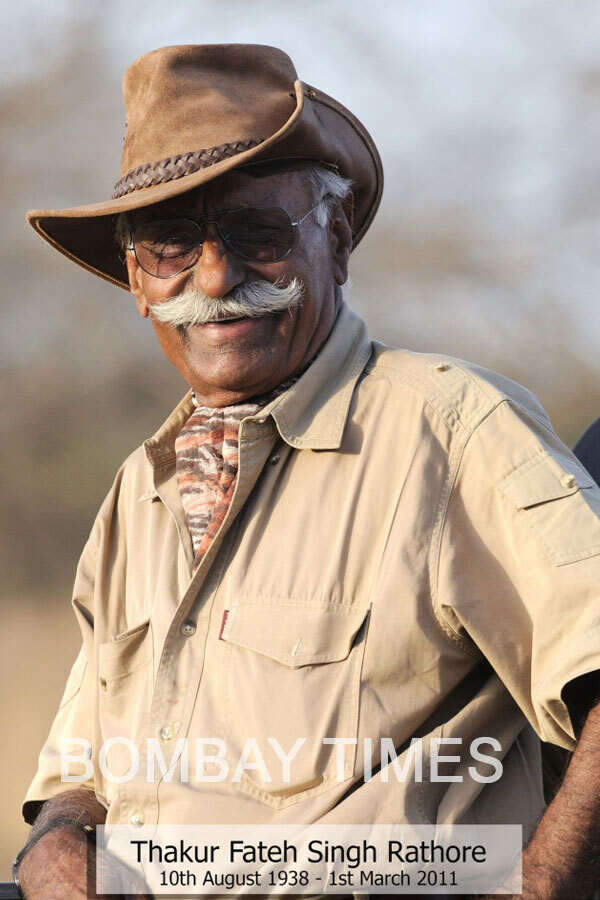
Thakur Fateh Singh Rathore
We started from Jaipur to make it in time for the evening safari, which starts early at 2pm. As we passed the city of Tonk, which produced one of our finest actors, Irrfan, I said a silent prayer in his memory. We stopped by Sawai Madhopur SP’s house which made me nostalgic and reminded me of my
nana
's house, who was a Tehsildar in British days. The civil servant’s kothi
built in the British era was a befitting home to this dynamic young officer and his wife Kritika; the couple represented the new India - modern in outlook, but steeped in the India of old.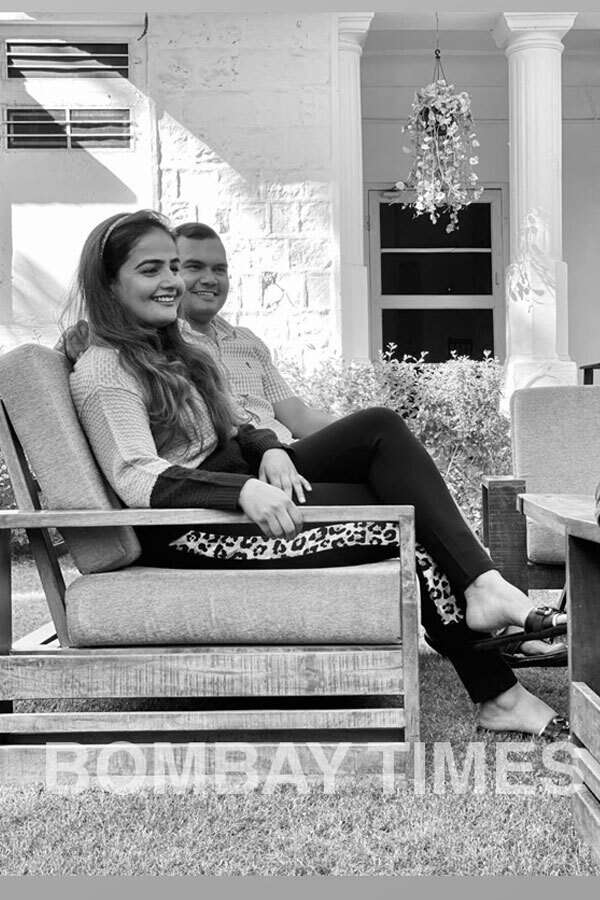
Two o’clock safari beckoned and we were off to our home-away-from-home, where we were greeted with warmth - and surprise – by Fateh Singh ji’s bahu Usha and his son Dr Govardhan Singh Rathore. The good SP saab had not let on that it’ll be an actor-type who’ll be staying at their home. I got to know that Fateh Singh wanted to be an actor and even acted in plays and a film that never got released. His passion for acting was diffused by his uncle after watching him in
Kalyug Ki Ramayan,
where he played Sita. It seems like a premature loss to the acting world. I guess the world needed Fateh Singh as the champion of tiger conservation more.We headed out to meet the result of the wheels set in motion by my other partner-in-crime, Sarosh Lodhi, wildlife photographer-and-safari guru beyond par. Yaduvendra Singh Rajawat was to be our naturalist. With knowledge and an inborn art for storytelling, Yadu knew the name of every species in Latin! This self-taught endemic species to Ranthambore, Yadusinghtia Indica, was a story unto itself. Our other man Arun Singh, no less of a naturalist himself, but in Hindi, was to escort us, in and above his duty as policeman.

Randeep Hooda was guided by policeman Arun Singh and naturalist Yaduvendra Singh Rajawat
No matter what you may have read in articles and books by the likes of Valmik Thapar and others about the tigers of the park headed by India's 'Tiger Man' Fateh Singh, nothing prepares you for what lies inside the world famous Ranthambore Tiger Reserve. In Ranthambore, human and tiger stories often go hand-in-hand and vary depending on who is telling them. Jungle lore generously provided by Yadu and Arun are too vast to be written here, but make for great campfire stories.
The park can be characterised by the presence of the 10th century ruins of Ranthambore Fort built by the Chauhan kings of the lineage of Prithviraj Chauhan overlooking the jungle.
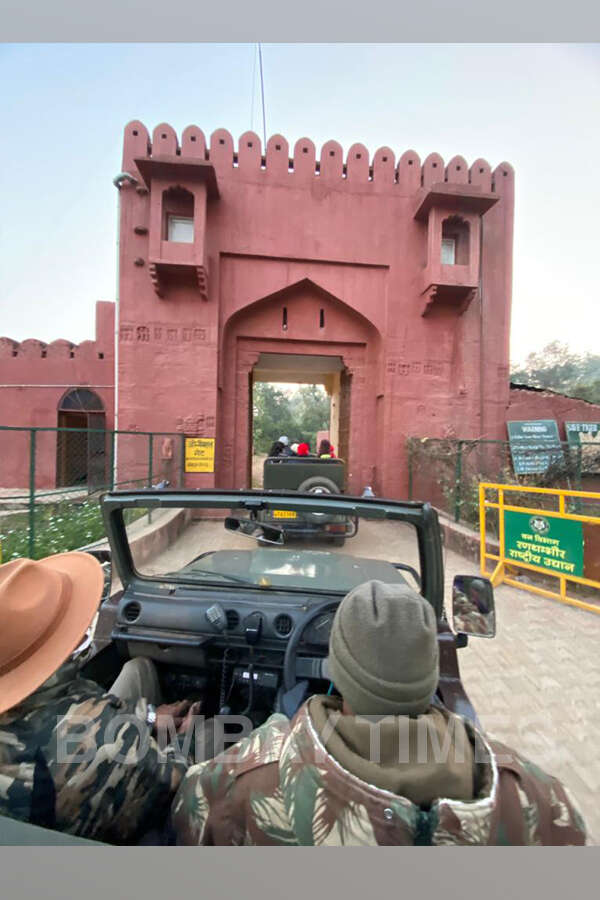
The park entrance is through the ancient Hammir Gate. You get a feeling of entering the world of Indiana Jones, with the roots on the wall, looming rocky hills, non-endemic palm trees growing perpendicularly out of other trees. It is said that they grew out of the camp sites of Alauddin Khilji, who laid siege on the fort. Chauhan King Hammir Dev fought valiantly before succumbing to battle wounds, finally losing the fort. That’s the law of the jungle it surrounds and it continues as it has always done. We were unaware still of a similar battle for territory going on in the jungle. The reigning queen of the lakes was under siege from her own daughters.
The cobbled road into the park is dotted with Hindu, Muslim and tribal reminders of faith. The road reaches the Ganesh temple upon the hill fort at the entrance of the park, which is through another ancient looking gate which was actually built by Fateh Singh ji whose aesthetics and life were one with the park.
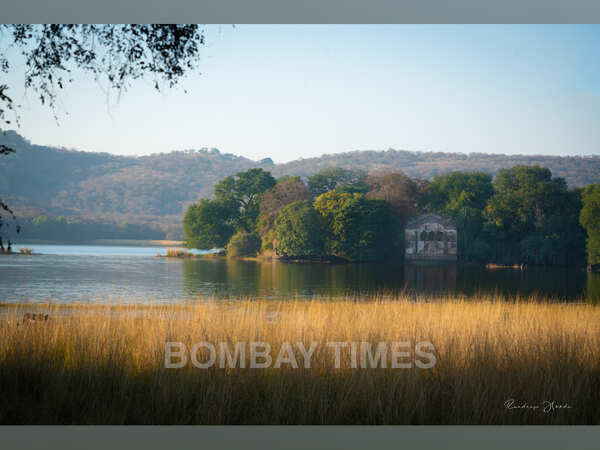
Ranthambore has a varied habitat ranging from dry deciduous to thick cool forest cover to blazing grasslands and lakes. You are greeted with the lakes of the park like Rajbagh, Padam Talao, Malik Talao, surrounded by ruins like the lake palace,
masjids, chatries
and more gates. All the entry/exit frames are a big part of the travel to and within the park. 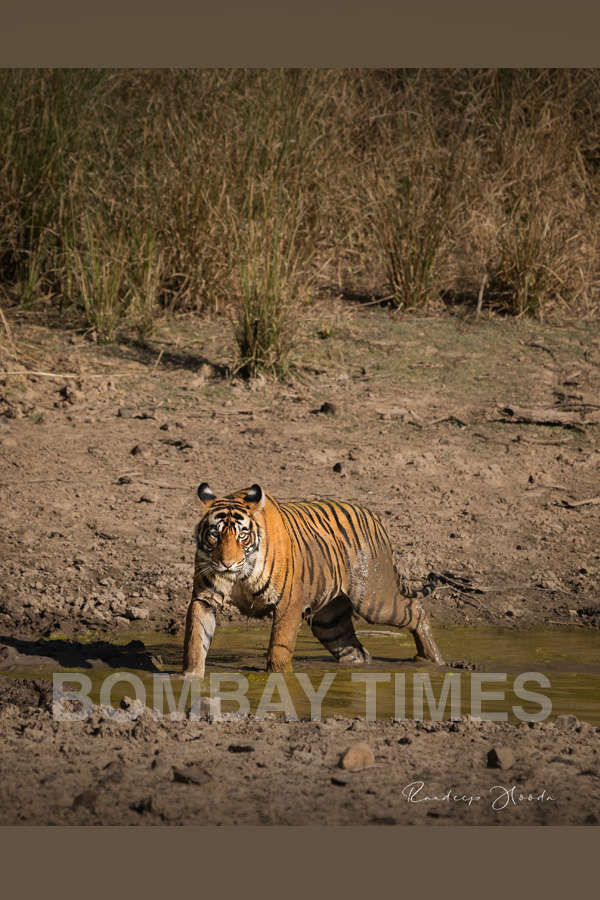
In mere minutes on entering the park, we sighted our first tiger, Siddhi.
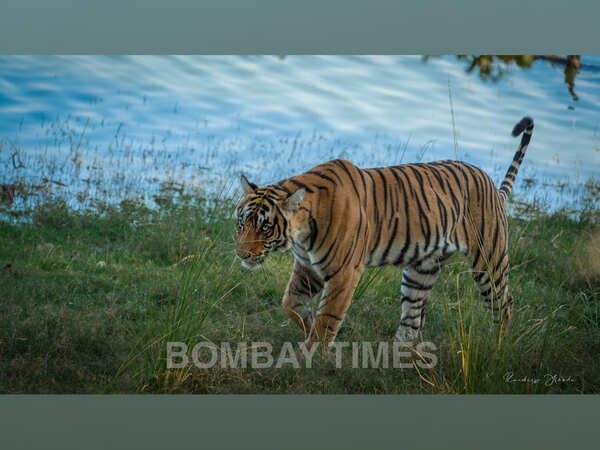
She finished cooling off in the water and wandered into the forest. We then moved on to find her sister Riddhi walking along Rajbagh lake. She was limping. We got to know that it’s due to one of her many fights with Siddhi. We finally learned of the big war going on for the territory around the lakes between the two daughters and their mother Arrowhead, the reigning queen of the lakes. There can be only one dominant female in the territory. The daughters, now grown up, each wants this picturesque and abundant territory to herself.
Thrilled with our sightings we headed for dinner at the SP’s house where the evening was a reminder of how far we are from real local problems. Things seem to have changed on social media and the modern connected world. But have they? Caste, dowry, smuggling and poaching are still prevalent in our society amongst many other issues. The ray of hope, I feel, are these young UPSC (Union Public Service Commission) officers who deal with issues not just with a heavy hand of the book of law, but also find solutions by engaging with the local culture and history. We returned to Fateh household a bit late for Dr Govardhan and Padmini, who had already gone to bed as is the norm for most people in touch with the jungle, where life still revolves around other elements.
The next morning we were off again on the path to the Ganesh Temple and the park, the morning's winter gloom still heavy on the humans waiting for the sun. We go through the ancient gates again. The stories start again and you are once again transported to another world.
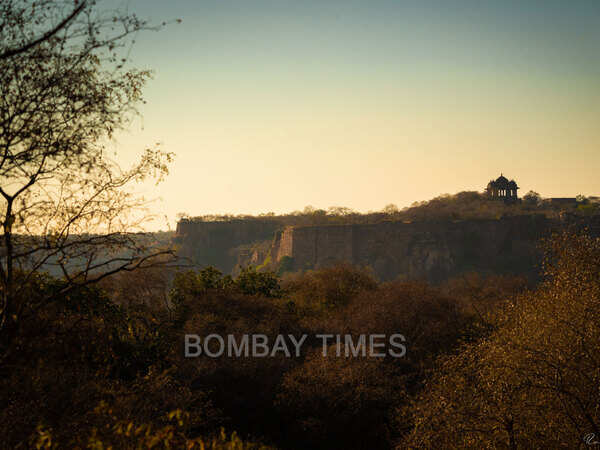
As the sun rises in Ranthambore, something magical happens - it strikes a match lighting its heart of gold, stunning you with its blinding breath-taking beauty. In this striking golden light we indulged in one of my most favourite things in the forest.
Chai.
To have the morning chai
, biscuits or sandwiches in your safari jeep in the golden light surrounded by sounds and smells of the forest is a privilege.In one of these fire-lit grasslands sprinkled with Dhonk trees we hear an alarm call by a Sambhar. A tiger is on the prowl. We spot a stag with great horns looking in a particular direction with utmost attention and stop our car in the direction he’s looking at. Some other vehicles also follow suit, and wait. We'd been talking about seeing pictures of people looking in one direction and taking photographs while a magnificent subject is right behind them. And it manifests. One of the drivers spots a tiger standing right behind us, through a rear view mirror of the gypsy. Everyone turns around at once in the grip of an excitement that only a tiger sighting can produce.
The heightened pandemonium that strikes the vehicles upon seeing a tiger is also something that's unique to Ranthambore. This powerful tiger is Arrowhead, the reigning queen of the lakes, a mother in siege by her own daughters, Riddhi and Siddhi. She once fought off her own mother, Krishna and her sister, Lightening, to take control of this territory. Well! I guess history was repeating itself.
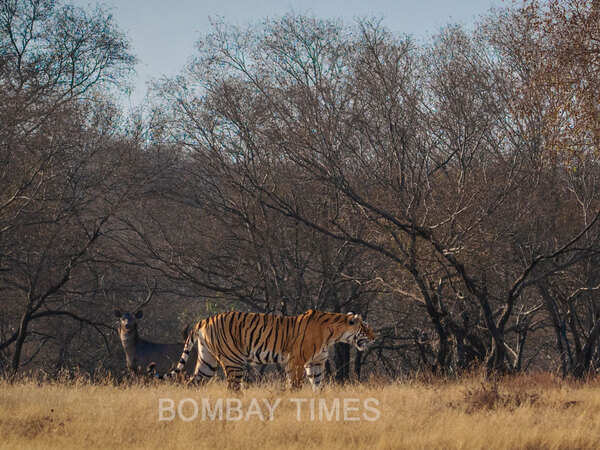
Arrowhead nonchalantly strolls past the mayhem, past the alarmed stag, through the fields of gold checking and marking her territory. She’s the star of the show and everyone, including her, I think, knows it. She kept in sight as if to let us bask in her glory. After a long walk, following a chase by the paparazzi, she had enough and settled in the tall grass besides the Rajbagh lake.
Upon our return to Fateh's Retreat we were greeted with a hearty second breakfast. I don’t know why jungles increase appetite and metabolism. Maybe it’s the excess oxygen, or the sheer journey within and without. Having a conversation with the family sitting in the garden, where Fateh Singh had held court was a memorable experience. Doc saab Govardhan ji, also an artist, though he no longer practises either, has set up a state-of-the-art community hospital, a school where his own kids studied, revived depleted forests, and now runs home places not only in Ranthambore, but also in Mount Abu and Kanha, carrying on the legacy of his father in his own way.
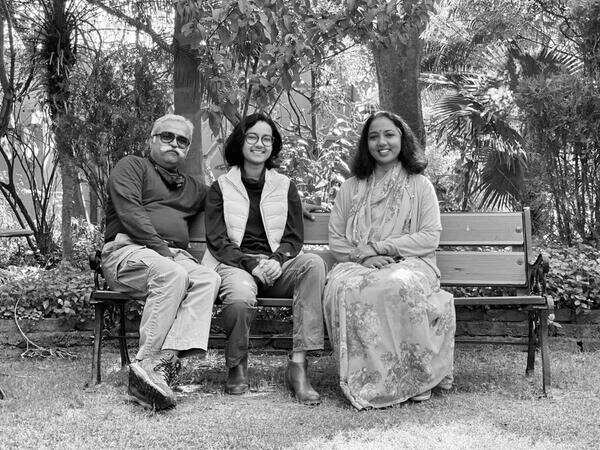
Their son working in America is stuck there due to the pandemic, but his daughter, also studying in the US, was home. She made a wonderful sketch of me, an art she inherited from her father. One of Fateh Singh’s daughters is a lawyer with a lovely glass office in her father's home, adding to the feel of the family warmth. Her conversations with the SP had us in splits about the characters and cases very endemic to Sawai Madhopur, which I choose to keep to myself, like many things the jungle keeps to itself.
The
thakurain
of the house took us around. A chatri
in the memory of Fateh Singh was at the entrance - there was no statue there, but a tile with tiger pug marks embossed on it. Surprisingly, there were a couple of human footprints, too. Befitting, I thought!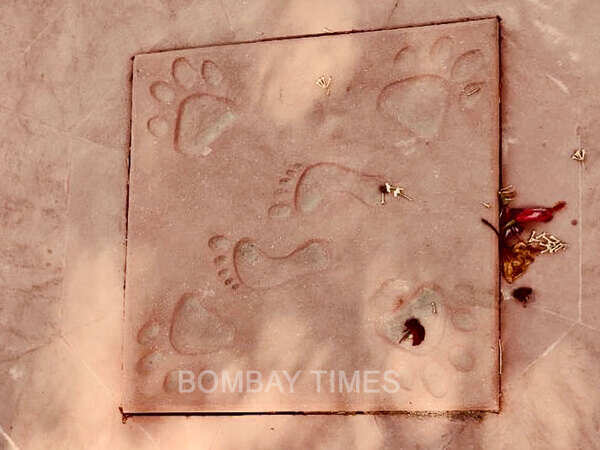
The time went so quickly that the afternoon nap, due to waking up early, was given a miss and we were in the car again entering the ancient gateways.
As the experience of Ranthambore guarantees, we spot yet another tiger. This was T112, cousin
mama
of Riddhi-Siddhi and half-brother to Arrowhead. He seemed detached from the war going on not far from him. He had his own territory in a cooler and thicker part of the forest. Upon seeing this big male in the water, the sheer size and bright yellow eyes, it struck me that there was something unique about these Rajasthani tigers. I feel it comes from the strong sun reflecting on the rocks or maybe the fiercely fought history of Ranthambore. They shine bright, nonetheless.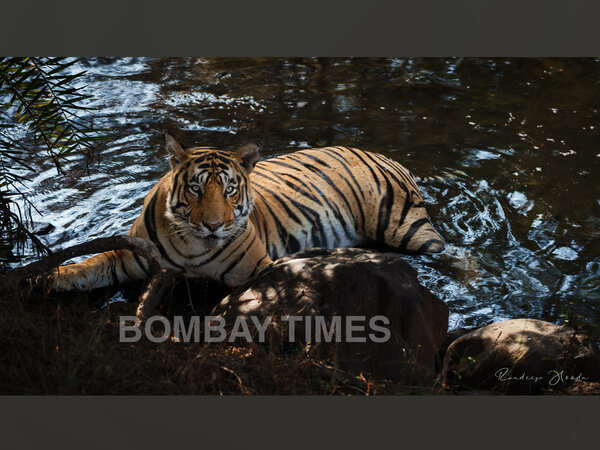
When too many people started gathering, we left him reluctantly. As soon as we reached the lakes we saw a huge number of vehicles around the
talao
next to the ruins of the masjid
with Jogi Mahal in the evening shadows on the opposite side. This was the spot I'd seen in pictures. It was where I could get my own picture of the ancient species against the ancient ruins with water of the lake shimmering in evening light. The queen obliged. Even with all the paparazzi around her she just strolled past the lake she owns. As I said, I feel Arrowhead knows she’s the star of the show. It's as if the queen of the lakes knows that many queens have come and gone before her, and so would she. She wants to relish it, as we must relish our lives.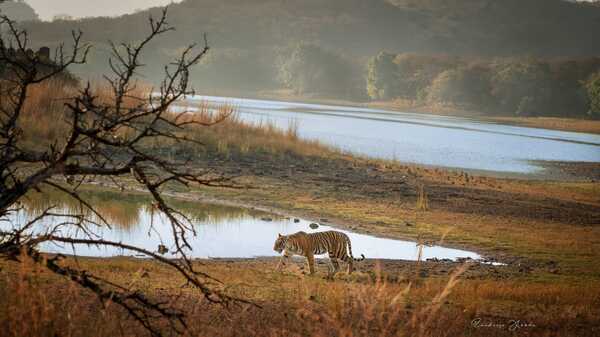
The next morning was spent cruising at Chambal river to see the critically endangered Indian gharial. It lives in a unique habitat with its competitive neighbour, the river crocodile. Upon our return to the territory of the warring family by the lake in the evening, Riddhi could be seen from a distance licking her wounded foreleg in the grass and Dhonk trees. We witnessed the mayhem all over again and decided to leave it as it got too much. Her anticipated path by Yadu and Arun bore fruit as we got a private audience of the princess-in-line, preening and cleaning herself as if to tell us who really is the star-in-the making. The sun was going down, the clock telling us to leave the wild ones to deal with their own survival and politics, as it should be, without us.
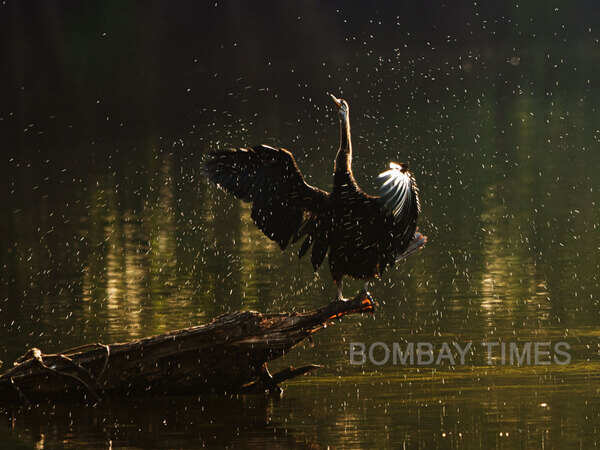
We did a total of 10 safaris, the most I’ve ever done in one jungle. We saw more of Riddhi, Siddhi and Arrowhead. We saw other creatures like sambhar, stags, dappled cheetal, Indian gazelle and even, mongoose. We saw tree framed paths with birds perched in the trees. In water, we saw the birds fish amongst the crocodiles, jumping fishes and gharials. We missed T8 with her cubs by a whisker and another fierce fight at the Rajbagh lake shores between Arrowhead and Siddhi.
We saw so much but I still feel like I could see more, hear more, experience more.
The evenings outside the park were spent around campfires exchanging stories, sampling great food and local music. Often one stopped mid-conversation to hear an alarm call right inside the property, reminding us of the presence of the tigers of Ranthambore. And probably the man behind all this being possible, Fateh Singh Rathore, was around us somewhere, raising a toast, the campfire glinting in his tiger eyes.
End of Article
FOLLOW US ON SOCIAL MEDIA







Photostories
entertainment videos
Featured In Movies

Popular Categories
Trending in Entertainment
Latest MoviesBollywood MoviesHollywood MoviesTamil Movies 2024Telugu Movies 2024Malayalam Movies 2024Kannada Movies 2024Marathi Movies 2024Bengali Movies 2024Top Rated Movies 2024Best Hindi MoviesBest English MoviesBest Telugu MoviesBest Tamil MoviesBest Malayalam MoviesBest Kannada MoviesBest Bengali MoviesUpcoming Hindi MoviesBest Movies Of All TimeBest Hindi Movies of All Time
Trending in Etimes
Horoscope TodayNumerology Predictions TodayVictorias Secret Fashion ShowJoe BidenKing CharlesPrince Harry Meghan MerkleBelly FatSean Diddy CombsKamala HarrisMagnesium DeficiencyBelly Fat LossWeight LossJustin TrudeauDonald TrumpElon MuskDiwali 2024 CalendarKarwa Chauth 2024Multitasking TipsFull Moon October 2024
Trending in TV
Trending in Lifestyle
Trending in Regional
Movie Reviews
Binny And Family ReviewLove, Sitara ReviewWill & Harper ReviewWolfs ReviewYudhra ReviewJo Tera Hai Woh Mera Hai ReviewKahan Shuru Kahan Khatam ReviewHis Three Daughters ReviewNever Let Go ReviewDancing Village: The Curse Begins ReviewTransformers One ReviewFirst Love ReviewBerlin ReviewThe Buckingham Murders Review
Upcoming Hindi Movies
Upcoming Regional Movies
Latest News
How Chennai Night Race swerved past challenges to zoom toward a brighter motorsports futureOnly 26.8% of Indian youth in the academic age group have internet browsing skills: Can this impact quality education?Ex-Indian cricketer Ajay Jadeja now wealthier than Virat KohliInfosys to no longer send job offer letters and attachments, the company will ...Bigg Boss 18: Avinash Mishra evicted by housemates following major clash with Chum Darang; Eisha Singh and Alice Kaushik left stunnedHappy Govardhan Puja 2023: Top 50 Wishes, Messages and Quotes to share with your loved onesAndre Chase Returns to NXT as Lexis King Defeats Oro Mensah in Gentleman’s DuelAshes 2025-26 fixtures announced: Australia vs England series to begin at Perth'Test cricket is nothing but...' - Indian players reveal what the red-ball format means to themWWE NXT Results and Highlights 10/15: Triple Threat No. 1 Contender match, Stephanie Vaquer vs. Wren Sinclair, and moreActress Helen Nelson aka Oviya files complaint against morphed viral video, takes legal actionRaghav Juyal's VIDEO of getting his shoe lace tied by someone else in public goes viral, netizens react as they get disappointed!Oviya lodges police complaint over her private video leak15-page letter circulating online accuses IBM China head of misconduct; here's what company said while confirming the letter7 deadliest reptiles in the world from venomous snakes to turtlesWorld Cup Finals: Sonam Maskar saves the day for IndiaOctober Full Moon 2024 Tonight: When and How to Watch Hunter's Moon?Watch: Two giant pandas Bao Li and Qing Bao arrive in Washington National Zoo
Other Group Sites -
ETimes is an Entertainment, TV & Lifestyle industrys promotional website and carries advertorials and native advertising.