- News
- entertainment
- events
- goa
- Molcornem plays holi with fire
Trending
This story is from March 5, 2018
Molcornem plays holi with fire
While the rest of the state played Holi with gulal yesterday, this small village in South Goa began ushering in a Holi of another kind on Thursday night, after midnight – where the villagers, both young and old, could be seen flinging burning embers in the air andliterally playing with fire
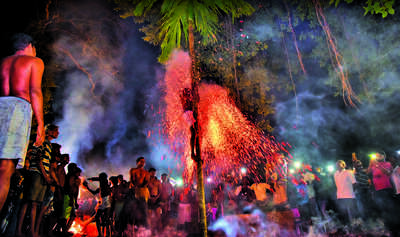
While the whole of Goa and the nation celebrates Holi with colours, the villagers of Molcornem in the South Goan taluka of Quepem prefer fire.
The original settlers of this place – the Goankars – have been celebrating this form of the festival for centuries, and the celebrations are unique to their village and community alone.
On the night preceding Holi, they worship the forest deities, run circles around the temple holding tree trunks, plant sacred trees, take part in fire dances, shower villagers with embers and break coconuts as tribute.
On Thursday night this year, the festival began at around 1.20 am, and went on till the morning. The first leg of the festival commenced at the temple courtyard, where the devotees sought blessings from their deity. The villagers who took part in this festival abstained from non-vegetarian food and alcohol post Mahashivratri, till the end of Shigmo.

During the course of the celebrations, groups of villagers lift the trunks of trees harvested from the villages plantations and run around the Malikarjun Temple in circles. Then, they are required to individually lift a large tree trunk, and run to dhol beats. The beats of this dhol are unlike what you hear in the cities. They have their own rythm altogether.
“This isn’t a religious festival per se. It’s more of a cultural festival that is unique to our community, and has been passed down by our ancestors. We do not question any rituals, and follow everything that we’ve been seeing over the years,” says Kushali. The Areca nut trunks are then installed outside the three village temples – Mallikarjun, Jalmi and Nagnath Temples, with Jalmi being the community deity.
Showers of fire
While the beats of the dhols start fading away in the temple premises, louder beats are heard from the opposite direction, where a group of around 150 gade are seen running with flickering embers. They burn cowdung cakes, and shower embers upon themselves by brushing a bunch of leaves against the burning cowdung cake. All the villagers – including the women – run towards the fire shower in the hopes of being blessed.
“They believe that once the embers touch you, you are blessed by the divine powers that protect you from evil. Tomorrow, we will visit houses with the bhowri (sotreo), until the culmination of the festival. While the men take part in xene uzo, the girls and married women take part in divza,” says Rajesh.
Climbing MAADI and flinging Embers
The gade then move towards the temple and break coconuts at the foot of the maadi. “Every man of the community is required to break a coconut to seek blessings and safeguard his family,” says Kushali, adding, “He should be able to do this in his first attempt.”
Soon after, the gade of all ages start climbing the tree and are showered in embers while on top. “We shower the maadi (an Areca nut tree installed in the temple premise) with embers, after lighting up cowdung cakes. We treat the fire as our gulaal and the Areca nut tree as our holika,” says Kushali Gaonkar, a local.
When quizzed about the significance of the fire, Rajesh says, “It’s a tradition that has been passed down by our ancestors and we try to keep it alive. This is the only place in Goa where xene uzo is celebrated and we want to continue it. The Shirgao zatra is quite popular in Goa, and we wish our zatra to be like that too.”
The original settlers of this place – the Goankars – have been celebrating this form of the festival for centuries, and the celebrations are unique to their village and community alone.
On the night preceding Holi, they worship the forest deities, run circles around the temple holding tree trunks, plant sacred trees, take part in fire dances, shower villagers with embers and break coconuts as tribute.
On Thursday night this year, the festival began at around 1.20 am, and went on till the morning. The first leg of the festival commenced at the temple courtyard, where the devotees sought blessings from their deity. The villagers who took part in this festival abstained from non-vegetarian food and alcohol post Mahashivratri, till the end of Shigmo.
“We prepare for the festival by sticking to a vegetarian diet – shivrak – post Mahashivratri. The gade who take part in the festival do not eat cooked food for 24 hours, starting from around 8 pm on Thursday night,” says Rajesh Gaonkar, a local, adding, “The gades are locals, and they abide by the strict rules, that include giving up fish and chicken during these days. Those who fail to do so suffer a certain kind of misfortune.”
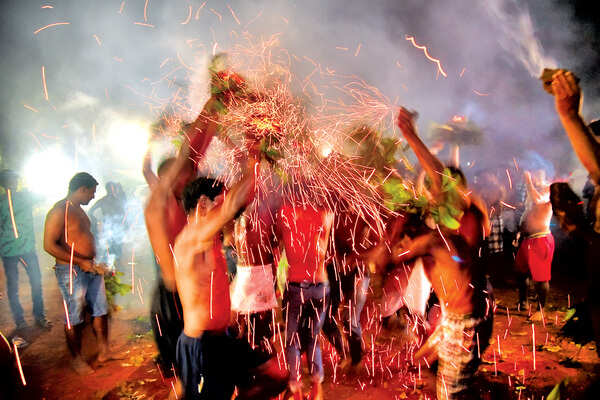
During the course of the celebrations, groups of villagers lift the trunks of trees harvested from the villages plantations and run around the Malikarjun Temple in circles. Then, they are required to individually lift a large tree trunk, and run to dhol beats. The beats of this dhol are unlike what you hear in the cities. They have their own rythm altogether.
“This isn’t a religious festival per se. It’s more of a cultural festival that is unique to our community, and has been passed down by our ancestors. We do not question any rituals, and follow everything that we’ve been seeing over the years,” says Kushali. The Areca nut trunks are then installed outside the three village temples – Mallikarjun, Jalmi and Nagnath Temples, with Jalmi being the community deity.
Showers of fire
While the beats of the dhols start fading away in the temple premises, louder beats are heard from the opposite direction, where a group of around 150 gade are seen running with flickering embers. They burn cowdung cakes, and shower embers upon themselves by brushing a bunch of leaves against the burning cowdung cake. All the villagers – including the women – run towards the fire shower in the hopes of being blessed.
“They believe that once the embers touch you, you are blessed by the divine powers that protect you from evil. Tomorrow, we will visit houses with the bhowri (sotreo), until the culmination of the festival. While the men take part in xene uzo, the girls and married women take part in divza,” says Rajesh.
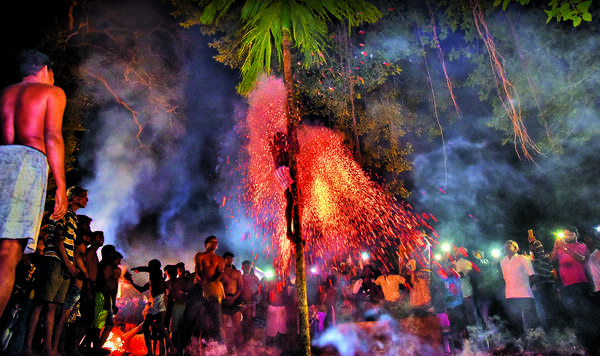
Climbing MAADI and flinging Embers
The gade then move towards the temple and break coconuts at the foot of the maadi. “Every man of the community is required to break a coconut to seek blessings and safeguard his family,” says Kushali, adding, “He should be able to do this in his first attempt.”
Soon after, the gade of all ages start climbing the tree and are showered in embers while on top. “We shower the maadi (an Areca nut tree installed in the temple premise) with embers, after lighting up cowdung cakes. We treat the fire as our gulaal and the Areca nut tree as our holika,” says Kushali Gaonkar, a local.
When quizzed about the significance of the fire, Rajesh says, “It’s a tradition that has been passed down by our ancestors and we try to keep it alive. This is the only place in Goa where xene uzo is celebrated and we want to continue it. The Shirgao zatra is quite popular in Goa, and we wish our zatra to be like that too.”
End of Article
FOLLOW US ON SOCIAL MEDIA









entertainment videos
Featured In Movies
Popular Categories
Entertainment NewsBollywood NewsTollywood NewsKollywood NewsMollywood NewsMovie ReviewsLatest Hindi MoviesLatest Tamil MoviesMX PlayerParenting TipsHome RemediesWeight LossBeauty TipsParenting TipsHindi VideosHindi Video SongsBhojpuri Music VideosLatest Telugu MoviesBhojpuri Music VideoHindi TV News
Trending in Entertainment
Latest MoviesBollywood MoviesHollywood MoviesTamil Movies 2024Telugu Movies 2024Malayalam Movies 2024Kannada Movies 2024Marathi Movies 2024Bengali Movies 2024Top Rated Movies 2024Best Hindi MoviesBest English MoviesBest Telugu MoviesBest Tamil MoviesBest Malayalam MoviesBest Kannada MoviesBest Bengali MoviesUpcoming Hindi MoviesBest Movies Of All TimeBest Hindi Movies of All Time
Trending in Etimes
Horoscope TodayNumerology Predictions TodayDinner With TrumpTim WalzIvanka TrumpJose LopezKristina JoksimovicJoe WilsonTrump Eating The Dogs SongGermany NewsKamala HarrisPrince HarryPatriot Day 2024Diabetes RiskHappy Mindfulness Day 2024Trump Vs HarrisJoe JonasPositive Thinking Day 2024Dave Bautista
Trending in TV
Trending in Lifestyle
Trending in Regional
Movie Reviews
Visfot ReviewThalapathy Is The G.O.A.T ReviewRebel Ridge ReviewDetective Conan vs. Kid the Phantom Thief ReviewBeetlejuice Beetlejuice ReviewPad Gaye Pange ReviewA Wedding Story ReviewThe Diary Of West Bengal ReviewTikdam ReviewKinds Of Kindness ReviewAfraid ReviewThe Deliverance ReviewBlue Lock: Episode Nagi ReviewDaddio Review
Upcoming Hindi Movies
Upcoming Regional Movies
Latest News
Regina Cassandra calls herself a 'serial dater,' had many relationships :'But I’m taking a break now'7. Hindi becomes officialKaun Banega Crorepati 16: Can you guess the answer for this Rs 3,20,000 question on Navy, which contestant Naman Jain incorrectly answered?Kitchen Tips: How to elevate home cooking to Michelin levelTragic road accident on Mogili ghat road claims seven lives in Chittoor districtRaveena Tandon apologizes to fans for not photo snub in London: "It was not my intention to offend"Preschools turn nursing homes, retirement age raised: China's demographic crisis explodesBest Phones Under 35000 To Smoothly Carry Out Multiple Tasks On A BudgetTovino Thomas praises Prithviraj Sukumaran as director: "One of the brilliant directors I have ever worked with"'Cops stood as mute spectators': Protesting doctors write to President over RG Kar impasseFatal crash in Australia's Netherby claims life of ToddlerNASA to establish New Lunar Time Standard with Coordinated Lunar Time (LTC) initiativeWWE Superstar Cody Rhodes and his Wife Brandi Rhodes Share Special Messages on Their 11th AnniversaryAnupamaa: Anuj and Anu to go legal against Ankush and Barkha'Dead cat hanging from a tree': Origin of Haitian immigrants row. Everyone heard itTop 5 least private zodiac signsPerfect comfort foods for every zodiac signWWE Hall of Famer sheds light on major difference between Jacob Fatu and the rest of the Bloodline
Other Group Sites -
ETimes is an Entertainment, TV & Lifestyle industrys promotional website and carries advertorials and native advertising.