
- News
- Mamata's Bhowanipore shows a rise in voters' turn out
This story is from May 3, 2016
Mamata's Bhowanipore shows a rise in voters' turn out
Bhowanipore has registered a surge in voter turnout when many constituencies in Kolkata showed a dip.Poll percentage in this high-voltage south Kolkata constituency rose by 2.99%.
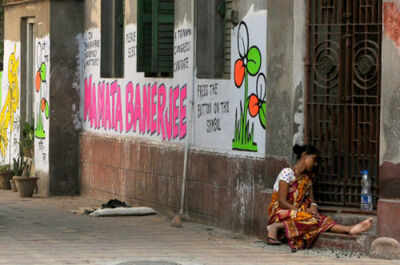
Mamata Banerjee's wall writing in Bhowanipore
The rise in poll percentage reflects, to say the least, an increased interest among voters to cast their vote, given the prominence Bhowanipore gained with Mamata Banerjee, Deepa Das Munshi and Chandra Bose in the fray. Trinamool insiders would love to see a dip in BJP votes, though not a slide from 17%, because that would help dividing the opposition votes giving Mamata an advantage.
Some others argue that priorities change in every elections, and it won't be wise to compare Lok Sabha votes with that of the assembly. There are instances where a surge in vote went for the government that has come under challenge from the opposition. But instances, to the contrary, are easy to find. The opposition banks on this comparatively high voter turnout saying that people came out in large numbers to vote against Trinamool. The truth will come out only when the results are declared on May 19.
Here are some hard facts. In the 22 constituencies in and around Kolkata, 18 recorded a dip by an average 3.5% with Bidhannagar and Rajarhat-Gopalpur showing a decrease of 6.38% and 6.43% respectively. Chief minister's constituency recorded a nearly 3% rise in voter turnout, the highest since delimitation, followed by Chowringhee (1.6%), Entally (1.04%) and Shyampukur (.61%).
When asked whether it is the ant-incumbency factor that has led to this huge turnout, political scientist Prabhat Dutta said, "There is definitely an anti-incumbency factor but there are several other factors which led to the rise in turnout. The middle class educated Bengali felt that their values and tradition are threatened under the leadership of Mamata Banerjee and they voted aggressively. This might be one of the main reasons behind the turnout mystery." Dutta also believes that the elite and the organised corporate class that has sizeable population in Bhowanipore might not be very happy with the industrialization policy of Mamata Banerjee.
"The Gujarati community holds key to the constituency. The Modi factor during the 2014 Lok Sabha polls might have prompted them to vote for BJP. The factor is no more there this time," political scientist Mohidul Islam said. Islam believes that Bhowanipore's contest was polarised between Mamata Banerjee and Deepa Das Munshi with both the parties trying their best to rally their supporters.
Psephologist Biswanath Chakraborty had a different take. "Bhowanipore's demography has changed substantially in the last five years. A whole lot of immigrant workers have started staying in this area. They constitute a considerable section of voters which is comparatively new in this traditionally upmarket constituency. Now these people, who are mainly workers and guards in different highrises, maids and are engaged in some other unorganised sectors, have a huge contribution to this rise in polling percentage." Chakraborty believes that these new voters may side with the ruling party. "The poll percentage may have risen due to these new voters. They may not go against the ruling party."
End of Article
FOLLOW US ON SOCIAL MEDIA
Photostories

Hot Picks
TOP TRENDING
Popular Categories
Hot on the Web
Top Trends
IND vs NZ Live ScoreBengaluru Collages Bomb ThreatSteve SmithNEET PG SC HearingMohammad KaifShailaja PaikHaryana Election ResultUGC NET ResultRishabh PantNima Hospital Doctor MurderTaylor SwiftThe RockWomen's T20 World CupTop MBA Colleges of IndiaT20 WC ScheduleWomen T20 World Cup Points TableLive Cricket Score
Trending Topics
Samantha Ruth PrabhuNavratri Colours 2024Navratri Day 2 ColourTMKOC New SonuNaga ChaitanyaDevara CollectionGOAT OTT ReleaseRajinikanthDeepika PadukoneGovindaDevaraGovinda NewsDevara Movie ReviewHealthy RaitasSwatantrya Veer SavarkarColdplay India tour 2025Maa Durga 108 NamesNavratri JewellerySony Bravia 55 inch 4k Ultra HD TVWordle Answer
Living and entertainment
Latest News
Navratri Will Be Luckiest for These SignsAny EU countries can grant asylum to Afghan women based on nationality and gender, Europe's top court rulesReport card of Rahul Gandhi's 100 days as leader of opposition courtesy CongressThe day Israel was caught off guard: How Hamas overran a key Israeli military base on October 7ISL: Borja’s left foot to Goa’s rescueNeelam Kothari speaks out against ageism says 'aunties' label is uncoolPer capita income to nearly double in 5 years: Finance minister SitharamanManju Pavagada gets engaged in a close affair; pictures go viral on social mediaCommunity Connect: Hungry for connectionInsider Claims Nick Sirianni Plays 'Madden' with Eagles, While AJ Brown Is Celebrated as Jalen Hurts' SaviorKremlin accuses Ukraine of 'playing with fire' after reported attack near Kursk nuclear plantGuns, firecrackers on display during Afghanistan star Rashid Khan's marriage. WatchZodiac Signs Most Likely to SucceedMysuru all set for a glittering Dasara'Disappointing, condemnable but not ... ': India on fugitive Zakir Naik's Pakistan visitTechnological advancements have revolutionized cancer treatment, say doctorsPakistan seals off capital, suspends internet ahead of rally by Imran Khan's supportersAmazon to increase the individual contributor to manager ratio by 15% through layoffs: How many reportees can a manager can effectively oversee?
Copyright © 2024 Bennett, Coleman & Co. Ltd. All rights reserved. For reprint rights: Times Syndication Service