
- News
- Thomas Isaac bats for inclusive growth, gender justice and environment protection
This story is from May 9, 2016
Thomas Isaac bats for inclusive growth, gender justice and environment protection
Former finance minister T M Thomas Isaac does not resort to hyperboles while campaigning in his constituency, Alappuzha. He speaks about a new economic agenda with ‘sustainable growth’, which he feels is the way forward unlike the ‘fast-forward’ model envisaged by the UDF government.
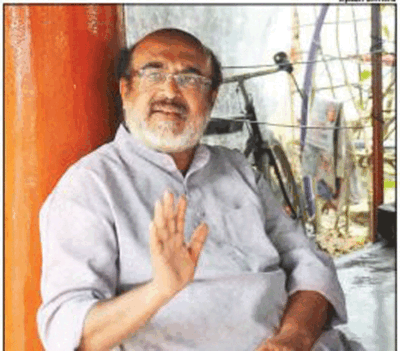
Isaac agreed that Kerala is at the critical juncture of a developmental paradigm and some major challenges must be resolved to overcome the socio-economic crisis in the coming years.
Former finance minister T M Thomas Isaac does not resort to hyperboles while campaigning in his constituency, Alappuzha. He speaks about a new economic agenda with ‘sustainable growth’, which he feels is the way forward unlike the ‘fast-forward’ model envisaged by the UDF government.
For him, unbridled economic growth, based on markets, is a misplaced enterprise.
Isaac said that three constraints had to be considered before unveiling a new economic agenda. “Economic growth should be maximized within the important parameters that are unique to Kerala. They are mainstreaming of marginalized section, gender justice and environment. I would also add protection of public healthcare and education,” he said. Isaac agreed that Kerala is at the critical juncture of a developmental paradigm and some major challenges must be resolved to overcome the socio-economic crisis in the coming years.
“The crisis was fuelled by many factors such as recession in the Gulf and the return of migrants. The lack of good governance and wrong policies adopted by the UDF government are major problems.
This reorientation should be done on the basis of social consensus. “This can be achieved by giving total social security to traditional industrial workers, farmers and the fishing community,” he said. He added that core sectors which need to be revived are knowledge, service and skill-based industries and valueadded agriculture.
Unlike other economists, Isaac does not support the theory that Kerala’s developmental model – based on remittance economy – was flawed. “We had a unique development growth experience and the focus on social sector has not impeded growth – unlike what scholars thought in the 70s and 80s – and our remittance-driven economy can be seen as a secondary bank of human development strategy,” he said.
The problem is there are no jobs for literate Keralites. “The challenge is to preserve the gains we achieved in social and health sector and movetowards a knowledge-driven industry,” he said, adding that the state should improve the quality of education in tune with modern demands. “Kerala had a robust public health system which was more state-governed (akin to British system) unlike the cut-throat insurance system prevalent in America. Changing our system is like inviting disaster,” he said.
On the key issue of waste management, he said that the state should go for decentralized processing of organic waste through a bioprocess mechanism. “Even the European Union is thinking of removing subsidies for incinerators. USA is not allowing new incinerators,” he said.
On the issue of declining agriculture sector, he said the state should increase the productivity of fallow lands. “People today want good food. If you dislike organic food, go for safe food,” he said.
Isaac plans to tap the huge remittance by starting a Kerala investment fund, exclusively for NRIs. “We need to provide employment opportunities to those returning from the Gulf. One option is starting major joint venture projects and if a return migrant invests beyond the minimum amount, he will be guaranteed a job if he/she is qualified. In simple words, you buy your own job,” he said.
For him, unbridled economic growth, based on markets, is a misplaced enterprise.
“If the state provides land as incentive to lure private investment or make core sectors – such as education and health – tradable commodities, then we are moving in the wrong direction,” he said.
Isaac said that three constraints had to be considered before unveiling a new economic agenda. “Economic growth should be maximized within the important parameters that are unique to Kerala. They are mainstreaming of marginalized section, gender justice and environment. I would also add protection of public healthcare and education,” he said. Isaac agreed that Kerala is at the critical juncture of a developmental paradigm and some major challenges must be resolved to overcome the socio-economic crisis in the coming years.
“The crisis was fuelled by many factors such as recession in the Gulf and the return of migrants. The lack of good governance and wrong policies adopted by the UDF government are major problems.
If the fiscal crisis continues, it would be very difficult for Kerala to raise funds for long-term infrastructure projects through special purpose vehicles. Kerala needs to urgently shift its development path, focusing on core sectors where the state is competent,” he said.
This reorientation should be done on the basis of social consensus. “This can be achieved by giving total social security to traditional industrial workers, farmers and the fishing community,” he said. He added that core sectors which need to be revived are knowledge, service and skill-based industries and valueadded agriculture.
Unlike other economists, Isaac does not support the theory that Kerala’s developmental model – based on remittance economy – was flawed. “We had a unique development growth experience and the focus on social sector has not impeded growth – unlike what scholars thought in the 70s and 80s – and our remittance-driven economy can be seen as a secondary bank of human development strategy,” he said.
The problem is there are no jobs for literate Keralites. “The challenge is to preserve the gains we achieved in social and health sector and movetowards a knowledge-driven industry,” he said, adding that the state should improve the quality of education in tune with modern demands. “Kerala had a robust public health system which was more state-governed (akin to British system) unlike the cut-throat insurance system prevalent in America. Changing our system is like inviting disaster,” he said.
On the key issue of waste management, he said that the state should go for decentralized processing of organic waste through a bioprocess mechanism. “Even the European Union is thinking of removing subsidies for incinerators. USA is not allowing new incinerators,” he said.
On the issue of declining agriculture sector, he said the state should increase the productivity of fallow lands. “People today want good food. If you dislike organic food, go for safe food,” he said.
Isaac plans to tap the huge remittance by starting a Kerala investment fund, exclusively for NRIs. “We need to provide employment opportunities to those returning from the Gulf. One option is starting major joint venture projects and if a return migrant invests beyond the minimum amount, he will be guaranteed a job if he/she is qualified. In simple words, you buy your own job,” he said.

About the Author
Viju BEnd of Article
FOLLOW US ON SOCIAL MEDIA
Hot Picks
TOP TRENDING
Trending Stories
In Section
Entire Website
- The Secret Behind NFL Marriages: How These Couples Make It Work
- UPI transaction limit to change from September 16! Here are the new limits for various UPI payments
- When Laura Loomer said she's single because she's too focused on Donald Trump
- South Delhi shooting: Sleuths see killing as a message to big businessmen
- Top 10 sports stars turned power couples: From Agassi-Graf to Conner-Comaneci
- 3 Zodiac Signs Most Likely to Become Multimillionaires
- Narayana Murthy faces backlash for parenting remarks on social media; users say, "after working 72 hours a week, there’s barely time left to have babies…”
- 'Would not fit in ... ': Princess Diana's brother warned Prince Harry about marrying Meghan Markle
- The 3 Strongest Zodiac Signs: Powerhouses of the Zodiac Wheel
- Dark Side Of Each Zodiac Sign
- 'Message for Modiji': Opposition takes jab at BJP over Nitin Gadkari's 'PM post' claim
- 'He never listened ...': Anna Hazare reacts to Kejriwal's 'will quit' decision
- Why it is so easy to quench ‘sadiyon ki pyas’ in dry Bihar
- Kejriwal says he will resign in 48 hrs: Does this mean early polls in Delhi?
- Taylor Swift's endorsement fails to move needle for Kamala Harris: Survey
- Kohli at his destructive best, shatters Chepauk wall with six
- Will Germany’s suspension of Schengen entry end the Europe dream?
- Melinda Gates reveals the 'best part' of not working with ex-husband Bill Gates
- 'Even Britishers didn't expect ruler more cruel in India': Kejriwal attacks BJP govt
- 'PR stunt ... gimmick': How BJP, Cong reacted to Kejriwal's shock announcement

Popular Categories
Hot on the Web
Top Trends
Trending Topics
World Largest HorseEID WishesOnam WishesPriyanka Chopra TattooKottukkaali OTT ReleaseEngineers Day WishesGoat CollectionHair LossSudha MurtyMalayalam ProducersIndia's Best Dancer 4Simi GarewalDilli BabuIndian National ParksLaung BenefitsVikas SethiApple iPhone 16Donald TrumpAadhar Card UpdateWordle Answer
Living and entertainment
Latest News
PM Modi's Sunday roadshow in Jamshedpur cancelled due to heavy rain4 types of tea to improve gut health and ease digestive issuesFour Zodiac Signs That Are Hard to Control'Message for Modi': Opposition takes jab at BJP over Nitin Gadkari's 'PM post' claimNetflix denies filmmaker Soham Shah’s plagiarism allegations over Squid Games, says claim holds 'no merit''Virat bhaiya's passion and dedication for the game is...': Sarfaraz KhanFather rapes and murders 8-year-old daughter in Madhya Pradesh, throws body in wellWeekly Career Horoscope, September 15 to September 21, 2024: Read your weekly astrological work predictions for all zodiac signsZodiac Signs That Crave a Luxurious LifestyleRain washes out England-Australia T20I series finale"Miami Dolphins Owner Stephen Ross Eyes Multi-Billion Dollar Deal: The $7 Billion Power Play"Rajkummar Rao hails Kareena Kapoor Khan's The Buckingham Murders as a 'gripping thriller'MoS Finance likely to be convenor of GoM on GST compensation cessRole Rewind: Did you know Ranveer Singh and Deepika Padukone's love story has a strong Kareena Kapoor Khan connection?Coin Master free spins and coins for 15 September, 2024: Earn 7 million coins using today’s linksHow to set up partner sharing in Google PhotosIndia, Pakistan players involved in heated exchange during Asian Champions Trophy. WatchNoida authority fraud: 2 arrested in Rs 3.9 crore scam linked to fake bank accounts
Copyright © 2024 Bennett, Coleman & Co. Ltd. All rights reserved. For reprint rights: Times Syndication Service