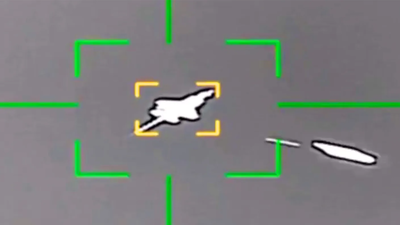
In the ongoing conflict in Iran, the Israeli-American coalition virtually controls the airspace over Iran. Air superiority over the West Asian region was secured very early in the conflict. Major air defense systems such as the Russian S-300 were the primary targets of the coalition.
One of the most important elements of modern combat is strong integrated layered air defenses, as demonstrated by India during Operation Sindoor and by Ukraine in the ongoing conflict with Russia.
MQ-4C Triton, $240 MN Drone Worth More Than Two F-35s, Crashes; Iran Role Being Probed | Details
The lack of such a system with redundancies shows how one can be completely destroyed, as in Iran, or bypassed, as in Venezuela.
A layered air defense system consists of different types of weapons to take on different types of threats, providing redundancy. These layers were stripped away one by one in Iran, except the last: point defense systems such as Man-Portable Air Defense Systems (MANPADS) or shoulder-fired missiles. These missiles target aircraft flying close to the ground and can reach up to 15,000 feet from the launch point.
The Americans reportedly lost an F-15E and an A-10 to these systems.
An F-35 was also damaged by a similar system.
What Are MANPADS?
These shoulder-fired missiles acquire targets passively. Unlike radar-guided systems, they home in on the heat emitted by their targets.
Since the aircraft cannot detect emissions from a tracking radar or the missile itself, pilots often lack warning of a launch and thus little chance to defend.
As man-portable systems, they can deploy anywhere at a moment's notice. India used an Igla missile in 1992 to down a Pakistani helicopter carrying Brigadier Masood Anwari, commander of Pakistan's 323 Brigade. The officer was on a reconnaissance mission when his helicopter crashed.
What Makes MANPADS Dangerous?
Their small size and low price allow deployment over large areas. Unlike regular air defense systems, they have a tiny footprint and evade detection before firing.
The Soviets learned this harshly during their Afghanistan intervention. Many helicopters and low-flying aircraft fell to these systems, supplied by Americans to Afghan rebels. This forced Soviet pilots to higher altitudes, slashing effectiveness.
How to Defend Against MANPADS
Modern combat aircraft feature Missile Approach Warning Systems (MAWS). These alert aircrews to launches by detecting radars, sometimes lasers, and missiles in infrared or ultraviolet spectrums. They automatically deploy countermeasures like flares to decoy missiles. Directional Infrared Countermeasures (DIRCM) systems also jam and redirect them.
Chinese Missiles in Iran's Arsenal—and Why It Worries America
Air mobility—moving troops by helicopter—is central to U.S. warfare. Americans rely on helicopters for combat, reconnaissance, patrolling, close air support, transport, logistics, and casualty evacuation. These missions expose them within MANPADS range.
China denies sending MANPADS to Iran, but reports confirm Chinese missiles have arrived. Iran's arsenal includes the QW series, like the QW-2 (alleged Igla copy, per The War Zone), and the Misagh series, reverse-engineered from Chinese designs.
This proliferation could force US tactics to adapt. Aggressive helicopter operations, like the Osama bin Laden raid or Maduro capture attempt, might shift toward caution, echoing Black Hawk Down (Operation Gothic Serpent in Mogadishu).