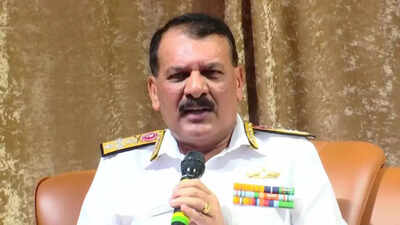
Bengaluru: Even as the ongoing conflict in West Asia reshapes modern warfare, India's Navy is holding back from drawing firm conclusions, choosing instead to watch, analyse and adapt in real time.
Speaking at Ran Samvad 2026 in Bengaluru on Thursday, Chief of Naval Staff Admiral Dinesh K Tripathi said it was "too early" to distil definitive lessons from what he described as a still-evolving conflict. “Right now, we are monitoring activities… We’re monitoring like a hawk, what’s working, what’s not working, what we can imbibe from that, what’s to be done, and more importantly, what’s not to be done,”
“...Disruptions near the Strait of Hormuz apart from the severe economic consequences, have also led to a significant increase in dark vessels that operate on the seas – further highlighting the simultaneity of security, economic, and informational challenges within the maritime domain,” the Admiral said.
'India Was On Verge Of Striking Before Pakistan Requested Halt During Op Sindoor': Indian Navy Chief
Transparency & vulnerability
The most striking takeaway, the Navy chief said, is the unprecedented transparency of the battlespace. "Anything that can be seen — moving or stationary — is vulnerable," he noted, underlining that land, sea, air and even space-based assets are now exposed in ways unseen before. Sub-surface platforms, particularly submarines, remain relatively less detectable, especially in complex waters like the Indian Ocean, where salinity and hydroacoustic conditions make detection extremely difficult.
Resilience over invulnerability
Rather than invincibility, the conflict has highlighted the importance of resilience. Admiral Tripathi pointed to the sustained operations of US carrier strike groups, including the USS Abraham Lincoln, as evidence of enduring combat capability despite threats. "Every platform is vulnerable. What matters is the balance between the adversary's offensive capability and your defensive strength," he said.
Carrier & amphibious relevance intact
Responding to questions on the vulnerability of aircraft carriers to low-cost drones and asymmetric attacks, the Navy chief rejected suggestions that their role is diminishing. Carrier battle groups and amphibious ready groups, he said, "do have relevance and purpose", with their employment shaped by operational and strategic context. He noted that amphibious forces in particular "carry a punch" and can be reused, a point illustrated by deployments monitored during the recent conflict.
Indian Navy officials have been closely tracking US naval deployments and sortie patterns.
Speed, scale, simultaneity
In his address, Admiral Tripathi framed modern warfare around three defining attributes — speed, scale and simultaneity. He cited the use of AI-enabled targeting systems in West Asia, which compress decision cycles from detection to strike, as a sign of how warfare is shifting from linear kill chains to networked kill webs.
Human judgement still central
Despite rapid advances in artificial intelligence and data processing, he stressed that machines cannot replace human decision-making. "Machines can give options. The final decision will remain human," he said, warning of cognitive warfare where adversaries may attempt to overload or mislead decision-makers with data.
Indian Navy’s response
Against this backdrop, the Navy is focusing on building a networked, resilient and integrated force. This includes greater use of uncrewed and autonomous systems, integration of long-range precision strike and layered defence, and indigenous combat management systems linking sensors and shooters across domains.
The Navy has also embraced spiral development, iterating on prototypes and scaling what works rather than waiting for a perfect solution, as a guiding principle for technology induction. Training in cyber, information and multi-domain operations is being progressively built in, with exercises such as the Navy-led Theatre Level Operational Exercise TROPEX and a tri-services exercise coordinated by the Navy in November last year already incorporating cyber and information warfare elements.
Admiral Tripathi said doctrine and strategy are being continuously updated, with a revised maritime security strategy expected shortly. The larger message, however, was one of caution. The Navy is watching closely, but not rushing to conclusions. "The correct lessons will come when the time is right," he said.