
Trending
This story is from January 14, 2023
Commit 1% share of GST to local bodies: Experts in Pune
Urban local bodies need to be better equipped and supported by the government as well as through public-private partnerships and market instruments like bonds to attract more capital for large-scale and climate-resilient projects said policymakers and finance experts at an event on Friday to discuss the dynamics and finances of developing urban infrastructure in Pune, as part of the G20 events in India.
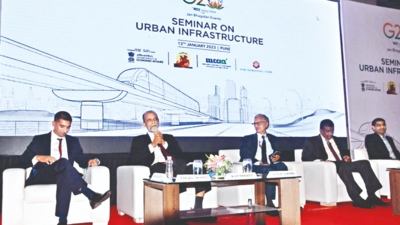
Participants hold forth at the seminar amid G20 events on Friday

The event was organised by the Mahratta Chamber of Commerce, Industries, and Agriculture, Pune International Centre, and other stakeholders. The city’s civic commissioner Vikram Kumar, additional secretary of the Union Ministry of Housing and Urban Affairs Surendra Bagde as well as representatives of the World Bank Group, the State Bank of India were present.
Neeraj Gupta, principal investment officer of the World Bank Group’s International Finance Corporation noted that only around 27 cities have creditworthiness and the finance to borrow to the tune of USD 1 billion each, and only 20% of all PPP projects in India have been executed in urban areas, with around 7% of such investments.
A number of panelists spoke about the need to make urban local bodies more autonomous and financially solvent. “Urban local bodies are generally small in India, and not of the size they should be because they don’t have many revenue handles, especially with the implementation of the GST, rationalisation of user charges, and abolition of octroi. The state and Union governments must commit to share 1% of GST revenue with urban local bodies, to help themclean up their balance sheets and attract partnerships,” said Abhay Pethe, a senior fellow at the Pune International Centre.
End of Article
FOLLOW US ON SOCIAL MEDIA







Photostories

Hot Picks
TOP TRENDING
Popular Categories
Hot on the Web
Top Trends
Travis KelceIsrael Hezbollah WarIND vs PAK Live ScoreElection Exit PollsSachin TendulkarKayla NicoleShan MasoodPrince WilliamAmethi Murder CaseAssembly Election Result 2024 LiveUGC NET ResultDiddyWomen's T20 World CupTop MBA Colleges of IndiaT20 WC ScheduleWomen T20 World Cup Points TableLive Cricket Score
Trending Topics
Bigg Boss 18 Launch LIVE UpdatesBigg Boss Tamil 8 Contestants ListBigg Boss Tamil 8 Launch LIVE UpdatesNavratri Colours 2024Navratri Day 2 ColourTMKOC New SonuBigg Boss 18 House PhotoDevara CollectionGOAT OTT ReleaseDeepika PadukoneGovindaDevaraGovinda NewsDevara Movie ReviewSwatantrya Veer SavarkarColdplay India tour 2025Maa Durga 108 NamesNavratri JewellerySony Bravia 55 inch 4k Ultra HD TVWordle Answer
Living and entertainment
Latest News
Virgo, Weekly Horoscope, October 06 to October 12, 2024: Financial setbacks may arise mid-week but will improve by the weekend49ers' Christian McCaffrey May Return in Week 7 Against Chiefs, Adam Schefter Shares Latest Injury UpdateBigg Boss Tamil 8: Sunitha Gogoi to dazzle with dance performance from Vijay’s film 'GOAT'Zodiac Sign Women Who Cherish Independence"Will form govt in both Haryana, J-K": BJP's Tarun Chugh on upcoming Assembly elections resultsFans shower praises for Indira Krishna's role Paani Bai in Durga writes, "She's Lady Nana Patekar, Yeh toh Komolika ka bhi record todegi"Bigg Boss Tamil 8: Actress Sachana Namidass to participate in the upcoming season?Yamuna river pollution hits record high in Delhi: Faecal coliform levels soar in SeptemberWest Bengal govt misses 'deadline', junior docs begin fastMayank Yadav set to become a capped player ahead of IPL auction'No need to think about India's foreign policy': BJP' Kavinder Gupta on Mirwaiz Farooq statementBigg Boss 18 Promo: Salman Khan reveals the theme of the season by predicting the contestants' future in the houseBigg Boss Tamil 8: Ex-contestant Pradeep Anthony to participate in the upcoming season?State reminds pvt med colleges to follow SC mandate, resume admissions; colleges wait for assurance on fee reimbursementsBigg Boss Tamil 8 logo unveiled: Vijay Sethupathi set to host the new seasonExclusive - Omung Kumar on Bigg Boss 18 house: My inspiration came from staying in cave hotels abroad, especially in Turkey, but this set reflects our India, with its carvings, sculpturesBigg Boss 18 Promo: Salman Khan makes a stylish return; says 'the 18th season feels like coming home to a grand legacy'Best 43 Inch TVs In India: Top FHD LED TVs, 4K TVs & QLED TVs With A Screen Size Of 43 Inches
Copyright © 2024 Bennett, Coleman & Co. Ltd. All rights reserved. For reprint rights: Times Syndication Service