
Trending
This story is from August 30, 2019
Books not ground for arrest, weren’t banned, says Mihir Desai
Mihir Desai, counsel for arrested activist in the Pune Elgar Parishad case Vernon Gonsalves, asked by the Bombay high court on Wednesday to explain the recovery of various books from his house by the Pune police, submitted.
Bombay high court

But before arguments began on Thursday in Gonsalves’ bail plea, advocate Yug Chaudhary, for a co-accused Sudha Bharadwaj submitted that the bench of Justice Sarang Kotwal had on Wednesday “at no time mentioned Leo Tolstoy” in reference to ‘War and Peace’. Attributed by a section of media as having asked Gonsalves to explain being in possession of the classic, Justice Kotwal on Thursday said he found Wednesday’s reporting “disturbing for the institution.”
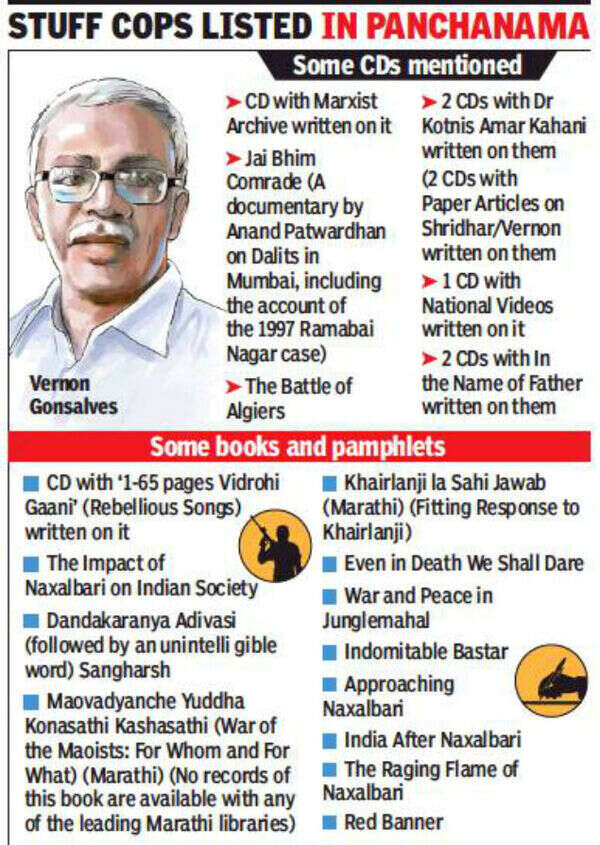
“You had asked what was seized from the house of Vernon Gonsalves. A panchanama was shown. On Page 10, War and Peace in Jungle Mahal was mentioned,” said Chaudhary to the Judge. The panchanama is a statement signed by independent witnesses at time of arrest, search and seizure.
Desai and additional public prosecutor Aruna Pai supported what Chaudhary submitted. Gonsalves and co-accused Arun Ferriera, the Pune police have alleged, were members of a “radical study group” and were engaged in recruiting cadres for banned terror organization CPI (Maoist).
Desai said, “None of these books are banned under Section 95 of Criminal Procedure Code.” The section empowers the state to forfeit any seditious or inflammatory book or document. He added the searches were carried out a year ago and if the books were found so inflammatory, at least subsequently the state could have banned them, but hadn’t. The search was on August 28, 2018. Besides, said Desai, about half these books “are available freely” on an online portal.
The counsel cited several SC judgments on two issues. One was to submit that being a “mere member of banned organisation is not enough” to secure custody. He has to be an active member and to have actually instigated violence, he argued. The other judgment he cited was the constitutional bench verdict on privacy to argue on sanctity of “freedom of thought and conscience” and submit that what a person reads in his own house is something the state should never interfere with.

About the Author
Swati DeshpandeEnd of Article
FOLLOW US ON SOCIAL MEDIA






Hot Picks
TOP TRENDING
Trending Stories
In City
Entire Website
- 'My father was on the flight': Jaishankar opens up about 1984 Air India hijack
- Airtel CEO Gopal Vittal sends letter to Reliance Jio, Vodafone-Idea, Tata Tele and BSNL CEOs; here's what he said
- Prince Harry to celebrate 40th birthday away from Meghan Markle
- Haitian immigrant pet-eating row: Ohio woman accused of eating cat is US citizen, video is not from Springfield
- Kejriwal out of jail; 'CBI arrest only to frustrate ED case bail': SC judge
- Donald Trump reveals what Laura Loomer is to his campaign: 'I don't control her'
- Hamster Kombat Daily Cipher Codes and Combo Cards for September 14, 2024: Unlock up to 1 million coins
- Laura Loomer's photo with Donald Trump viral. People ask where's Melania, where's wedding ring
- Garena Free Fire MAX redeem codes for September 13: Win in-game goodies and rewards
- Terrorist killed in encounter in J&K's Baramulla
- Troops disengaged in 4 areas, including Galwan valley: China
- Terrorist killed in encounter in J&K's Baramulla
- Why you should not be fooled by ‘20-year SIP crorepati’ dream
- Ind vs Pak: Famous encounters of storied hockey rivalry
- Tamil Nadu hotelier’s apology to FM over GST remark triggers row
- 'Water reached tomb of Shahjahan': Leaking from Taj Mahal's dome
- Will Germany’s suspension of Schengen entry end the Europe dream?
- Infosys founder Narayana Murthy: My wife's logic was ...
- Ind vs Pak: Why is India hot favourite for the ACT hockey match
- Fake police make woman lawyer strip on video call in Mumbai

Popular Categories
Hot on the Web
Top Trends
Moin KhanShreyas IyerWhere to Watch IND vs PAK Hockey MatchShannon Sharpes Net WorthVande MetroAadhaar Card UpdateTech LayoffsShannon SharpeUPSC Mains Admit CardKristina JoksimovicWay Chatgpt can be your Study PartnerAir Taxi IndiaAyushman Bharat SchemeKolkata Doctor Rape CaseDonald TrumpDiljit DosanjhLive Cricket Score
Trending Topics
Alia BhattMalaika Arora Father DeathArbaaz KhanNatasa StankovicMr Bachchan OTT ReleaseNational Parks In IndiaSelena GomezGOAT CollectionVikas Sethi DeathMalayalam ProducersIndia's Best Dancer 4Simi GarewalDilli BabuIndian National ParksLaung BenefitsVikas SethiApple iPhone 16SpaceXAadhar Card Update By Sept 14Wordle Answer
Living and entertainment
Latest News
Regina Cassandra calls herself a 'serial dater,' had many relationships :'But I’m taking a break now'Kaun Banega Crorepati 16: Can you guess the answer for this Rs 3,20,000 question on Navy, which contestant Naman Jain incorrectly answered?Exclusive - Has Palak Sindhwani aka Sonu from Taarak Mehta Ka Ooltah Chashmah breached her contract; Neela Film Productions to issue a legal notice to the actress?Mexico's president asks Sinaloa cartel to act 'responsibly' as violence escalates in the northKitchen Tips: How to elevate home cooking to Michelin levelFord drives into India for 3rd timePIL: Publicise laws, penalties to curb crimes against womenGrowth potential 7.5% or more: RBI governorHindus take to Bangladesh streets to stop attacks and demand justiceE-commerce speeds up to catch up with Quick commerce'Will take digital public infrastructure stack to 50 nations'Justin Timberlake faces DWI charges: Court-ordered apology, fine and community serviceTragic road accident on Mogili ghat road claims seven lives in Chittoor districtDonald Trump on another debate with Kamala Harris: 'Maybe, if I got in the right mood ... 'Sebi gives clean chit to NSE, ex-executives in co-location caseRusty or Ready? Falcons' Cousins Falls Flat in $180M NFL DebutEdible oil import duty hiked by 20%Lucky houseplants for each Zodiac, as per a renowned astrologer
Copyright © 2024 Bennett, Coleman & Co. Ltd. All rights reserved. For reprint rights: Times Syndication Service