
- News
- City News
- nagpur News
- ‘Introspection key to achieve spiritual goal’
Trending
This story is from July 7, 2017
‘Introspection key to achieve spiritual goal’
“Sadhana describes the process by which ultimate emancipation can be achieved. Different forms of meditation should be combined and merged into one and practised because there is no difference in their basic import, that of self and mind.
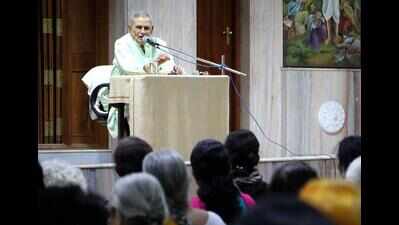
Scholar Shrikrishna Deshmukh deliveres a lecture on Brahmasutra at Ramkrishna Math, in Dhantoli, on Thursday
Delivering a lecture on ‘Brahmasutras’ at Ramkrishna Math, Dhantoli, Deshmukh explained the need for self-study, doing introspection on texts, meditation and the role of ‘sanyasa’ in pursuit of spiritual knowledge. He asserted that meditation is central to the Vedic texts and summarized its theories, from different shakha (Vedic schools) on “How a soul is enabled by meditation to obtain final release”. The last three ‘sutras’ of chapter 3 assert that a person, pursuing means to spiritual knowledge, should seek a childlike state of innocence, a psychological state that is free of anger, self-centredness, pride and arrogance.
The ‘Brahmasutras’ consist of 555 aphorisms or sutras in four chapters (adhyaya) with each chapter divided into four parts. Each part is further subdivided into sections called ‘adhikaraņas’ with ‘sutras’.
Swami Brahmasthananda, head of Ramkrishna Math, Nagpur, said, “Brahmasutras is one of the three most important texts in Vedanta along with the principal Upanishads and Bhagwad Gita. The text systematizes and summarizes the philosophical and spiritual ideas in the Upanishads. It is one of the foundational texts of the Vedanta school of Hindu philosophy. The most well-studied commentaries on ‘Brahmasutra’ include the ‘bhashya’ by Adi Sankara, Ramanuja, Madhvacharya, Bhaskara and many others.”
The swami said that ‘Brahmasutras’ is also known as the Vedanta which literally means the “final aim of the Vedas”.
End of Article
FOLLOW US ON SOCIAL MEDIA










Photostories

Hot Picks
TOP TRENDING
Popular Categories
Hot on the Web
Top Trends
CBSE Date Sheet 2025PM Modi Mann ki BaatLawrence Bishnoi BrotherPatrick MahomesIsrael Hezbollah Warillegal Indian ImmigrantsTaylor SwiftKamala HarrisDelhi Air PollutionMohammed ShamiVande Bharat SleeperUS Election 2024Actor Vijay RallyJaipur Chennai Indigo FlightMaharashtra Election ScheduleJharkhand Election ScheduleLive Cricket Score
Trending Topics
Diwali WishesDhanteras 2024Vettaiyan CollectionDhanteras 2024 Puja TimeDiljit Dosanjh ConcertDiwali Pooja TimingSatya NadellaVicky Vidya Ka Woh Wala Video CollectionSalman KhanJigra CollectionSurbhi JyotiSalman KhanPataudi PalaceActor Bala Wedding NewsKapil SharmaDiwali Bank HolidaysGoogle DoodleWordle Answer
Living and entertainment
Latest News
'Only 2 tons in last 5 years!': Aakash Chopra says Virat Kohli's form a concern but ...How Each Zodiac Sign Achieves Balance in LoveDavid Warner turns 38: A look at the Australian legend's stellar careerHow Each Zodiac Sign Celebrates FriendshipHyderabad teen beaten by principal & father for malpractice, dies by suicideRail minister Ashwini Vaishnaw too busy with bullet train, Mumbai passengers ignored: Sanjay Raut on Bandra stampedeNFL player and Taylor Swift's beau Travis Kelce joins Adam Sandler's ‘Happy Gilmore 2’ - ReportWhy Trump is holding a rally at Madison Square Garden despite New York being a long shot'I am surprised that...': Mohammad Amir blasts PCB for Fakhar Zaman omission'Indian players are best players of spin is merely a perception': AB de VilliersBandra stampede: Western Railways impose temporary restrictions on platform tickets saleTTD local temple and two more hotels receive fresh bomb threat via emailsEPL: Late Bowen penalty gives West Ham dramatic win over Manchester United5 killed, 12 injured in two seperate accidents in Madhya PradeshExploring the meanings behind Lamar Jackson’s tattoos as the quarterback shares rare glimpse of his full body tattooBaker Mayfield Net Worth 2024, current salary, and moreBTS' J- Hope pays heartfelt tribute to Shin Hae Chul at 10th memorial concert: 'Wonderful Senior Who Inspired' - WATCH VIDEOHow air pollution can trigger heart issues in young adults
Copyright © 2024 Bennett, Coleman & Co. Ltd. All rights reserved. For reprint rights: Times Syndication Service