
- News
- City News
- nagpur News
- 5.2 magnitude earthquake in Telangana sends tremors through Vidarbha, Nagpur
Trending
5.2 magnitude earthquake in Telangana sends tremors through Vidarbha, Nagpur
Reports of widespread tremors being felt in Gadchiroli, Chandrapur, Gondia, and Bhandara, apart from Nagpur in Vidarbha, surfaced later in the day. This is probably the first time after the 1997 Jabalpur earthquake that such intensity tremors rocked the region.
Nagpur collector Vipin Itankar told TOI that there was no need to panic and nothing major was reported in the district. "We are monitoring the situation," he said. Citizens from different corners felt the tremors and noticed articles and structures shaking in their vicinity after the earthquake in the neighbouring state. Panicked villagers in nearby rural parts came out of their homes after noticing the aftershocks. Social media was abuzz with news of the earthquake and created a lot of sensation.
"I felt something shaking in the flat and entire building," said a govt doctor from Jaripatka. Residents of Civil Lines, Mankapur, Anant Nagar, Jafar Nagar, as well as Kamptee, also posted on social media groups about their experience of the tremors. "I was getting ready for school when my tiffin started shaking," said a counsellor from Pension Nagar. A media professional recalled that the last time he felt such jerks in Nagpur was during the 1997 Jabalpur earthquake.
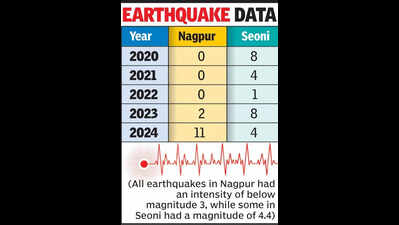
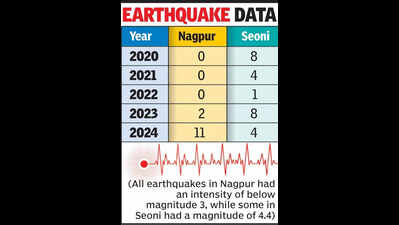
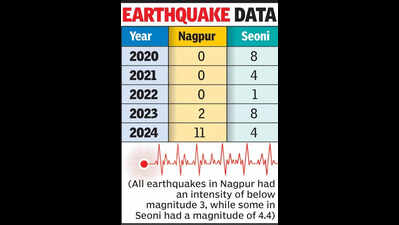
The Geological Survey of India (GSI), Central Region, Nagpur, conducted a comprehensive preliminary study of Nagpur district in June 2024 following a series of low-intensity earthquakes in May. The earthquakes measured less than 3 on the Richter scale in Nagpur.
No official recordings on the Richter scale were available for the Wednesday morning event in Nagpur, with the epicentre being Mulugu, officials said. In October, the region was rocked by an earthquake of 2.6 magnitude in Seoni, around 120km from Nagpur. Before that, Melghat in Amravati district was jolted by an earthquake of 4.2 magnitude on September 30. A study by GSI on the Melghat event is still underway.
In recent years, swarm activity has increased in the region and hit several places in and around Nagpur. A study by the Geological Survey of India is underway to find the causes of increased seismicity in the region. "As a part of preparedness for such a scenario, all civil structures must be made earthquake-safe, which can be achieved by following the guidelines prescribed by the ministry of home affairs (BIS Code: IS 1893 (Part 1):2002) for the construction of future civil structures in these areas," the GSI stated in its report to Nagpur district administration recently.
VNIT professor Yashwant Katpatal, who is dean (research and consultancy), said it is possible that the seismicity is due to the reactivation of faults, stress adjustment along them, or displacement of fault. He said shear zones are related to one another. "Ultimately, they are somewhere attached to the global tectonic system. Shear zones have a repeat or readjustment period. Depending on the type of rock, stress keeps accumulating over the years. This could be an area of 50km or more. The volume and type of rock, as well as the length of the fault, will decide the time taken for crustal adjustment. It may take 60 years or 100 years, which could be happening now," he said. Prof Katpatal ruled out any major risk from this crustal adjustment.
Stay updated with the latest news on Times of India. Don't miss daily games like Crossword, Sudoku, and Mini Crossword.
End of Article
FOLLOW US ON SOCIAL MEDIA










Photostories

Hot Picks
TOP TRENDING
Popular Categories
Hot on the Web
Top Trends
Bengaluru Techie SuicideIndia vs AustraliaCSJMU Admit CardTravis Hunter FianceRohit SharmaCISF Constable Fire Admit CardZomato GST Demand NoticeGautam GambhirVirat KohliIsha GuhaD GukeshBrisbane Weather UpdateNTA ApplicationUS CollegesAIBE 19 Admit CardWBCHSE Class 11 12 SyllabusJEE NEET QuestionsLive Cricket Score
Trending Topics
Pushpa 2 America Box Office CollectionPushpa 2 ReviewZakir Hussain Death NewsOptical illusionTaylor SwiftBaba VangaThe Christmas Chronicles 3Diabetes Type 2Weight LossIndia’s Got LatentTabla Maestro Zakir HussainShahid AfridiFull Cold Moon December 2024Skincare Tips for WinterWeight Loss TipsHair FallNYT ConnectionsNarayana MurthyElon Musk
Living and entertainment
Latest News
Kevin Owens and Cody Rhodes to Clash Again? WWE’s Next MoveIndia will be run by Ram's traditions, not Babur's: Yogi AdityanathIn a first, Indian services exports to outstrip goodsIconic 1971 war painting relocated, sparks rowPunjab sarpanch killed by 'pro-drugs' groupAfter NC, TMC too junks Congress' EVM chargesCompanies bring 'pet leave', 'live band days' for Gen Z staffAmbani and Adani drop out of $100 billion clubWon’t perform live in India till infrastructure is better: Diljit Dosanjh"Aaron Rodgers Unfiltered: ‘He doesn't give a s**t anymore, He's not Donald Trump’ Says Business Partner on Rodgers' Battle with Haters"Guilt-free winter snacks you can pair with teaUnBEATable Ustad: Taal of music falls silent with legend Zakir Hussain's deathWhat happens when you hold your pee for too long?Injury Crisis Continues for Detroit Lions: Montgomery’s Knee Injury Adds to Growing ListInstant Scholar: Niels Bohr's Nobel Lecture; revolutionising the understanding of atomic structureDhaka protests PM Modi's Victory Day social media postIzzy Nix’s Heartwarming Message as Broncos Edge Closer to Breaking 8-Year Playoff Drought—But Will Bo Nix Deliver?Kaun Banega Crorepati 16: Can you guess the answer for Rs 25 lakh question which contestant Dr. Anuja Tukaram Bandgar could not answer?
Copyright © 2024 Bennett, Coleman & Co. Ltd. All rights reserved. For reprint rights: Times Syndication Service