
- News
- City News
- mumbai News
- Amravati seeing an M-shaped curve: Expert
Trending
This story is from May 18, 2021
Amravati seeing an M-shaped curve: Expert
Amravati, which had less than 500 active cases on January 15, saw 3,090 cases by February 15—a 518% rise. By the end of February, the district had 6,600 active cases.
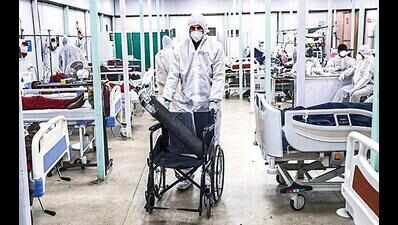
While cases are dipping in rest of the state, there’s a spike in Amravati
The state’s second wave started from this Vidarbha district that began to see a steady spike in mid-January.

Amravati, which had less than 500 active cases on January 15, saw 3,090 cases by February 15—a 518% rise. By the end of February, the district had 6,600 active cases.
As lockdown-like measures were introduced on February 22, cases started to climb down. By March 31, the active cases were down to 2,935. Within a month and despite the lockdown-like measures, cases started to rise again in mid-April. On April 15, it had 4,636 active cases, which touched 7,134 by the end of the month.
As on Monday, Amravati district had 10,205 active cases and 1,208 deaths.
Dr Chandrakant Lahariya, medical epidemiologist and health systems expert, called it the ‘M’ shaped curve. “Firstly, till a district’s positivity rate has come below 5%, we cannot say it is out of a wave. And, if a region starts witnessing a rise within an ongoing wave, it means measures on ground are not working,” he said.
Dr Shashank Joshi, member of the state Covid taskforce, said
mutations could be driving the high transmission in Amravati. The double mutation— E484Q and L452R, now classified as B 1.617, was detected in samples from Amravati as early as February. B1.617 was recently categorised as a variant of concern by the WHO. “Sub-lineages of the variant, B1.617.2, are also seen in Amravati samples,” he added.
A closer look at the transmission trend within the district shows Amravati Municipal Corporation was driving the January spurt, while the rest of the district, including its semi-urban and rural areas, pushed up the April numbers. On February 28, for instance, the corporation area had reported 632 new cases while the rest of the district had recorded 230 cases. The trend has completely reversed now. On May 15, for example, the corporation saw 219 detections, but the rest of the district contributed to 736 cases. State’s surveillance officer Dr Pradeep Awate called it a classic behaviour of the virus and not a third wave.
While a drift from urban to peri-urban and rural is common in other districts too, none of them have registered such a sharp rise after a drop.
“When all districts in Maharashtra, including Mumbai and Pune, were seeing a rise, we were seeing a decline. But when everyone is seeing a dip now, we continue to see an increase,” said district civic surgeon Dr Shyamsunder Nikam.
Within Amravati, Warud and other commercial towns like Achalpur and Morshi are contributing to most cases. District health officer Dr Dilip Ranmale said there is intermingling of people in these areas plus an influx from cities of Madhya Pradesh.

About the Author
Sumitra DebroyEnd of Article
FOLLOW US ON SOCIAL MEDIA










Photostories
Hot Picks
TOP TRENDING
Popular Categories
Hot on the Web
Top Trends
Exit Poll ResultsJ&K Election Exit Poll ResultHaryana Election Exit Poll ResultTravis KelceAUS vs SL Live ScoreWomen T20 World Cup ScenarioAmethi Murder CaseIsrael Iran WarJ&K Exit PollHulk HoganUGC NET ResultDiddyWomen's T20 World CupTop MBA Colleges of IndiaT20 WC ScheduleWomen T20 World Cup Points TableLive Cricket Score
Trending Topics
Bigg Boss 18 House PhotoNavratri Colours 2024Navratri Day 2 ColourTMKOC New SonuNaga ChaitanyaDevara CollectionGOAT OTT ReleaseRajinikanthDeepika PadukoneGovindaDevaraGovinda NewsDevara Movie ReviewHealthy RaitasSwatantrya Veer SavarkarColdplay India tour 2025Maa Durga 108 NamesNavratri JewellerySony Bravia 55 inch 4k Ultra HD TVWordle Answer
Living and entertainment
Latest News
India’s F&O addiction: Falling, hurting, bleeding but chasing that elusive pot of goldSnapshot of brutalityDRDO tests of man-portable air defence shield successfulWorld Meningitis Day 2024: What is meningitis, the deadly brain infection? Know signs and symptomsICC Women’s T20 World Cup India schedule: Key players, where to watch, match details, and other informationBlaze damages goods worth Rs 3L at Bambolim flat“With Davante Adams on the Verge of Departure, Raiders' Robert Spillane Promises Big Plays Ahead”Maryland Governor Makes Bold Pitch for Raiders' $140M All-Pro: Could Davante Adams Join the Ravens?Kareena Kapoor, Soha Ali Khan, Kunal Kemmu and others have a blast at Neha Dhupia's son Guriq's birthday bash - See INSIDE photosAmid China's muscle-flexing, Malabar drill to start on October 86,000 Dasara dolls bring underwater city of Dwarka to life in BasavanagudiWWE Bad Blood 2024 Betting Odds: Dominik Mysterio favored to escape shark cage, Punk and McIntyre favored to bleed, and moreBigg Boss Tamil 8: Sunitha Gogoi to dazzle with dance performance from Vijay’s film 'GOAT'IIT-JEE aspirant dies by suicide after jumping from 8th floor of high-rise in LucknowKorean cult-horror series 'Hellbound' returns at BIFFTripura court serves notice to a police officer on cash looting chargeYeh Rishta Kya Kehlata Hai: Ruhi Discovers Abhira’s True Identity, Family Feud IntensifiesRecord 41 companies files for IPOs in September
Copyright © 2024 Bennett, Coleman & Co. Ltd. All rights reserved. For reprint rights: Times Syndication Service