
- News
- City News
- mumbai News
- High on rock, he wanted to be a DJ... until Beethoven beckoned
Trending
This story is from September 26, 2017
High on rock, he wanted to be a DJ... until Beethoven beckoned
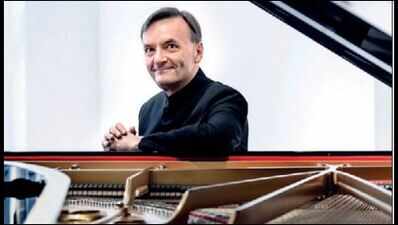
Stephen Hough, who is also a composer, writer, poet, painter, teacher, blogger, newspaper columnist and perhaps wearer of a few secret hats.

A: Well, I think there are certain lev els of commitment of time. My principal commitment is playing the piano. But I always loved words. Even at five or six I loved writing. Composing is something I just do, as in the past it always came out of playing.People who were composers were also performers and (vice versa). Obviously we think of someone like Liszt, but there was also Mendelssohn.This idea that there is a separation between composers and performers is really since WWII. So, composing is something I've been doing. Painting is just a hobby . I really don't think of it much more than that. But writing music and writing words... my life would feel as if it had a big hole if I took those away . This last week I've been very much concerned because my novel is going to be published next year. So, I've been working this week with the publisher.
Q:What is this novel about?
A: It's in the form of a diary of a priest on a retreat, talking about how he has lost his faith. He's depressed. He's been blackmailed by a prostitute. So, basically his life is at an end.He feels like he hasn't a thing worth living for. So, the whole book is trying to create how he feels really , his mood through his memories.
Q:You hit a rough patch in your teens.
A: I was stressed at school. I was like 12. I wouldn't call it a nervous breakdown, but it was something along those lines. I didn't do well in those final years in school until I went to (conservatory). I listened all the time to rock music. I wanted to be a disc jockey . And I was watching so much television, maybe six hours a day .I have tried to make up for it since, but it was a lot of wasted time.
Q:What are you reading now?
A: I'm just finishing a history of the Reformation. It's a huge book by a Yale professor called Carlos Eire.Then there are two books I was reading on the plane yesterday (Sunday).One by Josh Sparrow, a journalist in London. He took 10 or 12 second-hand books he owned and traced the people who had owned them before. So it's his story, the stories of the (previous owners), and also what the books were about. And then I'm reading a book on empathy . By someone who was the head of I think the British Arts Council. It is on how important empathy is for human life and indeed how the arts can help us empathise.
Q:Are you seriously carrying all these heavy books with you?
A: No! I read on this thing (points to his 5.5-inch smartphone).
Q:Do concerts have a larger meaning?
A: Some people like to make political statements out of concerts. But for me, a concert means that for two hours all of us from every political and religious background can actually be united in some way in the music, even if we would be fighting with each other outside the concert hall.
Q: Then what do you say of Beethoven's music? Isn't that intensely political, with all its references to the French Revolution, to `liberty, equality, fraternity'?
A: Yes, he was political, but he was broad. He wasn't sort of a party man.He was just very intoxicated, as with many people, with the idea of the rights of man, of equality of human beings. It also depends on the time.Maybe there are times in history where we have to be a bit more outspoken. Like in Nazi Germany or Apartheid South Africa. The French Revolution, of course, was one of those moments in human history . It was a real dividing line. It was the first time that the idea of an aristocracy being always on top and always in charge was challenged.
Q:How do you reconcile your gay identity with your Catholic faith, to which you converted in your late teens?
A: Our understanding of homosexuality has increased in the last 10 years through research, through work on animals. From a Catholic point of view, where the belief is that creation is something good, if something is in Nature, it can't be inherently bad. No species is absolutely clean. There are always deviations.
Q: What's the need for coattails and other paraphernalia in concerts?
A: A concert is like theatre. It's a change of gear for the audience and for the person on stage. There is a ceremonial aspect to human life which is very important. We create these rituals around our lives, for all sorts of reasons, good reasons, not just out of habit. And I am just not convinced that coming on to the stage wearing an old pair of jeans is really going to make more people want to come. I don't think that argument has been won. Of course, I'm not dogmatic about it; I'm just not convinced that making things easy makes them attractive.
End of Article
FOLLOW US ON SOCIAL MEDIA




Photostories

Hot Picks
TOP TRENDING
Popular Categories
Hot on the Web
Top Trends
PAK vs NZ Live ScoreNigeria Football Team LibyaUGC NET ResultIsrael Hezbollah WarGautam GambhirBaba Siddique NewsRussell WilsonsBahraich ViolenceSarfaraz KhanGen AI Shift ImpactsAmazon LayoffsPM Internship SchemeNEET PG Counselling ScheduleMayank YadavTamil Nadu Board Exam Time TableN ChandrasekaranLive Cricket Score
Trending Topics
Diwali WishesAtul ParchureBaba SiddiqueShraddha KapoorVettaiyan CollectionVettaiyan ReviewNatasa StankovicDevara CollectionBigg Boss 18Deepika PadukoneShraddha KapoorRatan Tata Passed AwayJigra Movie ReviewVettaiyan Movie ReviewSwatantrya Veer SavarkarDussehra 2024Star Health Hacker DemandedViral MemesUltimate Football Codes October 2024Wordle Answer
Living and entertainment
Latest News
Zodiac Signs Who Are Easily HurtUPSC Releases EPFO 2024 Interview Schedule: Dates from November 4 to December 6PCB defends decision to drop Babar Azam, Shaheen Afridi, Naseem ShahMini setback for Season 1 of women's Hockey India League, four teams instead of sixFormer Maharashtra CM Uddhav Thackeray admitted to HN Reliance HospitalInfosys to no longer send job offer letters and attachments, the company will ...Happy Dev Diwali 2023: Best Wishes, Images, Status, Quotes, Messages, Facebook and WhatsApp Greetings to Share on Dev DeepawaliZodiac Signs Who Love Too HardChina September soybean imports surge to near record 11.37 million tonsMithun Chakraborty REVEALS he never asked anybody to give work to his kids in BollywoodWhat Are Square Aspects in Astrology?Reliance Jio reaches this milestone in less than two years of 5G launch30 detained, internet shutdown after massive violence erupts in UP's Bahraich'Trump doesn’t care about anyone but himself’: Supporters left stranded in 93°F heat after rallyPapankusha Ekadashi 2024: Date, Parana Time, Puja Rituals and SignificanceBattling accomplished Ashwin, Jadeja crucial for New Zealand: Rachin RavindraWinners of The Times Hospitality Icons- Ludhiana 2024, 1st EditionPannun case: Indian inquiry team to reach US on Oct 15 to probe 'foiled plot'
Copyright © 2024 Bennett, Coleman & Co. Ltd. All rights reserved. For reprint rights: Times Syndication Service