
- News
- City News
- lucknow News
- Lucknow monument stands on Taj Mahal like foundation
Trending
This story is from March 22, 2016
Lucknow monument stands on Taj Mahal like foundation
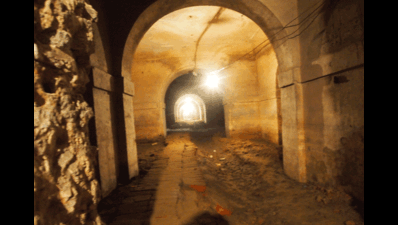
TOI photo by Shailvee Sharda.
Archaeologists and conservation architects are aware that the has been used to built the Taj as well.

State culture department and other authorities are oblivious about the fact. Project manager from UP Rajkiye Nirman Nigam for Chhatar Manzil Sandeep Kumar Singh said, "certain wooden planks have surfaced but we are yet to decode their importance."
The message is yet to be communicated officially. "State Archaeology Directorate is yet to receive any information from the agency," an officer said. Insiders revealed that the news of wooden planks inside Chhatar Manzil basement spread like a fire and it compelled certain inquisitive officials to visit the spot.
"These are indigenous sal wood beams and it appears that the building rests on a network of wooden beams like the Taj Mahal," confided one of them adding, "it appears that the vertical beams were also used to measure the water level of the Gomti in case of floods."
Faculty, architectural conservation, School of Planning and Architecture, Delhi who is working on several research papers on Chhatar Manzil said that use of wood in construction of the palace was no surprise. "It was customary to use wood in the foundation if a building was being raised on river bank. While the Taj rests on the Yamuna, Chhatar Manzil Palace is along the Gomti," she shared.
Historians in Lucknow who have extensively studied Chhattar Manzil Palace are also excited. Raushan Taqui, who book on architectural importance of Nawabi monuments is in print, said: "As a child, I had learnt that the building rests on a wooden structure. But we never believed in it thinking how can a five floor building rest on wooden planks. As a student and researcher, i tried gathering evidences for the same. Finally, the story is a fact," he shared.
Different authors on Lucknow have noted the story of Chhattar Manzil. One of them, Ravi Bhatt shared that the journey of the palace began with what is known as the Kothi Farhat Baksha - a summer home built by French army officer and architect Claude Martin. Nawab Saadat Ali Khan bought this grand piece of architecture 200 years ago for Rs 50,000 from Claude Martin.
Not meant for public eyes, Saadat Ali Khan commissioned the construction of an extension, which is now Chhattar Manzil. From then, it became the principal residence of the Avadh sovereign. Nawab Saadat Ali Khan died before the completion of the construction of Chhatar Manzil and it was completed by his successor Nawab Ghazi-ud-din Haidar.
After the war of independence in 1857, the British acquired the palace and turned it into the United Services Club — stripping much of its former grandeur. After Independence, it was taken over by the government and on February 17, 1951, then-Prime Minister Jawaharlal Nehru inaugurated the Council for Scientific and Industrial Research (CSIR) here to start the first drug research laboratory in the country.
Now that it has been handed over to the state archaeological department, the doors of Farhat Baksh Kothi and Chhatar Manzil will be opened to public for the first time in history.

About the Author
Shailvee ShardaEnd of Article
FOLLOW US ON SOCIAL MEDIA








Photostories
Hot Picks
TOP TRENDING
Popular Categories
Hot on the Web
Top Trends
IND vs NZ Live ScoreBengaluru Collages Bomb ThreatSteve SmithNEET PG SC HearingMohammad KaifShailaja PaikHaryana Election ResultUGC NET ResultRishabh PantNima Hospital Doctor MurderTaylor SwiftThe RockWomen's T20 World CupTop MBA Colleges of IndiaT20 WC ScheduleWomen T20 World Cup Points TableLive Cricket Score
Trending Topics
Samantha Ruth PrabhuNavratri Colours 2024Navratri Day 2 ColourTMKOC New SonuNaga ChaitanyaDevara CollectionGOAT OTT ReleaseRajinikanthDeepika PadukoneGovindaDevaraGovinda NewsDevara Movie ReviewHealthy RaitasSwatantrya Veer SavarkarColdplay India tour 2025Maa Durga 108 NamesNavratri JewellerySony Bravia 55 inch 4k Ultra HD TVWordle Answer
Living and entertainment
Latest News
Kolkata’s Ganga ghats transform into a hub of rituals with the arrival of DurgaNavratri Will Be Luckiest for These Signs5 corporate employees share their workplace horror storiesNeelam Kothari speaks out against ageism says 'aunties' label is uncoolJr NTR-Hrithik Roshan dance-off in 'War 2' set to be shot during THIS timeYouTube Shorts extends duration to 3 minutesWill join NCP (SP) with supporters, says BJP leader Harshvardhan Patil'Was screaming, hitting him': 5-year-old Florida boy suffers cardiac arrest on Disney rollercoaster ride'We spoke about it and ...': What Trump said on wife Melania backing abortion rights in new memoirTDP welcomes SC's ruling on SIT to probe Tirupati laddu adulterationJannik Sinner not 'comfortable' as doping case clouds Shanghai campaignKolkata shoppers flood markets ahead of Durga Puja weekend rushCongress leader urges West Bengal governor to act against politicians for polarizing votersTwo Indian-Americans among 15 selected for prestigious 2024-2025 White House fellowshipWWE Throwback: Shawn Michaels retires with a heartfelt speech after losing the “Career vs Streak” matchSupreme Court dismisses pleas seeking review of sub-classifications in SC reservation judgmentCoin Master free spins and coins for 4 October, 2024: Earn million of coins using today’s link'Disappointing, condemnable but not ... ': India on fugitive Zakir Naik's Pakistan visit
Copyright © 2024 Bennett, Coleman & Co. Ltd. All rights reserved. For reprint rights: Times Syndication Service