
- News
- City News
- kolkata News
- Solar halo adds buzz to peaceful poll day
Trending
This story is from May 1, 2016
Solar halo adds buzz to peaceful poll day
The action on Saturday was supposed to be on the ground, at the poll booths.But it was the sky that grabbed all the attention around noon when a halo wreathed the sun, mesmerizing voters and party workers alike. In reality, it was an atmospheric condition that led to the solar halo.
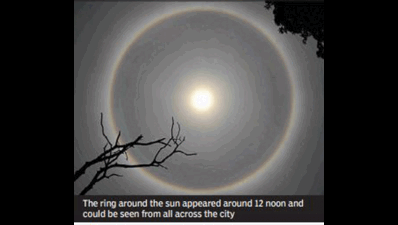
The action on Saturday was supposed to be on the ground, at the poll booths.But it was the sky that grabbed all the attention around noon when a halo wreathed the sun, mesmerizing voters and party workers alike. In reality, it was an atmospheric condition that led to the solar halo.

News about the large ring around the sun spread like wildfire on social media, prompting everyone to gaze skyward. Even polling personnel took a break and stepped out of the booths to look upwards. The chatter on social media revolved around the appearance of the phenomenon on the very day star candidates, led by chief minister Mamata Banerjee, went to poll.
In reality, it was an atmospheric condition that led to the solar halo. As National Council of Science Museums physics curator Kanchan Choudhuri explained, the optical phenomenon is called the 22° halo and forms around the sun, and occasionally the moon, due to refraction of sunlight as it passes through hexagonal ice crystals in the atmosphere.
"Around this time of the year, when temperature and humidity are high, thin cirrus clouds are formed. When they drift up to an altitude of around 20,000 feet above the earth's surface, the water vapour in the clouds freezes to form of tiny crystals of 20.5 micro-meter diameter. These crystals act as prisms when sunlight passes through them, refracting the light twice - once at the point of entry and again at the exit. The deviation is 22° and hence, the name. At times, the inner edge of the circle takes a reddish tinge and the outer a bluish hue," he said, adding that usually, the 22° halo is followed by rain.
GC Debnath, the deputy director general of the Regional Meteorological Centre, Kolkata, said rain was indeed expected in the next couple of days.
"The heatwave will abate. From Tuesday, half of south Bengal will receive rainfall. We expect the conditions to favour Nor'westers," he said.
The city and rest of the state has witnessed only two Nor'westers in March, but none in April, mirroring what had happened in 2014. "Usually, there are three to four Nor'westers in April, but there have been none this year. We expect that situation to change. There should be about six to seven of them in May," Debnath added.
End of Article
FOLLOW US ON SOCIAL MEDIA









Photostories

Hot Picks
TOP TRENDING
Popular Categories
Hot on the Web
Top Trends
IND vs BAN Live ScoreNEET UG CounsellingDolly ChaiwalaKamindu MendisDU ElectionIsrael StrikesRavichandran AshwinHigh Paying Freelance JobsElon Musk Dating MeloniUS FDAKerala Lottery ResultsRohit SharmaTamil Nadu NEET UG CounsellingWho is Dominik Mysterios WifeChina SubmarineIsrael Hezbollah WarLive Cricket Score
Trending Topics
Devara ReviewNavya Naveli NandaPawan KalyanJungle SafariStree 2 OTT ReleaseRose GardenDevara CollectionOTT Release MovieMasala OmeletteEmergencyDevaraTaaza Khabar 2 Twitter ReviewDevara Movie ReviewHealthy RaitasSwatantrya Veer SavarkarColdplay India tour 2025Best Branded HandbagsApple Macbook Air M1Amazon SaleWordle Answer
Living and entertainment
Latest News
Archana Puran Singh opens up on turning down multiple film offers for ‘The Kapil Sharma Show’Seasonal Rituals According to the Zodiac CalendarJr NTR's 'Devara' takes over USA; fans garland actor's photoFirst person died in UK from ‘liquid’ Brazilian butt lift: All you need to know about liquid BBL and risks it posesNayanthara and Vignesh Shivan share emotional notes on their twins Ulag and Uyir's second birthdayPressure Cooker: How Hypertension Can Lead to Heart FailureWeight loss and more: 5 reasons to eat soaked methi seeds every morningBad Boy electric trike unveiled in India: F1-inspired cockpit, 400 km range and more!Best Watches Under 5000: Stylish Picks For Everyone'Attempt to defame my govt': Kerala CM Vijayan rejects allegations of independent MLA P V AnvarIlaiyaraaja thanks Tamil Nadu CM MK Stalin for naming a street after his late friend SPBBig Story -Has Kollywood lost its plot?Did Vincent van Gogh’s paintings have a connection with Bihar? Research says yes!Bangladeshi fan hospitalised after 'falling ill' in Green Park stands; Police denies assault speculationTirupati Laddu row: Police likely to serve notices to ex-CM Jagan Mohan Reddy ahead of his Tirumala temple visitIndian economy projected to grow 6.5-7% in FY 2024-25: Chief economic advisor NageswaranCong, PDP & NC 'sinners' for encouraging terrorism in J&K: UP CM Yogi Adityanath'Demons in power': Jagan Reddy cancels Tirumala temple visit amid Tirupati laddu row, says 'denied permission'
Copyright © 2024 Bennett, Coleman & Co. Ltd. All rights reserved. For reprint rights: Times Syndication Service