
- News
- City News
- kolkata News
- Kolkata: Heritage & conservation tips for kids at South Park Street Cemetery
Trending
This story is from November 20, 2022
Kolkata: Heritage & conservation tips for kids at South Park Street Cemetery
The Christian Burial Board (CBB), the official custodian of the South Park Street Cemetery, organised an interaction with students of a school that is just across the street on Saturday to sensitize young minds about heritage and conservation.
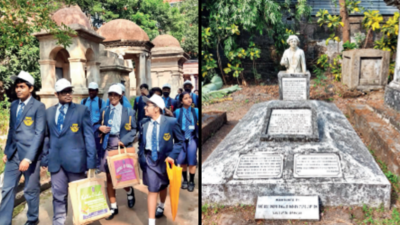
Students during the cemetery visit; The tomb of Henry Louis Vivian Derozio
The cemetery is considered the world’s ninth most beautiful cemetery and a national treasure.
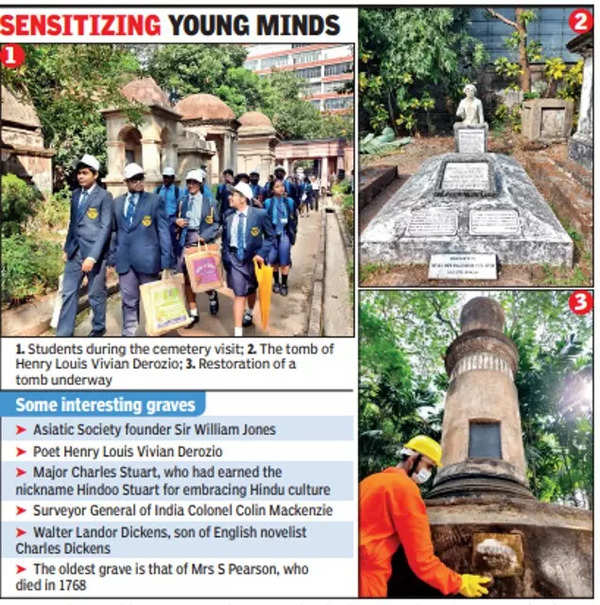
Set up in 1767, the South Park Street Cemetery that was restored from ruins with support from UK-based British Association for Cemeteries in South Asia in 1981, has 1,600 vaults with tombs on top exhibiting architecture styles that encompass several civilizations spanning 3,500 years.

“There is perhaps no other public colonial cemetery (not controlled by any church) of this variety and dimension anywhere else in the world,” CBB honorary executive member Ranajoy Bose told students of Assembly of God Church School, which had been built where the North Park Street Cemetery stood. Students of several other schools will be invited to experience the cemetery over the next week.
After a guided tour of the cemetery by former director (science) of Archaeological Survey of India, Surajit Maiti, former ASI deputy superintending archaeological engineer Tapan Bhattacharya explained the challenges in maintaining the tombs and demonstrated how they are restored.
“Growth of wild vegetation and large trees adjacent to the tombs cause damp and penetration of roots into the core of the structures. The resultant cracks at various levels of the structure lead to dislocation of their original alignments. Long exposure to rain and water causes salinization of the bricks. Unscientific repairs carried out earlier with materials that are not compatible also caused damage to the tombs,” Bhattacharya pointed out.
To restore the tombs, one has to remove dead mortars and cement coatings from the surface, provide plinth protection with brick work, and undertake water-tightening measures with soluble solvents. Cracks and voids need to be repaired with grouting using lime-mortar.
“Underpinning brick work to the damaged walls is important as is filleting of bulged-out portions to their original alignment,” he said.
The students of classes IX to XII also learnt about structural and curative restoration. While the former is about the use of compatible material and grouting, the latter involves use of chemicals to clean the surface, desalinate, offer protection from damp and fungus and application of preservatives.
Atrija Gupta of Class IX and Sayan Das of Class X who had been to the cemetery before, learned a lot more about its history and heritage. Class XII student Rooprekha Banerjee who had stepped into South Park Street Cemetery for the first time found the experience fascinating. “I now realise why it is important to maintain and preserve places like these that add so much to our city’s character and history,” she remarked.

About the Author
Subhro NiyogiEnd of Article
FOLLOW US ON SOCIAL MEDIA










Photostories
Hot Picks
TOP TRENDING
Popular Categories
Hot on the Web
Top Trends
IND vs NZ Live ScoreBengaluru Collages Bomb ThreatSteve SmithNEET PG SC HearingMohammad KaifShailaja PaikHaryana Election ResultUGC NET ResultRishabh PantNima Hospital Doctor MurderTaylor SwiftThe RockWomen's T20 World CupTop MBA Colleges of IndiaT20 WC ScheduleWomen T20 World Cup Points TableLive Cricket Score
Trending Topics
Samantha Ruth PrabhuNavratri Colours 2024Navratri Day 2 ColourTMKOC New SonuNaga ChaitanyaDevara CollectionGOAT OTT ReleaseRajinikanthDeepika PadukoneGovindaDevaraGovinda NewsDevara Movie ReviewHealthy RaitasSwatantrya Veer SavarkarColdplay India tour 2025Maa Durga 108 NamesNavratri JewellerySony Bravia 55 inch 4k Ultra HD TVWordle Answer
Living and entertainment
Latest News
Kolkata’s Ganga ghats transform into a hub of rituals with the arrival of DurgaNavratri Will Be Luckiest for These Signs5 corporate employees share their workplace horror storiesNeelam Kothari speaks out against ageism says 'aunties' label is uncoolJr NTR-Hrithik Roshan dance-off in 'War 2' set to be shot during THIS timeYouTube Shorts extends duration to 3 minutesWill join NCP (SP) with supporters, says BJP leader Harshvardhan Patil'Was screaming, hitting him': 5-year-old Florida boy suffers cardiac arrest on Disney rollercoaster ride'We spoke about it and ...': What Trump said on wife Melania backing abortion rights in new memoirTDP welcomes SC's ruling on SIT to probe Tirupati laddu adulterationJannik Sinner not 'comfortable' as doping case clouds Shanghai campaignKolkata shoppers flood markets ahead of Durga Puja weekend rushCongress leader urges West Bengal governor to act against politicians for polarizing votersTwo Indian-Americans among 15 selected for prestigious 2024-2025 White House fellowshipWWE Throwback: Shawn Michaels retires with a heartfelt speech after losing the “Career vs Streak” matchSupreme Court dismisses pleas seeking review of sub-classifications in SC reservation judgmentCoin Master free spins and coins for 4 October, 2024: Earn million of coins using today’s link'Disappointing, condemnable but not ... ': India on fugitive Zakir Naik's Pakistan visit
Copyright © 2024 Bennett, Coleman & Co. Ltd. All rights reserved. For reprint rights: Times Syndication Service