
- News
- City News
- kolkata News
- Filmmaker uses Hitler footage to 'depict present political climate'
Trending
This story is from July 4, 2018
Filmmaker uses Hitler footage to 'depict present political climate'
A Bengali political film starring Soumitra Chatterjee is using footage of Hitler to show the rise of fascism in this country. Saibal Mitra’s film titled "Tokhon Kuasa Chhilo" is a modern-day interpretation of Syed Mustafa Siraj’s story by the same name.
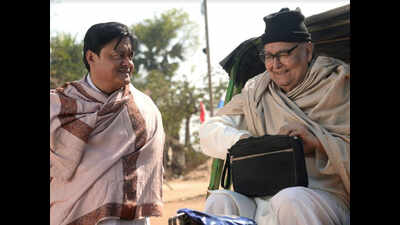
Soumitra Chatterjee and Saswata Chatterjee in a still from "Tokhon Kuasa Chhilo"
In the garb of a love story, the film depicts how people in positions of power intrude into the daily lives of common men and even thrust their decisions on matters related to the heart.

"Tokhon Kuasa Chhilo" is based on the life of a village school teacher played by Soumitra Chatterjee. He has two students - played by Saswata Chatterjee and Barun Chakraborty. While Barun becomes a henchman of a political party, a one-time cadre of a Leftist political outfit played by Saswata withdraws to lead a life of an unemployed youth. Barun forcefully offers to marry Soumitra’s grand daughter played by Basabdutta Chatterjee. Soumitra tries to rescue her and seeks help from everyone. When no one rises to the occasion, he asks Saswata to marry her. Conflict between two political parties takes centre stage after that.
Incidentally, this is the first time that a Bengali film is using a footage of Hitler. Mitra has sourced the footage from the Net. On being asked to explain the Hitler connection, the director said, “My film is a commentary on the contemporary political climate in India where anyone in a position of power expects unconditional loyalty. I thought it was best to use footage of Hitler to cinematically express this totalitarian and fascist attitude.”
Footage of Hitler marching and giving speeches have been used as montage shots while Soumitra and Basabdatta Chatterjee lip-sync to Tagore’s “Andhar raate ekla pagol”. “The lyrics suggest that Tagore was perhaps apprehending a dark age in world politics. I wanted this Tagore song to be used to highlight a similar atmosphere in the Indian context,” Mitra said.
According to music director Pt Tejendra Narayan Majumdar, it was through Mitra’s research on Tagore that he came to know that the song was penned when Mussolini was ruling Italy. “Mussolini is considered a central figure in the creation of fascism and was a close ally of Hitler during World War II. I used this song in a scene involving two panic-stricken protagonists who sit inside their house while political parties – all trying to dictate and control the lives of others - create a rampage outside. Legendary singer Kanika Banerjee’s niece Ranjini Mukherjee and visually-impaired singer Swapan Gupta have sung this Tagore song,” Majumdar said.
The director, however, is clear that his film isn’t targeting any particular party per se. “Power is very democratic in its influence on leaders. It corrupts people across party lines. That’s the inherent message of my film,” Mitra signed off.

About the Author
Priyanka DasguptaEnd of Article
FOLLOW US ON SOCIAL MEDIA










Hot Picks
TOP TRENDING
Trending Stories
In City
Entire Website
- GK for students: 7 Fascinating Features of These Unique Birds
- 'Wearing undergarments must but...': Delta's 'specific' memo for flight attendants
- We're 'disturbed' by findings of CBI's RG Kar report: SC
- What are pagers? Devices that led to wave of blasts in Lebanon
- Fired techie who worked as Swiggy delivery partner shares his 'survival story' on LinkedIn, post goes viral
- India Post GDS Result 2024: Merit list 2 released for all regions, state-wise direct links to check
- Traffic Police announce road restrictions for Eid on Wednesday
- Melania Trump spotted in New York, Eric had to walk for stepmother's enhanced security
- Diddy and Donald's photo viral as Sean charged with sex trafficking: 'Why all Trump's friends...'
- NPS Vatsalya: FM Nirmala Sitharaman launches National Pension Scheme variant for children; check details
- Hezbollah's walkie-talkies, home solar systems explode killing 14; Israel declares 'new phase' of war
- US Federal Reserve cuts interest rates by 50 bps in key FOMC meet chaired by Jerome Powell
- Why Bengal doctors aren't going back to work after talks with Mamata
- Video: Moment walkie-talkies exploded across Lebanon during funeral
- 'One nation, one election': How Lok Sabha and assembly polls could be synchronised
- Exclusive: 'Bangladesh played very well in Pakistan, but India…'
- Does India wish to disappear like Indus valley civilisation once did?
- Fired techie shares his 'survival story' on LinkedIn, post viral
- Top-notch drone goes down off Chennai ahead of mega US deal
- Citing cross-border terrorism, India seeks Indus treaty review

Popular Categories
Hot on the Web
Top Trends
Oleksandr UsykIndia Fastest Metro ServiceVince McMahonNPS VatsalyaDonald TrumpKolkata Doctor Rape CaseShreyas IyerTaiwan PagersGautam Gambhir Press ConferenceUGC Net ResultVirat KohliSukanya Samriddhi YojanaIsrael Hezbollah WarNEET UG Admission CriteriaPager Attack in LebanonArvind KejriwalLive Cricket Score
Trending Topics
Diljit DosanjhsJatt Juliet 3 OTT ReleaseAbdu RozikKhatron Ke Khiladi 14Chinas EggBigg Boss 18Sunita AhujaGoat CollectionLebanon Pager BlastPitra Paksha 2024CheetahsKangana RanautAditi Rao HydariDalljiet KaurHoliday DestinationVikas SethiBest Selling Earbuds Under 1000Apple iPhone 16 ProVirat KohliWordle Answer
Living and entertainment
Latest News
Zilla Fatu Reacts to Armando Estrada's Contract Signing with WWEChandrayaan-4, Venus Mission, New-Gen Rocket, Space Station get Cabinet nod, Gaganyaan budget doubles to Rs 20,000 croreUniversity of Texas at Austin and Stanford University: Which Offers a Better Petroleum Engineering Degree?Former WWE star addresses potential heel turn in AEWThe man who wants to 'cancel' Adani from Sri LankaSuriya to play the antagonist in 'Dhoom 4', here's what we knowAmazon India appoints new country headBigg Boss Tamil 8: Actress Sachana Namidass to participate in the upcoming season?Jr NTR's 'Devara: Part 1' to have early morning showsGrieving mom's heart-wrenching letter blames toxic culture for daughter’s deathWhat is a walkie talkie that was used as a bomb in Lebanon against Ricky Ponting is new Punjab Kings head coachWorld is moving into Indian era: Salesforce chairmanElon Musk's Neuralink gets FDA's 'breakthrough device' tag for thisFour lakh people visit Madurai Book Fair; books worth Rs 3.5 crore soldI am looking at finite projects: Prachee Shah PaandyaEU court reduces Qualcomm's antitrust fine but why the US chipmaker is penalisedEx-India cricketer warns against overloading Rishabh Pant after long hiatus post major car accident
Copyright © 2024 Bennett, Coleman & Co. Ltd. All rights reserved. For reprint rights: Times Syndication Service