
- News
- City News
- kochi News
- Djinn & tonic
Trending
This story is from October 9, 2021
Djinn & tonic
The one thing that strikes you on reading the Tanzanian writer Abdulrazak Gurnah -- from some of his earliest short stories like “The Retaining Wall” that appeared in Granta in the nineties to “Afterlives”, his 2020 novel -- is the “Englishness”. Not just the prose style, which is conspicuously formal, but also the sensibility, which seems to be always on the cusp of claustrophobia.
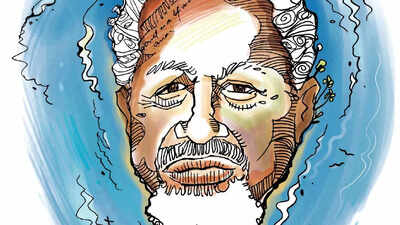
Gurnah has won the 2021 Nobel for literature, and the awards committee in its citation, spoke of his “uncompromising and compassionate penetration of the effects of colonialism and the fate of the refugee”.

To be sure, most of his characters inhabit a half-way house between identities. Take Khalifa Qassim in “Afterlives”, for instance, a third-generation Gujarati in Zanzibar during the early 20th century, who doesn’t really fit in with the influential Indian community there because he looks more like his Black African mother. Unlike Saleh Omar in “By The Sea”, Gurnah's 2001 novel, Khalifa is not a refugee, but both are deeply divided souls. “I am a refugee, an asylum-seeker; these are not simple words, even if the habit of hearing them makes them seem so”, Saleh says at the beginning of the novel and Gurnah’s story goes on to show how complex and fraught these words can be.
Most of Gurnah’s stories are set at the crossroads of a plethora of imaginary worlds— Arab, British, Indian, Persian and, of course, East African (specifically Zanzibar, in Arabic, “the country of the blacks”) -- all of them to varying degrees a mix of modern aspirations and ancient prejudices. There is obviously a lot of colour, a lot that is exotic, especially to Western eyes, and this aspect of Gurnah’s work, already highlighted in the Anglo Saxon world, will get even more exaggerated following his Nobel recognition. Consider this unalloyed praise by a critic reviewing “By The Sea”: “We are the Sultan before Scheherazade asking for more stories, like a vital need, a question of life and death. A sudden change in the course of the narrative brings in new characters, multiplying suddenly and with bravado performance the perspectives of the original story....Each character could become a character in her own tale, a contemporary “Arabian Nights” rendered post-exotic by its political relevance in modern times”. Partly true, but such views also miss the point of Gurnah’s real legacy, which is to debunk Orientalist constructions of former colonies of the current global south and east.
The evidence of this is Gurnah’s prose and it seems an anomaly at first -- how, it is always so well groomed, never casual or outlandish, as consciously “regulation style” as the land he took refuge in after leaving his native Zanzibar at the age of 18. Gurnah’s subversion lies in what his prose is eventually employed for -- a mind holding a distorting mirror to itself, catching it in the most unflattering angles, exposing how premeditated we mostly are, revelations that come from a certain asymmetry and, last but not least, the prevailing leitmotif that nothing is unworthy of our attention.
There is a Naipaul-like, or even Hemingwaylike, insistence on banal details in Gurnah’s stories as though he is establishing familiar landmarks on a map, not because a surprise snowstorm may erase them but because one’s bearings, like one’s place in the world, should not be forgotten. Along with the external problems that refugees face -- housing, jobs or rather their lack, racism, scorn etc -- that Gurnah describes memorably, his actual focus is on how the refugee experience (exile in fact) profoundly rearranges what goes on in their minds. As Saleh Omar explains his attempt to reconcile what he has left behind and what he must adapt to: “I marvel how the hours of darkness have come to be so precious to me, how night silences have turned out so full of mumbles and whispers when before they had been so terrifyingly still, so tense with the uncanny noiselessness that hovered above words”.
End of Article
FOLLOW US ON SOCIAL MEDIA










Photostories

Hot Picks
TOP TRENDING
Popular Categories
Hot on the Web
Top Trends
IND vs BAN Live ScoreNEET UG CounsellingDolly ChaiwalaKamindu MendisDU ElectionIsrael StrikesRavichandran AshwinHigh Paying Freelance JobsElon Musk Dating MeloniUS FDAKerala Lottery ResultsRohit SharmaTamil Nadu NEET UG CounsellingWho is Dominik Mysterios WifeChina SubmarineIsrael Hezbollah WarLive Cricket Score
Trending Topics
Devara ReviewNavya Naveli NandaPawan KalyanJungle SafariStree 2 OTT ReleaseRose GardenDevara CollectionOTT Release MovieMasala OmeletteEmergencyDevaraTaaza Khabar 2 Twitter ReviewDevara Movie ReviewHealthy RaitasSwatantrya Veer SavarkarColdplay India tour 2025Best Branded HandbagsApple Macbook Air M1Amazon SaleWordle Answer
Living and entertainment
Latest News
Seasonal Rituals According to the Zodiac CalendarJr NTR's 'Devara' takes over USA; fans garland actor's photoNayanthara and Vignesh Shivan share emotional notes on their twins Ulag and Uyir's second birthdayPressure Cooker: How Hypertension Can Lead to Heart FailureApple’s Vision Pro 2 may come with M5 chip for powering Apple IntelligenceBest Watches Under 5000: Stylish Picks For EveryoneHoroscope Today, September 28, 2024: Read your today's astrological predictionsNFL Offenses Grounded, But Fans Still Soaring: Why TV Ratings Are Thriving Despite Fewer Passing YardsCauvery authority orders Karnataka, TN to abide by SC orderSS Rajamouli's son SS Karthikeya becomes speechless after watching Jr NTR's 'Devara: Part 1'TapSwap Daily Codes for September 28, 2024: Earn coins and cryptocurrency by completing tasksIlaiyaraaja thanks Tamil Nadu CM MK Stalin for naming a street after his late friend SPBCameron Green in doubt for India Tests following back injuryWho is Rey Mysterio's wife? Exploring the personal life of the master of the 619Medical Breakthrough: 1st lung cancer vaccine BNT116 clinical trials launched, vaccine based on Covid mRNAWhen Lionel Messi was booed: A rare fan backlash against the football legendWrestling Veteran Supports Rikishi's Take on Jacob Fatu's Backstage Meeting with Triple HMinimum wages for unorganised sector to rise as variable DA up
Copyright © 2024 Bennett, Coleman & Co. Ltd. All rights reserved. For reprint rights: Times Syndication Service