
- News
- City News
- jaipur News
- Rajasthan: Blame conservative mindset for low rural female literacy, say experts
Trending
This story is from September 22, 2021
Rajasthan: Blame conservative mindset for low rural female literacy, say experts
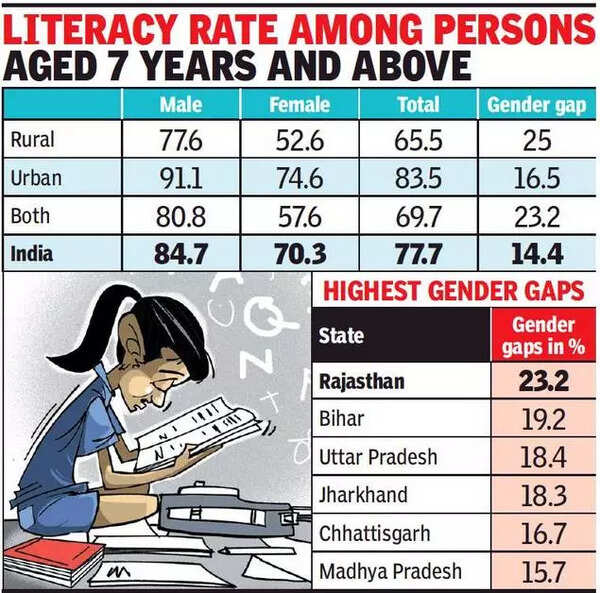
With almost 50% women in Rajasthan unable to read and write, the tall claims of the state being an education hub with the highest number of women universities and colleges have fallen flat. The significant gap of 23% in literacy levels among males and females further question the discrimination against women.
Representative image
Thinly populated areas, conservative mindset, poor economic conditions and failing policies are reasons behind the low literacy rate among women in the rural areas of the state, say experts.
Formed in 1950, Rajasthan had the worst literacy rate of 8.5% in 1951 in the country. Even after 70 years, the state continues to lead the chart from the bottom with the worst literacy rate among its female population. According to a recent study conducted by the National Statistical Organisation on the survey report, Household Social Consumption (July 2017 to June 2018), almost every second woman in Rajasthan’s villages cannot read, write or perform simple calculations. On the contrary, the male literacy rate in the state is more than 80.8%, which is just 4% lower than the country’s overall literacy rate.
The gender gap has a lot to do with the geography of the state. Desert covers more than 60% of the state, including nine districts. Hence, these areas are less accessible and are pulling the literacy rate down. “The sparsely populated areas combined with conservative mindset have deterred all social movements related to literacy programmes. Stories of oppression against women by invaders constitute a huge part of the oral history among the rural communities. This has turned practices which lead to the exposure of women to strangers into taboos,” said Rashmi Jain, head of the sociology department at Rajasthan University.
According to the 2011 Census, Jaisalmer, Jalore and Sirohi have female literacy rates below 40%, while Kota, Jaipur and Jhunjhunu have more than 60% female literacy rates. Also, several villages in Mewat region have recorded less than 5% literacy rate among females in the 2011 Census.
Effect on workforce:
The literacy rate corresponds to poor sex ratio, low per capita income, poverty, poor enrollments in institutes and sustaining orthodoxy. The biggest casualty of the situation is the overall poor workforce in the state. The demographic and statistics wing of the state government said barely 12% of females were engaged in economic activities in urban areas, while 35.1% women were earning in the rural areas, which accounted for a total workforce population of 43.6%. However, Jhunjhunu with 75% rural population is an exception to come in the league of the top three districts. Jaipur and Kota have the highest density of schools and colleges per lakh population giving its populous upper edge in literacy over other worst-performing districts.
Failing policies:
KB Kothari, former policy and planner at the United Nations Children's Fund (UNICEF), recalled that slight growth in the literacy rate continued in the country till 1991. “Thereafter, the union government along with state governments began tailormade literacy programmes to suit the social dynamics of the respective states with the help of international agencies,” said Kothari. Almost all literacy programmes in the state have failed to achieve their targets due to poor infrastructure, lack of accessibility, high pupilteacher’s ratio, overcrowded classrooms and declining funds for basic literacy programmes.
End of Article
Follow Us On Social Media









Photostories

Hot Picks
Top Trending
Explore Every Corner
Across The Globe
Lil WayneKhawaja AsifJuan ToscanoJD VanceKash PatelBrad MarchandVegas Golden KnightsPahalgam Terror AttackJ&K Terrorist AttackJaylen BrownRohit SharmaTrevor LawrenceSRH vs MI HighlightsIPL Match TodayJohn Cena Net WorthTyreek HillBoard Exam ResultAustin Reaves GirlfriendNFL MVP Josh AllenSSC CGL 2025 NotificationIshan KishanNYT ConnectionsElon MuskAnn CoulterTravis KelceShannon SharpeIPL Purple CapIPL Orange CapIPL Schedule 2025IPL Points Table
Hot on the Web
Kashmir Band TodayJaat Box Office CollectionKesari 2 Box Office CollectionGood Bad Ugly Box Office CollectionPrince Al-WaleedHimalayas Tectonic PlatesLalit ManchandaRahul BhattPapaya BenefitsKesari 2 ReviewMind Sharp TipsBeautiful BirdsPushups BenefitsSouth Indian Rice DishesVirat KohliApoorva MukhijaBetta FishSoaked Chia SeedsHair Regrow TipsDipika KakarKashmir TravelDaily Push Ups BenefitsAirlines Fare HikesAli GoniNational Park IndiaAirlines Travel AdvisoryRajeev SenWorld Horses TypesShubhangi Atre Ex HusbandCharu Asopa
Trending Topics
Pahalgam TerroristsPahalgam AttackGhost Of YoteiSunrisers Hyderabad vs Mumbai IndiansRajnath SinghMohammad AmirMohammad HafeezGautam GambhirAIIMS INI SS July 2025 RegistrationAttari Border ClosedVinay NarwalIshan KishanJasprit BumrahNEET UG Admit CardWhat is Indus Water TreatyCharles BarkleyBitan AdhikaryImprove Your Communication SkillsUPSC Result 2025Fortnite UpdateIntel LayoffsGarena Free Fire Redeem CodesNYT StrandsWordle HintsElon MuskHafiz SaeedPope FrancisJason WhitlockOverwatch 2 Season 16 Release TimeSolo Leveling Season 3
Popular Categories
HeadlinesSports NewsBusiness NewsIndia NewsWorld NewsBollywood NewsHealth+ TipsIndian TV ShowsTechnologyTravelEtimesHealth & FitnessWWENFLICC Champions TrophyAstrologyWeather TodayIPLAnimeApril Bank HolidaysPublic Holidays in AprilIPL TeamsStock Market HolidaysNSE HolidaysBSE HolidaysMCX HolidaysTechnology NewsInternational SportsPublic HolidaysBank Holidays
Latest News
India a country just as powerful as the world of 'One Piece': Usopp voice actor Kappei YamaguchiRishi Sunak condemns Pahalgam attack, stands in solidarity with IndiaWhen Rekha was unable to say 'I hate you' to Amitabh Bachchan during a scene in ‘Silsila’: I had a hard time...Noah Schnapp says he instantly approved of Millie Bobby Brown's then bf Jake BongioviLuka Doncic joins rare Los Angeles Lakers club – Kobe Bryant missed the cutKaran Singh Tyagi reveals Ananya Panday's performance in 'Gehraiyaan' helped in 'Kesari Chapter 2' castingSteve McMichael passes away at 67: What is the ALS disease he suffered from?NBA Trade Rumors: Los Angeles Lakers could sign $238 million Utah Jazz superstar to form Big 3 with LeBron James and Lukia DoncicParesh Rawal reveals getting a role in ‘Andaaz Apna Apna’ was a big deal for him: ‘I used to do some really terrible villain roles…’PM first public meetpost Pahalgam todayExplosions rock Kyiv as Russia launches new wave of missile and drone strikesCourt reserves order on Rana petition to talk to familyPakistan to chart response today as India suspends Indus Treaty, expels military attachesUK hospital denies link to 'fake cardiologist' YadavDelhi HC declines to expunge observations in Swain OCI caseKesari Chapter 2 Box Office Collection Day 6: Akshay Kumar starrer to fall short of Rs 50 crore mark as it nears end of week 1 under‘Jaat’ Box Office collection day 14: Sunny Deol’s action drama earns Rs 1.09 Crore, its LOWEST so far as it struggles to cross Rs 80 Crore mark'We have a deal with Russia': Trump accuses Zelenskyy of derailing peace in Ukraine war
Copyright © 2025 Bennett, Coleman & Co. Ltd. All rights reserved. For reprint rights: Times Syndication Service