
- News
- City News
- gurgaon News
- 4 days ahead of GRAP, first hint of ‘poor’ air
Trending
This story is from September 27, 2023
4 days ahead of GRAP, first hint of ‘poor’ air
The air quality in Gurgaon has deteriorated to 'poor' just days before the implementation of the Graded Response Action Plan (GRAP). Low wind speed is said to be the cause of the rise in pollution levels, and it is expected to continue for the next three days. PM2.5 levels at monitoring stations have also increased, exceeding the permissible limit. Dust and vehicular emissions are identified as the primary causes of air pollution in the city. The GRAP has different stages based on the air quality index, with corresponding actions to be taken accordingly.
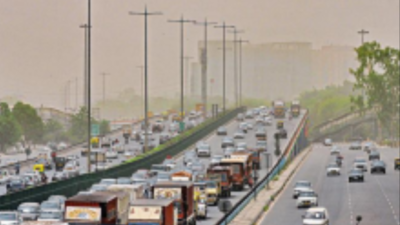
Image used for representational purpose only.
Officials attributed the rise to low wind speed on Tuesday (4kmph) — it was 16kmph the day before. The wind speed is likely to remain in the range of 6kmph to 12 kmph for the next three days, due to which the city’s AQI is expected to remain ‘poor’.
Track the pollution level in your city
Before Tuesday, the last time the city had ‘poor’ AQI was August 27 at 214.

PM2.5 levels witnessed an increase at two of the city’s four air quality monitoring stations in the past 24 hours, according to the Haryana State Pollution Control Board (HSPCB).
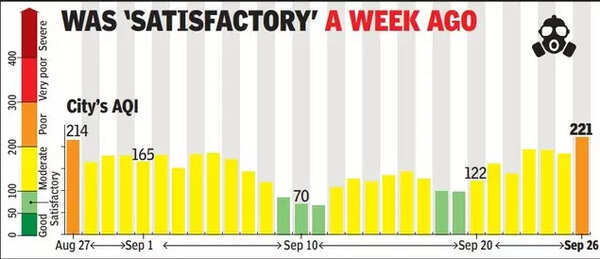
While the permissible PM2.5 limit is 60ug/m3, it was several times beyond that in three stations. At Teri Gram, it was 123ug/m3 on Monday, which rose to 308ug/m3 on Tuesday. At Sector 51, the PM2.5 level was 264ug/m3 the previous day and 321ug/m3 on Tuesday, while it was 148ug/m3 on Monday and 220ug/m3 on Tuesday at Vikas Sadan. Data wasn’t available for the Gwalpahari station.
PM2.5 is one of the six routinely measured air pollutants and is commonly accepted as the most harmful. It has been found to be a major contributing factor for conditions such as asthma, stroke and heart and lung diseases.
Meanwhile, HSPCB officials said localised factors are responsible for turning the AQI ‘poor’. “Dust and vehicular emission are the primary cause of air pollution in our city. Traffic congestion due to unpaved roads and dust from unregulated construction activities are the major contributors to the city’s air pollution. We will be taking measures to mitigate air pollution,” said Kuldeep Singh, the HSPCB regional officer.
Air pollution has become a year-round problem for Delhi-NCR and neighbouring areas. Weather conditions and high doses of pollutants envelop urban areas in a toxic haze every winter — an annual feature over the past few years.
The GRAP for NCR has been classified under four different stages of adverse air quality in Delhi, reflected through the (AQI) — stage 1 is when it is ‘poor’ (AQI 201-300), stage 2 when it is ‘very poor’ (AQI 301-400), stage 3 when it is ‘severe’ (AQI 401-450) and stage 4 when it is ‘severe+’ (AQI >450).
Actions under stages 2, 3 and 4 shall be invoked at least three days in advance of the AQI reaching projected levels of that stage, based on the dynamic model and meteorological forecast on a daily basis. Restrictive actions underprevious stage shall be continued, in addition to the air pollution stage under which restrictive actions are envisaged to be taken.
End of Article
FOLLOW US ON SOCIAL MEDIA








Photostories

Hot Picks
TOP TRENDING
Popular Categories
Hot on the Web
Top Trends
AUS vs SL Live ScoreWomen T20 World Cup ScenarioHaryana Election Exit PollAmethi Murder CaseJ&K Election Exit Poll ResultIsrael Iran WarTravis KelceHulk HoganMohammad KaifUGC NET ResultNima Hospital Doctor MurderDiddyWomen's T20 World CupTop MBA Colleges of IndiaT20 WC ScheduleWomen T20 World Cup Points TableLive Cricket Score
Trending Topics
Bigg Boss 18 House PhotoNavratri Colours 2024Navratri Day 2 ColourTMKOC New SonuNaga ChaitanyaDevara CollectionGOAT OTT ReleaseRajinikanthDeepika PadukoneGovindaDevaraGovinda NewsDevara Movie ReviewHealthy RaitasSwatantrya Veer SavarkarColdplay India tour 2025Maa Durga 108 NamesNavratri JewellerySony Bravia 55 inch 4k Ultra HD TVWordle Answer
Living and entertainment
Latest News
Trump promotes fake JPMorgan endorsement, then denies involvement: 'I don't know'5 must follow rules of Ayurveda to lose 5kg in 30 daysMarshawn Lynch heaps praise for Aaron Rodgers as he leads the Jets after his decades long NFL careerBigg Boss Tamil 8: Sunitha Gogoi to dazzle with dance performance from Vijay’s film 'GOAT'IIT-JEE aspirant dies by suicide after jumping from 8th floor of high-rise in LucknowNFL has denied the 49ers appeal of changing their red home jerseys to white amid heatwave hitting the Santa Clara areaAe halo! Get your garba OOTD readyHaryana assembly elections: BJP MP Naveen Jindal reaches polling station on horseInd vs Ban T20I: New Gwalior stadium set to alternate hosting India matches with Indore says MPCA chiefHarnaaz Sandhu's breathtaking golden gown appearance after incredible weight loss!SmackDown Tease Points to Possible Motor City Machine Guns WWE DebutBigg Boss Tamil 8: Contestant Aishwariya Bhaskaran—Here’s what you need to know about the Aaru actressVadodara airport receives bomb threat email'No use of bowing before Shivaji after scaring people, destroying Constitution': Rahul GandhiMindy Kaling: It still never gets old being in glamWhen Jaya Bachchan strongly reacted to being asked if she needed Amitabh Bachchan's approval to make a comeback in movies: 'He's not my guardian!'Former Pakistan PM Imran Khan's sisters arrested in IslamabadWorld Wide Web foundation announces to ‘wind down’ and close ‘virtual doors’: Here’s what it said in the letter
Copyright © 2024 Bennett, Coleman & Co. Ltd. All rights reserved. For reprint rights: Times Syndication Service