
Trending
This story is from September 3, 2018
A tradition that bore the pulse of the people
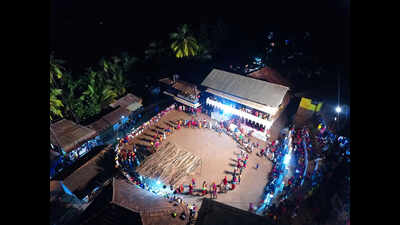
The maand, once considered to be a repository of socio-cultural values of goa’s tribes, is now fading into oblivion.
The maand, in the literal sense, is nothing more than a small plot of land, but metaphorically speaking, it is a repository of secular socio-cultural values.

It is, however, difficult to really understand the philosophy behind the ‘maand’ as an outsider. Rachol seminary professor, Fr Victor Ferrao, says it could be understood as a totemistic or anionic representation of tribal faith.
He draws a parallel between tribals of Africa, who dance around a totem as a way to appease their gods, and the tribal communities of Goa that dance around a lamp placed on the maand with the same intent.
In the absence of records about the maand, it is difficult to understand its significance entirely. What is known about the over 5,000-year-old tradition is what researchers have gathered over the past few decades.
They have learned that the maand is an open meeting place of a particular ward of a community, which, for centuries, served as a place of cultural activities, where folk arts were developed and perpetuated.
“While it was a place where cultural activities like dhalo, fugdi, intruz, intrumez, zagor, ranmalem, shigmo, etc, would take place, it was also a place where important decisions pertaining to the ward were taken,” secretary of the Adivasi Sangatna Kepem, Joao Fernandes, says.
Researcher and writer Vinayak R Khedekar reveal an interesting financial aspect of the ‘maand’, one rarely heard of. In an article in the periodical, ‘Govapuri’, he writes, “It (financial power) encompasses all aspects of rural life. Even activities unrelated to the maand were affected by it, like the dhenlo of the cowherds…the digging of the village well or building of bandhs...”
Khedekar goes on to explain that the money required by the cowherds to celebrate dhenlo and the instruments required for it came from the maand. “Even the annual dramas staged in the village were given monetary aid by the maand. Except for the perni zagor and the dashavatar kala, the rest of the art forms depended on the help of the maand,” he writes.
Similarly, a person from the community in need of money could be sure of getting a loan from the maand, of course on interest, as fixed by its committee. And in the simplistic, trust-based tradition of the maand, no collateral was needed. “Sometimes things like utensils or cattle were kept as a security deposit,” writes Khedekar.
In fact, all maand-related activites were rooted in trust, and if, perchance, someone had to betray that trust, the gods would be invoked to mete out punishment.
Sadly, this multi-faceted tradition largely died out in the mid-‘90s. After surviving for thousands of centuries, even persevering during the Portuguese rule, it ultimately succumbed to modernisation and changing social values.
The maands that died out were mostly those of the Christian communities. Fernandes, alleges that the Church “or to the effect some priest” that likened performing on the maand to “worshipping a blind god”, was responsible for the decline of the tradition among Christian tribes.
Ferrao, who believes that just attributing one reason for the decline of the tradition would be inaccurate, says, “It is also true that finding themselves in an encounter with modernity, these agrarian communities, in an attempt to shake off the ‘backward’ tag, slowly moved away from the maand, an intrinsic, all-encompassing symbol of their culture.”
All are equal here. However, on some maands, one male villager — deemed the ‘maandkari’ — has precedence at every observance
Maands derive their names from the folk festival or art they are associated with. So, Hindus have the shigmo, dhalo, zagor, ranmalle and gadde maands, while Christians have the Sao Joao, intruz and dhalo maands. This sacred space has no written rules. It functions purely on beliefs, tradition and trust.
Variations in folk dances were introduced on the ‘maand’. Change in governance and social customs were also depicted through these folk dances
LAW OF THE LAND
All village disputes were handled in a democratic manner and given the sacred nature of the maand, there were no arguments during hearings.
Even the gravest of offences would be condoned on the payment of a fine or carrying out of community service. But, first, due forgiveness had to be sought In rare cases, a person could be declared an outcast
Popular religions have no place on the ‘maand’, and deities like ‘Dhartimata’ (earth goddess) and ‘Vanadevta’ (forest god) are invoked.
Instead of the mantras seen in Vedic cultures, here there are songs, which are just as sacred
On Christian maands, though Jesus is prayed to, the recitation ends with the words ‘in fact all gods are one’
FUND MANAGEMENT
A maand had money of its own, collected through donations either in the form of cash or kind. The latter would be auctioned.
There was a tax the maand collected called the ‘pati’.
This would be collected per person, per household, per head of cattle or per fruit-bearing tree. The decision on which of these tax would be collected depended on the year’s expenditure
Some communities associated with the maand
Dhangars, Kulwadis, Kulambis, Gawdas
Qoute
It is essential that awareness be created that some maands are unknowingly moving away from the core concept of the folk tradition, which is to ensure man remains connected with nature — the ‘panchamahabhutas’. Roofing and tiling the maand cuts the cord with nature, and the very essence of the culture is lost. The government initiative to incentivise the maand monetarily is welcomed on the condition that its authentic values and folk festivals are preserved and promoted in the right perspective
Pandurang Phaldesai
Folk Researcher
End of Article
FOLLOW US ON SOCIAL MEDIA










Photostories

Hot Picks
TOP TRENDING
Popular Categories
Hot on the Web
Top Trends
ENG vs WI Live ScoreSL vs WI Live ScoreAllan LichtmanJharkhand Election ScheduleYashasvi JaiswalBaba SiddiqueMaharashtra Election Full ScheduleRavichandran AshwinCanadian DiplomatMaharashtra Election DatePublic Speaking SkillsHCL Salary HikesAssam Adre Grade Admit CardKEA VAO ResultPankaj Oswal DaughterBengaluru Schools ClosedLive Cricket Score
Trending Topics
Diwali WishesJigra Movie ReviewSunny DeolDevara OTT ReleaseVettaiyan CollectionSharmila TagoreLawrence BishnoiBigg Boss KannadaBigg Boss 18Salman KhanShraddha KapoorRatan Tata Passed AwayJigra Movie ReviewSharad Purnima Moonrise TimeSwatantrya Veer SavarkarSharad Purnima 2024Star Health Hacker DemandedViral MemesUltimate Football Codes October 2024Wordle Answer
Living and entertainment
Latest News
Ajay Devgn refers to his wife Kajol as 'ghar ka Singham' after her 'asli Singham' remarkActor Sreenath Bhasi’s driving licence suspended in the hit-and-run caseVarun Dhawan reveals Aditya Chopra did not want to invest in an action film starring him: ‘I kept pursuing..’Karan Johar extends heartwarming Diwali wishes with adorable video of Yash and Roohi: see insideGST drive harassing middle class, small businesses in Punjab: Warring154 pledge to donate their bodies to GMCBigg Boss 18: Avinash Mishra evicted by housemates following major clash with Chum Darang; Eisha Singh and Alice Kaushik left stunnedBaba Siddique murder case: Mumbai police arrest 1 suspect from UP's BahraichHamster Kombat Season 2: What players can expect from the upcoming airdrop, launch date, features, and moreManish Naggdev shares a pic with Anupamaa’s Rupali Ganguly as he joins as ToshuAyodhya-bound Air India Express flight gets bomb threatNorth Korea blows up parts of inter-Korean roads in a symbolic display of angerSecond day: Now Ayodhya flight faces bomb threat'If we can keep Bumrah quiet': Pat Cummins outlines strategy for Australia in Border-Gavaskar TrophyIndiGo Ventures gets SEBI nod as alternative investment fundRobust and Stylish Biometric Lockers Suitable For Home And Office UseMaharashtra, Jharkhand assembly elections: What's at stake for BJP-led NDA, INDIA bloc'Kamran Ghulam has got a bit of Steve Smith about him': Nasser Hussain
Copyright © 2024 Bennett, Coleman & Co. Ltd. All rights reserved. For reprint rights: Times Syndication Service