
- News
- City News
- delhi News
- DMRC fare hike: Pay more for your Metro ride from today
Trending
This story is from October 10, 2017
DMRC fare hike: Pay more for your Metro ride from today
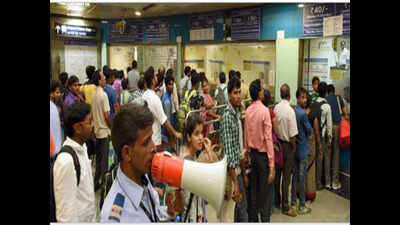
If you are travelling beyond 5 km on the Delhi Metro from today, be prepared to shell out Rs 10 extra with yet another fare hike coming into effect.
The hike, which comes five months within the last one, will affect every commuter of the mass rapid transit who travels beyond 5 km, while journeys falling in the 2-5 km distance slab will cost Rs 5 more.

The revised fare structure will be: up to 2 km -- Rs 10, 2 to 5 km -- Rs 20, 5 to 12 km -- Rs 30, 12 to 21 km -- Rs 40, 21 to 32 km -- Rs 50 and for journeys beyond 32 km -- Rs 60.
Smart card users, who, according to DMRC's estimates, happen to be 70 per cent of the metro's total ridership, will continue to get 10 per cent discount on each ride.
They will get an additional discount of 10 per cent while travelling during off-peak hours, that is from beginning of services till 8 am, between 12 pm and 5 pm and from 9 pm to end of the services.
The new fares would be applicable across five corridors -- Blue, Yellow, Red, Green and Violet -- of the metro that crisscrosses the national capital, with the total network length currently standing at around 213 km.
There shall be no change in the fares of Airport Express Line (Orange Line).
When the Delhi Metro had started operations on December 25, 2002, the minimum fare was Rs 4 and maximum was Rs 8.
A tweet from chief minister Arvind Kejriwal, however, indicated that the political slugfest over the fare hike wasn't over yet.
“Out of 16, the Delhi government has five directors, who opposed but Centre adamant. Hike too steep. Centre should have been more considerate for common man,“ Kejriwal tweeted. An official, meanwhile, quoted from the min utes of Monday eve ning's DMRC Board meeting, saying, “The Board noted that it does not have the competence to consider defer the implementation of the recommendations of the fare fixation committee (FFC). Delhi government nominees on the board, including chief secretary M M Kutty, informed the Board that the chief minister desired the hike to be postponed and a fresh FFC be constituted to examine various aspects of the fare fixation.“
The official added that the board meeting convened at the behest of housing and urban affairs minister Hardeep Singh Puri had discussed all issues, and that it was informed that under Section 37 of the Metro Railways (Operation and Maintenance) Act, 2002, the FCC's recommendations were binding on the Metro rail authorities.
TOI has learnt that earlier on Monday urban affairs secretary Durga Shanker Mishra, who is also DMRC chairman, had informed DMRC managing director Mangu Singh that there was no need to convene a board meeting. But Puri intervened and suggested to the secretary that a special meeting be called since CM Arvind Kejriwal had pressed for this in his letter to the Union minister to break the deadlock.
Following his suggestion, Singh wrote to the ministry stating, “I agree the Board does not have competence to change the recommendations of the fare fixation committee. However, since the state government representatives have been requesting to discuss the issue in the board and are pressing for it, I would request you to reconsider the decision and hold the board meeting today itself for discussion on the issue.“
Mishra approved and an emergency meeting was called late in the evening.
Though Central government officials said the board's decision should put an end to the controversy , there is little chance of an early end to the political blame game.
The Delhi government had earlier termed the Metro fare hike as “anti-people“ and had issued orders to the DMRC MD to put on hold its implementation till the government had examined the matter and checked how fares were decided.
Saying the hike was likely to hit 30 lakh daily Metro commuters hard, the city government had justified its order to the DMRC to put the hike on hold, saying it was being done “keeping in mind the interests of the people“.
According to the DMRC, the capital-intensive construction of the Metro network had been possible due to a soft loan from Japan International Cooperation Agency (JICA), which it has been paying back in instalments. As a result, all the income from fare box collections and other sources are ploughed into repaying the loan. “ As on March 31, the outstanding JICA loan to be repaid is Rs 26,760.28 crore, along with interest thereon,“ a DMRC spokesperson said. “The per day operating profit earned by DMRC for financial year 2016-17 is Rs 1.58 crore,“ he said.
The spokesperson said till date the total repayment made by DMRC towards the JICA loan was Rs 3,770.79 crore, of which interest paid was Rs 2,263.67 crore and principal paid was Rs 1,507.12 crore.
Rebate likely for students?
The Centre and Delhi governments can discuss whether any provision of monthly passes could be issued to certain categories of passengers including students and physically challenged at discounted price, a top Union government official said. He said such a possibility could be explored only for those who take the Metro service regularly.
End of Article
FOLLOW US ON SOCIAL MEDIA








Photostories

Hot Picks
TOP TRENDING
Popular Categories
Hot on the Web
Top Trends
Exit Poll ResultsJ&K Election Exit Poll ResultHaryana Election Exit Poll ResultTravis KelceAUS vs SL Live ScoreWomen T20 World Cup ScenarioAmethi Murder CaseIsrael Iran WarJ&K Exit PollHulk HoganUGC NET ResultDiddyWomen's T20 World CupTop MBA Colleges of IndiaT20 WC ScheduleWomen T20 World Cup Points TableLive Cricket Score
Trending Topics
Bigg Boss 18 House PhotoNavratri Colours 2024Navratri Day 2 ColourTMKOC New SonuNaga ChaitanyaDevara CollectionGOAT OTT ReleaseRajinikanthDeepika PadukoneGovindaDevaraGovinda NewsDevara Movie ReviewHealthy RaitasSwatantrya Veer SavarkarColdplay India tour 2025Maa Durga 108 NamesNavratri JewellerySony Bravia 55 inch 4k Ultra HD TVWordle Answer
Living and entertainment
Latest News
ICC Women’s T20 World Cup India schedule: Key players, where to watch, match details, and other information6,000 Dasara dolls bring underwater city of Dwarka to life in BasavanagudiBigg Boss Tamil 8: Sunitha Gogoi to dazzle with dance performance from Vijay’s film 'GOAT'IIT-JEE aspirant dies by suicide after jumping from 8th floor of high-rise in LucknowYeh Rishta Kya Kehlata Hai: Ruhi Discovers Abhira’s True Identity, Family Feud IntensifiesInd vs Ban T20I: New Gwalior stadium set to alternate hosting India matches with Indore says MPCA chiefWWE Unveils Bad Blood 2024 Opening Video Package, Featuring Triple H, Cody Rhodes, and Metro BoominNaga Chaitanya looks dashing in an ethnic outfit as he attends Navratri festivitiesHaryana assembly polls: 61 per cent voter turnout recorded till 5 pmSamantha Ruth Prabhu showers praise on Ananya Panday's 'CTRL'; calls her 'outstanding'Venus In Aries: What Does It Mean For Your RelationshipCR Park street food vendors gear up for Durga Puja rush5 Greatest matches of the “Phenomenal One” AJ Styles in WWEIDF conducts military operation against Hezbollah in southern Lebanon; destroys tunnels, eliminates terroristsAdnan Khan to romance Ayesha Singh in Mukta Dhond’s upcoming showCaroline returns to theatres for Halloween re-release in 3D, 2DSuzuki GSX-8R launched at Rs 9.25 lakh: Nearly same power as Tata Punch!Ashton Kutcher not a target in investigations involving Sean "Diddy" Combs?
Copyright © 2024 Bennett, Coleman & Co. Ltd. All rights reserved. For reprint rights: Times Syndication Service