
- News
- City News
- delhi News
- Delhi: Celebrating Sita and her grace, strength & sacrifice
Trending
This story is from May 13, 2022
Delhi: Celebrating Sita and her grace, strength & sacrifice
You can learn and unlearn a lot from Sita. She was never a victim of patriarchal mores. Instead, she could teach you a thing or two about how to be an independent person and stand your ground with grace and dignity, say participants at “Vaidehi: Sita beyond the body”, a seven-day festival being held in Delhi till May 16.
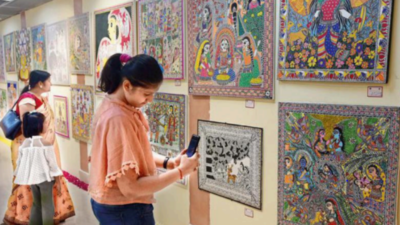
Vaidehi: Sita beyond the body’, a seven-day festival, is being held in Delhi till May 16
“Sita was not just the wife of Ram, or daughter of King Janak, but was Vaidehi, born outside the womb, a daughter of Nature and an epitome of dignity and grace, strength and sacrifice,” says Savita Jha Khan, head of Centre for Studies of Tradition and Systems (CSTS) that has organised Vaidehi to mark the birth anniversary of Goddess Sita, in collaboration with Indira Gandhi National Centre for Arts (IGNCA) and Nari Samvaad Prakalp.

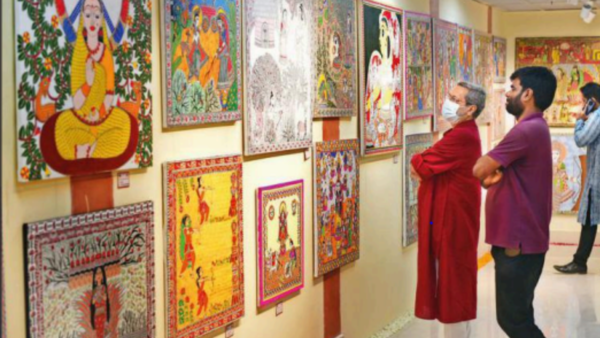
“Why don’t we celebrate our daughters, why does it take the world to praise them before we recognise their worth at home?” As an answer to this question, CSTS has organised an international painting exhibition as part of the festival, inviting artists to paint the daughter of Mithila in an ancient art tradition of that region — Mithila art form. Of the entries received, 125 paintings from seven nations have been put on display, all compelling us to rethink who Sita is.
In her painting, artist Supriya Jha, for instance, shows Sita holding her two children, Luv and Kush, but her eyes are full of aakrosh, anger. “Sita’s life was full of sadness, so I have only used black colour over a golden canvas to show her. I, too, have two children and wonder how Sita must have felt giving birth to her children in the jungle, thinking about how to inform her family and bring them up,” says Jha, who has also written a sohar for Sita. Sohar is a song that’s typically sung at the birth of a male child in Bihar.
On the opposite wall, there is a colourful canvas by award-winning artist, Shanti Devi, which shows different phases of Sita’s life — from her birth to her marriage to Prince Ram. “I come from a village near Janakpuri, where Sita was born. While painting her, I try to connect and draw energy from this devi who also manifests as Durga, Parvati, Radha and Kali,” says Devi.
“Vaidehi tries to explore Sita’s inner potential. She goes through all kinds of trial but remains graceful and dignified. She has her own potential, philosophy and her own ways. All the sacrifices she made were to uphold her dignity. You can’t be a weak person to do that,” says Savita Jha Khan.
Sita was also an epitome of selfless love, something that she imbibed from her father. Maninder Nath Thakur, a professor at Jawaharlal Nehru University, says the theme of Vaidehi symbolises the crux of the dialogue between King Janak and sage Ashtavakra, who believed that the practice of unconditional love alone can save humanity. “This dialogue transformed Janak as a ruler. The ruling class today needs to understand this philosophy, which has been imbibed by Sita. Many philosophers today are thinking that unless we transcend modernity into a new form of philosophy that focuses on unconditional love, we will not be able to save humanity, something has been happening in Ukraine, for instance,” Thakur says.
“Gandhiji and Tagore understood this problem of modernity. Gandhi believed that if we are in touch with our feminine side, ours would be a politics of unconditional love. We won’t get offended if someone criticises us or makes a cartoon on us. That is why Sita as a philosophical symbol is so relevant today,” he adds.
Underscoring this, Ram Bahadur Rai, president of IGNCA, quotes from a recent “Speaking Tree” article by Dena Merriam in The Times of India to say that Sita may be a historical character, but she is present in our hearts even today, urging us to go beyond domination mentality, if we are to evolve. He says Vaidehi is a spiritual concept referring to the one who rises above vasanas, desires, attains mukti while being alive, and lives only to accomplish her kartavya karma, duty. And Sita can teach us how to perform our duties diligently.
End of Article
FOLLOW US ON SOCIAL MEDIA









Photostories

Hot Picks
TOP TRENDING
Popular Categories
Hot on the Web
Top Trends
IND vs BAN Live ScoreNEET UG CounsellingDolly ChaiwalaKamindu MendisDU ElectionIsrael StrikesRavichandran AshwinHigh Paying Freelance JobsElon Musk Dating MeloniUS FDAKerala Lottery ResultsRohit SharmaTamil Nadu NEET UG CounsellingWho is Dominik Mysterios WifeChina SubmarineIsrael Hezbollah WarLive Cricket Score
Trending Topics
Devara ReviewNavya Naveli NandaPawan KalyanJungle SafariStree 2 OTT ReleaseRose GardenDevara CollectionOTT Release MovieMasala OmeletteEmergencyDevaraTaaza Khabar 2 Twitter ReviewDevara Movie ReviewHealthy RaitasSwatantrya Veer SavarkarColdplay India tour 2025Best Branded HandbagsApple Macbook Air M1Amazon SaleWordle Answer
Living and entertainment
Latest News
Archana Puran Singh opens up on turning down multiple film offers for ‘The Kapil Sharma Show’Jr NTR's 'Devara' takes over USA; fans garland actor's photoFirst person died in UK from ‘liquid’ Brazilian butt lift: All you need to know about liquid BBL and risks it posesNayanthara and Vignesh Shivan share emotional notes on their twins Ulag and Uyir's second birthdayPressure Cooker: How Hypertension Can Lead to Heart FailureWeight loss and more: 5 reasons to eat soaked methi seeds every morningBad Boy electric trike unveiled in India: F1-inspired cockpit, 400 km range and more!'Attempt to defame my govt': Kerala CM Vijayan rejects allegations of independent MLA P V AnvarIlaiyaraaja thanks Tamil Nadu CM MK Stalin for naming a street after his late friend SPBBig Story -Has Kollywood lost its plot?Did Vincent van Gogh’s paintings have a connection with Bihar? Research says yes!Court gives man life for forced miscarriage, raps cops over false rape slurTirupati Laddu row: Police likely to serve notices to ex-CM Jagan Mohan Reddy ahead of his Tirumala temple visitIndian economy projected to grow 6.5-7% in FY 2024-25: Chief economic advisor Nageswaran'Demons in power': Jagan Reddy cancels Tirumala temple visit amid Tirupati laddu row, says 'denied permission'Twenty-Seven: Where Science Meets Skincare with Purpose Mohammedan Sporting snatch their first win in ISLChina covered up sinking of newest submarine: US official
Copyright © 2024 Bennett, Coleman & Co. Ltd. All rights reserved. For reprint rights: Times Syndication Service