
- News
- City News
- coimbatore News
- Diabetic kids to get free insulin pens, glucometer strips
Trending
This story is from January 30, 2021
Diabetic kids to get free insulin pens, glucometer strips
As many as 36 children from poor background with type 1 diabetes being treated in Coimbatore Medical College Hospital will soon receive the latest type of insulin replacement therapy.
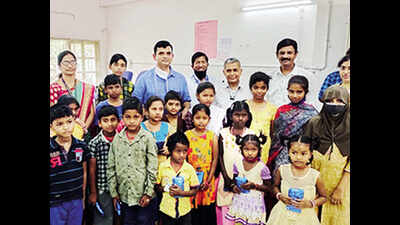
Of the 36 children, around 10 to 12 who are over the age of eight may receive insulin pumps
City-based Idhayangal Charitable Trust (www.idhayangal.org) has decided to launch a special programme called ‘Kovai Thulir’, under which each of these 36 children will be given a refrigerator each to store insulin, a glucometer with 25 strips every month and an insulin pen or pump, where the needle is much finer than a normal injection needle, free of cost.

"There is no point giving poor child insulin for a month, unless we give them a refrigerator to store it properly. We have given them glucometers, so the parents can detect early stages of glucose levels rising or dropping and correct it the same day or seek medical help before it leads to complication," says founding trustee Dr Krishnan Swaminathan. "The insulin pen’s needle is much finer and almost painless compared to the usual injection needles. The insulin quality is also better in a cartridge," he adds.
Of the 36 children, around 10 to 12 who are over the age of eight may receive insulin pumps. The pumps like an artificial pancreas will keep giving insulin in small doses throughout the day.
With a small press of a button, on a device resembling a pager, a child can increase or decrease their dose depending on their snack or exercise.
"On Monday, we have called the older children who will receive pumps for a meeting and training session on how to use them," professor and head of pediatrics department at CMCH Dr V Booma Dr Booma said.
The Rs 12 lakh a year project’s main sponsors are chairman of Roots group of companies, K Ramasamy and former CMCH alumni Dr Indira and her uncle Dr Veerappan Subramanian in the US.
Doctors hope this will reduce the number of admissions with diabetic coma or major complications like kidney-failure in the long-term, because of uncontrolled glucose levels.
Dr Booma said children with type 1 diabetes are completely dependent on insulin injections multiple times a day. "In their case the pancreas produces no insulin. So, they need life-long insulin injections generally four times a day," she said.
End of Article
FOLLOW US ON SOCIAL MEDIA








Hot Picks
TOP TRENDING
Trending Stories
In City
Entire Website
- Who is Anura Kumara Dissanayake, Sri Lanka's new president
- Early-century Lord Ganesha, Buddha statues: Images of stolen antiquities US handed over to India during PM Modi's visit
- 'My daughter would have been dead by now': When a ‘monkey attack’ in UP foiled man’s bid to rape 6-year old girl
- 'Will kill them and ...': Israel, Hezbollah vow to intensify cross-border attacks
- Ex-Google employee looking for job in Canada: “I've been reducing my India experience on my resume because …”
- How India prices of iPhone 16 series compare with that in the US, Canada, Singapore and Dubai
- 'Detonators' put on way of Army train set off alarm
- Garena Free Fire MAX redeem codes for September 21, 2024: Win free pets and vouchers today
- Intel's biggest-ever restructuring: Read the complete memo sent by CEO Pat Gelsinger to employees
- US Space Force to help set up semiconductor plant in India
- 'Move away': Israel calls on Lebanese to leave homes where Hezbollah stores arms
- Watching, downloading child pornography are offences under POCSO Act: SC
- No added sugar or sweet lies? How health-washing is misleading us
- Atishi takes charge as Delhi CM, places empty chair for Arvind Kejriwal
- Rohit Sharma to Akash Deep after no-ball drama
- 'Laapataa Ladies' is India's official entry for Oscars 2025
- Why Project Cheetah's biggest successes are also its biggest worry
- iPhone 16 series record sales on Day 1 in India, could help Apple to set milestone
- Congress, other casteist parties only remember Dalits during their bad days: Mayawati
- Sri Lanka gets Leftist prez, India a challenge in a man it’s not acquainted with

Popular Categories
Hot on the Web
Top Trends
Radhika GuptaYahya SinwarRishabh PantIsrael Hezbollah WarPakistan Bomb BlastAnura Kumara DissanayakeJetblue Flight Emergency LandingPM Modi with Tech CEOAwadhesh PrasadUGC NET Result LiveBengaluru Mahalakshmi MurderRohit SharmaStolen Antiquities USShoaib AkhtarTirupati LadduPM Modi US VisitLive Cricket Score
Trending Topics
Aishwarya RaiZodiac SignsBigg Boss 18 PromoThe Great Indian Kapil ShowChia SeedS ShankarOptical IllusionSharp Eye TestChiranjeevis FarmhouseSana KhanDevaraStree 2 CollectionAnupam MittalHealthy RaitasUrvashi RautelaColdplay India tour 2025Best Laptops For CodingPM Narendra ModiAnupam MittalWordle Answer
Living and entertainment
Latest News
EC team in Jharkhand to review poll preparednessElon Musk's SpaceX to send uncrewed Starships to Mars by 2026: “One of my biggest concerns right now..”Ghosts Season 4: Premiere date, plot, and cast revealedWhat is the 30-30-30 weight loss method? How to do it for maximum benefits?Mom's everyday tips were a must for golden boy D GukeshYudhra Box Office: Siddhant Chaturvedi starrer earns only Rs 8.60 crore over the weekendKaun Banega Crorepati 16: Amitabh Bachchan praises Ujjwal’s resilience as he attempts the 1 Crore questionGen-Z slang words explained: 30 terms you need to knowThe truth about sugar substitutes: Safe alternative or hidden health risk?Decomposed body of civil services aspirant found in DelhiGemini, Daily Horoscope Today, September 23, 2024: Face financial strain today with expenses outpacing incomePisces, Daily Horoscope Today, September 23, 2024: Day marked by restlessness and a need for changeNolan Gould would make personalized ornaments for Modern Family castmates and crew each ChristmasKartik Aaryan and Karisma Kapoor capture hearts with their cute selfie momentSri Simha and Satya starrer comedy drama, 'Mathu Vadalara 2' mints 1 million dollars at US office“That's the dirtiest s**t I ever saw in football”: C.J. Gardner-Johnson on Khristian Boyd as his hit left DeVonta Smith concussedAyushmann, Pashmina's vibrant new poster for Garba song 'Jachdi' unveiledWho is not a friend? 5 subtle signs to notice before they are fully exposed
Copyright © 2024 Bennett, Coleman & Co. Ltd. All rights reserved. For reprint rights: Times Syndication Service