
- News
- City News
- chennai News
- Stained to stun
Trending
This story is from September 11, 2023
Stained to stun
Among all the architectural wonders invented by humankind, nothing could be more poetic or sublime than stained glass windows.
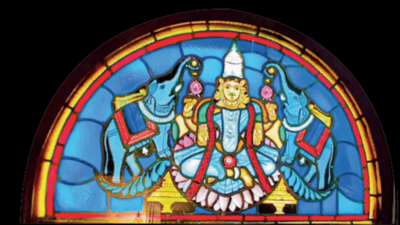
A rare piece with Indian motifs
Ironically, the stained-glass panels at the high court are among the most poorly maintained in Chennai, which has some of the best in the country – at the Senate Hall on the Madras University campus at Chepauk, the Connemara Library, the Anthropology Gallery at the Government Museum, the PWD Building near Marina, the State Bank head office, some of the old churches including the Santhome Basilica and St Mary’s Church, and even Higginbotham’s on Mount Road.
Stained-glass architecture, which was most popular in cathedrals in Europe from the 12th to the 16th centuries, was brought to India by the British during the late 1800s and the early 1900s. “The technique was unknown to Indian craftsmen, and so these were probably shipped to India all the way from England or assembled here,” says M N Manikantan, Art and Stained Glass Conservator, whose team has led the official restoration of stained glass in several landmark structures in the city.
History enthusiast Pradeep Chakravarty says that there was a department in the College of Fine Arts, Chennai, where Indian craftsmen were taught the art of staining glass, and who later created the art works in the city. Pradeep also owns a collection of traditional stained-glass panels with motifs from Indian mythology, as well as of peacocks and dogs, which are quite rare. “Only in Tamil Nadu will you find Tanjore and Ravi Varma paintings as stained-glass motifs, besides those featuring animals,” he says.
But what exactly is stainedglass architecture and how is it different from the commercial pieces being made currently?
Traditional stained-glass will always involve designs – mostly floral or figurative – and are created by putting together numerous pieces of coloured glass, which are first cut according to the designs. Multiple pieces were preferred because in the event of breakage, only one piece needed to be replaced.
“The staining technique is quite laborious and involves the painting of intricate designs on various pieces of coloured glass, which are then fired at 625-650 centigrade in the furnace so that the design fuses into the glass. The pieces are then assembled using lead and soldered, the reason for the signature ‘lead lines’ of stained glass. At the end of it all, waterproofing is done using cer tain substances which seal it and give it strength,” says Manikantan.
Once the process is completed, the colour never fades, and the art works can stay as they are for centuries.
Today, even a painting on coloured fibreglass is passed off as stained glass. “Collectors are often duped by those who just draw lead lines over the painting, without firing the design or piecing together glass. These colours will fade as well,” says Manikantan.
The new ones also use all kinds of bright colours whereas traditionally only soft pastel shades were available, says S Srinivasan, who also works in restoring stained glass. For the same reason, stained glass panels need to be replaced only if they are vandalised or broken. “At times, the glass might crack from the lead buckling over the years. We add a protective mesh or a plexiglass shield in some cases,” says Manikantan.
Restoration should be done only by trained professionals and they recently found that some of the panels at the high court had been replaced by coloured glass sans the design, he says. Panels have even been removed to make space for exhaust fans in some of these buildings.
The Connemara Library currently doesn’t allow visitors to the section with the stained-glass panels, where they remain unseen, while the massive panels in the anthropology gallery are in need of dusting. Sadly, even those that have been restored and can be viewed in all their glory are rarely noticed, nor is the public aware of their significance.
Stay updated with the latest news on Times of India. Don't miss daily games like Crossword, Sudoku, and Mini Crossword.
End of Article
FOLLOW US ON SOCIAL MEDIA






Photostories

Hot Picks
TOP TRENDING
Explore Every Corner
Across The Globe
Tijuana Bound FlightHighest Gold Reserves CountriesBengaluru Executive SuicideJoe BurrowUS Green Card Visa
Taylor SwiftPushpa 2 CollectionUPSC Mains Candidates ListChennamaneni RameshBengaluru Techie Suicide
Popular Categories
Hot on the Web
Top Trends
Atul Subhash SuicideSunil GavaskarWho is Sanjay MalhotraShaheen AfridiMilwaukee Bucks vs Brooklyn NetsLuigi MangioneMohammed SirajIPL 2025 Full Teams SquadRCB Team SquadDiljit Dosanjh Indore ConcertIsrael Strike SyriaKobe Bryant DaughterRashid LatifMumbai Bus AccidentMohammed ShamiHardik PandyaUPSC Mains ResultLive Cricket Score
Trending Topics
Pushpa 2 America Box Office CollectionPushpa 2 ReviewUnitedhealthcare CEOWeight LossBhool Bhulaiyaa 3 OTTViral NewsAmitabh Bachchan HouseOptical illusionBhagavad GitaMukesh Ambani's Favorite FoodSnowfall in KashmirZodiac SignsHair RegrowSkincare Tips for WinterWeight Loss TipsHair FallMicrosoft 365 OutageNarayana MurthyElon Musk
Living and entertainment
Latest News
As cybersecurity threats rise, ISB Executive Education's Cybersecurity for Leaders programme equips leaders with AI-integrated solutions'Zero evidence': What UnitedHealthcare CEO Brian Thompson's alleged shooter Luigi Mangione's lawyer saidRescue operation of 5-year-old Aryan from borewell in Rajasthan's Dausa enters day 3After AR Rahman's exit, Vijay Sethupathi approached to be part of 'Suriya 45'Actor Mohan Babu booked for allegedly attacking journalistLuigi Mangione’s mugshot sparks internet frenzy: Netizens dub him ‘hot assassin’OpenAI Chief Financial Officer Sarah Friar on Elon Musk: ‘We trust him...as a competitor he will...’4 Visakhapatnam boarding students go missing, traced in VijayawadaGita Jayanti 2024: Timeless wisdom for each zodiac sign for the coming year 2025'Let us back into our homes in Bareilly': 40 Muslim families barred for months after Muharram clashes'Only three options are there': Aakash Chopra on the Champions Trophy 2025 impasseVishal Mega Mart secures Rs 2400 Crore from Anchor Investors ahead of IPO launchApple Watch Ultra 3 to reportedly come with satellite texting and blood pressure monitoring featuresPM Narendra Modi signs autograph for Taimur and Jeh, as Saif and Kareena Kapoor Khan, Ranbir, Alia pose with him - PICS insideUnitedHealth Group CEO murder: Luigi Mangione's arrest still leaves key questions unansweredLeBron’s NBA Job Forces Savannah James to Embrace an Unconventional ChristmasWhen Govinda confessed to being the victim of nepotism and shared even saw Amitabh Bachchan struggling1 killed, 22 injured in road accident in Azamgarh
Copyright © 2024 Bennett, Coleman & Co. Ltd. All rights reserved. For reprint rights: Times Syndication Service