
- News
- City News
- chennai News
- Chennai: Inside Covid-19 control rooms
Trending
This story is from May 21, 2020
Chennai: Inside Covid-19 control rooms
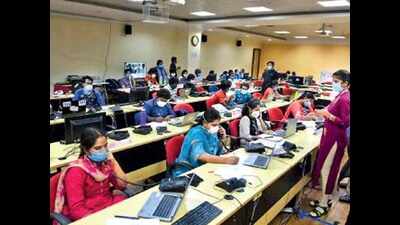
A scene inside a Covid-19 control room in Ripon Buildings on Wednesday
The call was transferred to Selvaraj. A patient who had recovered from Covid-19 feared a relapse of symptoms. Selvaraj, who leads this part of the control room, assured the caller that a doctor would provide all guidance and gestured to a colleague to follow up.
Every day for the past two months, Selvaraj and his team of 21 doctors, 60 social workers, a handful of police personnel and a big team of psycho-social counsellors under professor Gladston Xavier of Loyola College, have been handling more than 1,000 such calls dealing with everything related to Covid.

The work entails tracing contacts of every patient, how they may have contracted the infection, the people they might have spread the virus to and dealing with psychological pressures felt by patients or those under quarantine. “A doctor handles around 375 calls in an eight-hour shift. Some calls go on for more than half an hour,” Selvaraj says.
TOI spent a couple of hours with the experts at the control room on Monday.
The corporation has four control rooms. Two in Ripon Buildings and two in Amma Maligai. In Ripon Buildings, the one that addresses the health issue is headed by city health officer (CHO) Dr Jagadeesan. It takes stock of the overall cases in the city, data crunching, analysis and strategy with more than 50 people working in a room without air-conditioning. The other one handles issues regarding relief work.
Selvaraj’s team pieces together information on every case in the city. They follow certain operation procedures, one of which is ‘recall method’. For instance, a patient who has tested positive isn’t called on the same day. “He will be overwhelmed and hence we give him time to relax,” Xavier says. The next day, the team calls his contacts, asking questions about where all the patient has travelled, people he was in touch with and zeroing on his neighbours.
To find out the source of infection the doctors ask when he first started developing symptoms and the places he went to 14 days ago. Each doctor in the control room handles around 15 patients at every shift; each patient has a minimum of 25 contacts. That translates into 375 calls per shift.
If a frontline worker tests positive, the team traces out the places she might have visited using her movement registry and even call up tea stalls in the area.
A separate team follows up on patients admitted to the Covid care centres, checking on their health every day on a tele-appointment basis. A cyber cell team is also deployed to trace out movements of the patient based on call records, location and history.
End of Article
FOLLOW US ON SOCIAL MEDIA






Hot Picks
TOP TRENDING
Trending Stories
In City
Entire Website
- 'We were treated like slaves, made to work for 15 hours a day': Tricked into Ukraine war, 3 from Karnataka return home
- 'My father was on the flight': Jaishankar opens up about 1984 Air India hijack
- Airtel CEO Gopal Vittal sends letter to Reliance Jio, Vodafone-Idea, Tata Tele and BSNL CEOs; here's what he said
- Prince Harry to celebrate 40th birthday away from Meghan Markle
- Haitian immigrant pet-eating row: Ohio woman accused of eating cat is US citizen, video is not from Springfield
- Kejriwal out of jail; 'CBI arrest only to frustrate ED case bail': SC judge
- Donald Trump reveals what Laura Loomer is to his campaign: 'I don't control her'
- Hamster Kombat Daily Cipher Codes and Combo Cards for September 14, 2024: Unlock up to 1 million coins
- Laura Loomer's photo with Donald Trump viral. People ask where's Melania, where's wedding ring
- Garena Free Fire MAX redeem codes for September 13: Win in-game goodies and rewards
- 'Can't keep on insulting me': Mamata to docs as another effort to end RG Kar impasse fails over live stream
- 'Nafrat ki dukaan pe ...': PM Modi attacks Congress over 'brutality' in US
- Why you should not be fooled by ‘20-year SIP crorepati’ dream
- Blast in central Kolkata leaves 1 person injured, area cordoned off
- Trump defends 'loony' Laura Loomer amid MAGA meltdown
- Prashant Kishor vows to end Bihar liquor ban within 60 mins of taking office
- 'I was molested in ambulance in which my husband was fighting for life'
- Bengaluru woman sparks controversy with comments about Swiggy delivery executive
- Jasprit Bumrah says he's the fittest Indian player
- Eid-e-Milad-un-Nabi 2024: Top 50 Eid Mubarak wishes, messages & quotes

Popular Categories
Hot on the Web
Top Trends
Trending Topics
World Largest HorseEID WishesGreen Apple BenefitsPriyanka Chopra TattooKottukkaali OTT ReleaseNarendra ModiGhaziabad Juice SellerHair LossSudha MurtyMalayalam ProducersIndia's Best Dancer 4Simi GarewalDilli BabuIndian National ParksLaung BenefitsVikas SethiApple iPhone 16Donald TrumpAadhar Card UpdateWordle Answer
Living and entertainment
Latest News
Kaun Banega Crorepati 16: Can you guess the answer for this Rs 3,20,000 question on Navy, which contestant Naman Jain incorrectly answered?Ananya Panday urges all industries to form Hema Committee': 'Clearly, no one else is doing it but women'Nine arrested on charges of assaulting a Dalit woman at Kallukunta village in Kurnool district'Calling all Swifties for Trump': Donald's new campaign merch imitates Eras Tour shirtsWWE Hall of Famer Watches 15 Hours Of Wrestling Each WeekDallas Cowboys Set to Defend AT&T Stadium in Week 2 Clash with New Orleans SaintsTovino on training for Kalaripayattu in ‘ARM’: I practiced every single day, even if I had a hectic day on set8 animals that reproduce without matingDelhi Police Files FIR for Firecracker Celebration Outside CM Kejriwal's ResidenceThrowback: When Alia Bhatt responded to insecurity questions about Ranbir Kapoor, shut down gossipIndia's T20I captain Suryakumar Yadav turns 34: A glimpse into his stellar T20 careerThe 3 Strongest Zodiac Signs: Powerhouses of the Zodiac WheelRakul Preet Singh reveals Bollywood stylists charge from Rs 15000 to Rs 1 lakh for one event, one outfit: 'Living in Mumbai requires a lot of PR'Thrashed for 'molesting' kid on train, rail staffer diesDhruv Kapila's health setback shatters Indian pair's Vietnam Open semifinal hopesFormer Titans Cheerleader Danielle Sekelsky Begins WWE NXT Training"Birthday aapka hug aur paari I am getting...": Tahira Kashyap pens adorable b'day wish for hubby Ayushmann KhurranaRecord-Breaking Viewership for NFL’s 2024 Season Kickoff
Copyright © 2024 Bennett, Coleman & Co. Ltd. All rights reserved. For reprint rights: Times Syndication Service