
- News
- City News
- bengaluru News
- World Storytelling Day: Meet Bengaluru's storytellers
Trending
This story is from March 20, 2017
World Storytelling Day: Meet Bengaluru's storytellers
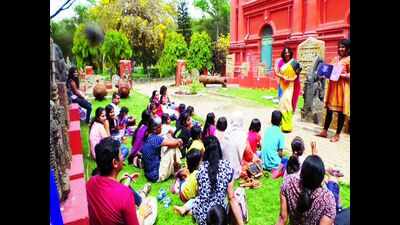

Founder member of the Bangalore Storytelling Society, Aparna Athreya, for instance, is thrilled that people are not only taking the art form back to its roots -- to a time when it was used extensively as tool of communication and education and to understand societal aspects or advise caution, as the case may be – but are also pushing it ahead, beyond boundaries that were thought to exist. “These days, we are using storytelling intelligently in the new-age set of ways of life. Earlier, people’s well-being was taken care of based on how society was structured. But today it is such that everyone’s in a nuclear family, has no time for anything and is in an inclusive and isolated environment, which pushes the need for therapy and counseling. We have discovered that storytelling is a great means for narrative counseling. We use it as a catharsis tool for people who have undergone trauma. Corporate leadership teams use personal stories to weave into the organizational narrative or use business stories to get across to the outside world. Storytelling is even being used in education and not only for languages, but the application of subjects like mathematics and science as well. It has been a very transformational journey,” explains Aparna, adding that teachers today not only need to be subject-matter experts and researchers, but good storytellers as well and are being trained in the art form.
Presentation, adds Shreya Biswas of Kathayalaya, is a key element of storytelling. “Even though I have used the art form back in the day when I was a teacher to get the attention of the students in my class, it wasn’t until I attended a storytelling session at the British Council that I realized the importance of how a story is presented. The person who was conducting that session narrated three tales, all of which I knew, but what struck me was the way he told it. And I figured that if you know stories and can tell them, you just need to do it differently. It is not just about telling stories, but using them as well. Stories are metaphorical; they hold information, entertainment and values that you need to be mature enough to understand. And that’s why storytelling is not limited to children alone,” says Shreya.
Taking the artform to the board room, as Aparna stated, takes boredom out of statistics and figures, adds Shreya. “It really helps people remember what you want to say. Listeners then begin to empathize with the characters and relate to the story or incidents, and eventually open up to share their own stories, thereby starting a conversation – a scenario that has been missing from our lives,” she says.
“Anything in life cannot be taken in isolation. I can’t say I am great in mathematics and want to make a living out of it. You have to be generalist with core skills. Similar is the case with storytelling. If you are purist and say storytelling is what I know and I need to make a living, it is a very isolated niche skill. You need to see how it can be applied in a larger context to today’s world. For instance, when it comes to narrative counseling, I need to know the fundamentals of counseling, interpersonal relationship and how to elicit stories from them by which I can understand the person, work out a solution for them or point them in the direction of a solution. In essence, I use a multiple set of skills, in which storytelling is the core skill set. Storytelling as a pure performance art may not help you make a living; it needs to evolve,” Aparna signs off.
End of Article
FOLLOW US ON SOCIAL MEDIA









Photostories

Hot Picks
TOP TRENDING
Popular Categories
Hot on the Web
Top Trends
ENG vs WI Live ScoreSL vs WI Live ScoreAllan LichtmanJharkhand Election ScheduleYashasvi JaiswalBaba SiddiqueMaharashtra Election Full ScheduleRavichandran AshwinCanadian DiplomatMaharashtra Election DatePublic Speaking SkillsHCL Salary HikesAssam Adre Grade Admit CardKEA VAO ResultPankaj Oswal DaughterSCO Meeting in PakistanLive Cricket Score
Trending Topics
Diwali WishesJigra Movie ReviewSunny DeolDevara OTT ReleaseVettaiyan CollectionSharmila TagoreLawrence BishnoiBigg Boss KannadaBigg Boss 18Salman KhanShraddha KapoorRatan Tata Passed AwayJigra Movie ReviewSharad Purnima Moonrise TimeSwatantrya Veer SavarkarSharad Purnima 2024Star Health Hacker DemandedViral MemesUltimate Football Codes October 2024Wordle Answer
Living and entertainment
Latest News
Jani master's nephew files legal complaint against the woman who accused the choreographer of sexual assaultSingapore's Indian-origin LoP, Pritam Singh goes on trial for lying in ParliamentVarun Dhawan reveals Aditya Chopra did not want to invest in an action film starring him: ‘I kept pursuing..’Karan Johar extends heartwarming Diwali wishes with adorable video of Yash and Roohi: see insideSamantha Ruth Prabhu lauds Alia Bhatt's fiery performance in 'Jigra'Baba Siddique murder case: Mumbai police arrest 1 suspect from UP's BahraichSC seeks Centre’s response on protecting rivers from encroachmentsHamster Kombat Season 2: What players can expect from the upcoming airdrop, launch date, features, and more“He’s passionate”: Jason Kelce Comes to Nick Sirianni's Defense After a Heated Postgame Altercation With FansManish Naggdev shares a pic with Anupamaa’s Rupali Ganguly as he joins as ToshuAyodhya-bound Air India Express flight gets bomb threatNorth Korea blows up parts of inter-Korean roads in a symbolic display of angerIndia, US to ink Predator deal todaySecond day: Now Ayodhya flight faces bomb threatSpaceX Marks A Spot That Isro Has Its Sights On'If we can keep Bumrah quiet': Pat Cummins outlines strategy for Australia in Border-Gavaskar TrophyHockey India League Players' Auction: Full list of squads of eight men's teamsHappy Diwali 2023: 10 amazing quotes and saying that perfectly depicts the festival of lights
Copyright © 2024 Bennett, Coleman & Co. Ltd. All rights reserved. For reprint rights: Times Syndication Service