
- News
- City News
- bengaluru News
- Monitoring Bengaluru air quality from highrises is faulty: Study
Trending
This story is from January 22, 2020
Monitoring Bengaluru air quality from highrises is faulty: Study
Official claims that Bengaluru’s air quality is improving may have to be taken with a pinch of salt. Raising doubts over the accuracy of official air quality index (AQI) statistics and terming them misleading, a recent study says monitoring stations set up by central and state pollution control boards are located at altitudes higher than what’s ideal for collection of data.
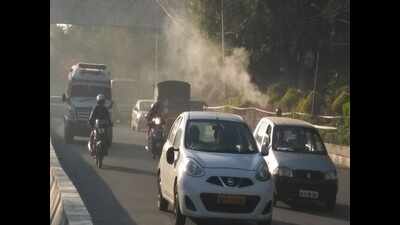
Vehicles are a major source of pollution in Bengaluru
“Vehicles account for around 40% of the particulate matter (PM) in Bengaluru’s atmosphere.

Monitoring stations in Bengaluru are mostly on skyscrapers and tall buildings, Shishir said. “As there is more PM dispersion at higher altitudes, this may lead one to believe that the air is cleaner than it is. This means most measurements from these stations are misleading,” he explained.
The duo conducted the study when they were in the city for a break and submitted their findings to the government a few months ago.
More stations needed
With Bengaluru not having as many air quality monitoring stations as required, the figures only get more skewed, the study observed.
There are 13 manual monitoring stations and seven real-time continuous ambient air monitoring stations (CAAMS) in the city. “It’s like using a single toothbrush for the whole family; it just can’t last. PM meters are sophisticated monitors consisting of sensors and actuators, which need to be calibrated from time to time. Since they are not maintained properly, data collected may be skewed,” pointed out Shishir.
The researcher duo collected data from sources like central and state pollution control boards, open AQI, NASA and WHO and consolidated it for the study.
Station set up at prescribed height: KSPCB
A senior official from KSPCB said monitoring stations have been set up at the prescribed height of six metres. Asked about vehicular emissions and the need to monitor quality of air in people’s breathing zone, the official said they have mobile monitoring stations to collect the said data. “In fact, Karnataka was one of the first to deploy mobile stations, which collect data at a height of 1.5 metres. However, I agree that we don’t have enough monitoring stations. We’re in the process of setting up more centres,” he added.
What is particulate matter
Particulate matter comprises particles suspended in the air — they may be in solid or liquid state or a complex mixture of both. Together, they are hazardous to humans when ingested or inhaled or when they come in contact with hair or skin. PM is measured in two sizes: up to and lesser than 10 microns, and 2.5 microns.
End of Article
FOLLOW US ON SOCIAL MEDIA










Photostories

Hot Picks
TOP TRENDING
Popular Categories
Hot on the Web
Top Trends
Trending Topics
Diwali WishesDhanteras 2024Fake PaneerKarwa Chauth WishesSomy AliVicky Vidya Ka Woh Wala Video CollectionKarwa Chauth 2024Akash AmbaniAvinash MishraBigg Boss 18Kaun Banega Crorepati 16Shraddha KapoorVettaiyan CollectionBougainvillea Movie CollectionJuhi ChawlaLiam PayneTop Load Washing MachinesBest Premium LaptopsIntel LayoffsWordle Answer
Living and entertainment
Latest News
Pics: Hina Khan seeks peace at Haji Ali Dargah during her brave fight against cancerBest Watches for Men To Suit Every Style and OccasionMoody's assigns first-time Baa3 ratings to Bajaj FinanceEldeco: A Legacy of Excellence in Real EstateBigg Boss 18: Avinash Mishra evicted by housemates following major clash with Chum Darang; Eisha Singh and Alice Kaushik left stunnedWhen Ranveer Singh made a hilarious comment on Kareena Kapoor Khan, catching Karan Johar and Anushka Sharma off guardVijay's 'Kaththi' and 'Mersal' re-release postponedHappy Diwali 2021: Best SMS, Images, Wishes, Facebook, and WhatsApp messages to send as Happy Diwali greetingsBLACKPINK’s Lisa opens up about the challenges of maintaining privacyStop music by 10pm and verify crew, cruise owners toldKarwa Chauth moonrise time today, Puja timing and Puja Samagri'Aaqib bhai, Pakistan cricket ko kya ho gaya?' Gautam Gambhir asked - WatchWatch: Priyanka Chopra dazzles in pastel dress at event, cheerfully tells paps ‘sham ko milte hai’NEP 2020 drives push for learning in Indian languages, says education minister PradhanLiam Payne passes away: Woman tweets that the singer ' jumped off his balcony'Crystals for Grounding: Find Your Balance in a Chaotic WorldBigg Boss Kannada 11 faces backlash over focus on confrontationsWin over England a 'relief' but doesn't fix Pakistan woes, says skipper Shan Masood
Copyright © 2024 Bennett, Coleman & Co. Ltd. All rights reserved. For reprint rights: Times Syndication Service