
- News
- City News
- bengaluru News
- Karnataka high court suspends Waqf Board’s power to issue marriage certificates
Trending
Karnataka high court suspends Waqf Board’s power to issue marriage certificates
The Karnataka High Court has temporarily suspended a government order that granted the Karnataka State Waqf Board the authority to issue marriage certificates to Muslim applicants. The court has deemed that the Waqf Board lacks the legal standing to issue such certificates, citing that this responsibility extends beyond the scope of the Waqf Act.

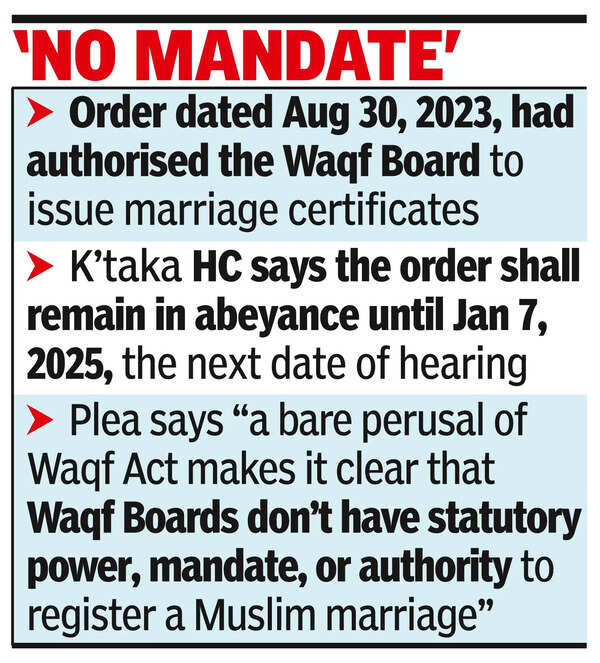
"In view of the strong prima facie case, the order dated Aug 30, 2023, authorising the board and officers to issue marriage certificates shall remain in abeyance until the next date of hearing. The Waqf Board or its officers shall not issue marriage certificates under the guise until the next date," Chief Justice NV Anjaria and Justice KV Aravind observed, while adjourning the hearing on a public interest litigation (PIL).
"It is difficult to perceive that a marriage certificate issued by Wakf Board or officers could be used as valid certificates for any official purpose," the division bench observed.
A Alam Pasha, a Bengaluru-based social activist, filed a petition challenging the order empowering Waqf Board to issue marriage certificates to Muslim applicants.
"Conferring of power to register a Muslim marriage on Waqf Board goes beyond the legislative mandate of Waqf Act, 1995, which created State Waqf Board statutorily. The entire power and functions of Waqf Board have been defined under Section 32 of Waqf Act, and the power to register a Muslim marriage cannot be said to flow from the said section. A bare perusal of Waqf Act makes it clear that Waqf Boards do not have the statutory power, mandate, or authority to register a Muslim marriage. Various high courts have already held that the registration of marriage by Waqf Boards is beyond the scope of power conferred under the Waqf Act," the petitioner stated.
According to the petitioner, Waqf Board's administration is already crippled, and it has failed to properly implement the provisions of the Act. Burdening it with additional duties of registration of Muslim marriage would only undermine its operational efficacy to look after and administer Wakf properties.
The petitioner further claimed that in terms of the Supreme Court's judgment in the Seema vs Ashwani Kumar case, from a governance point of view, the purpose of registration of any marriage is solely for maintaining records of "vital statistics".
"The sanctity of marriage is not dependent upon its registration. A valid marriage, as per personal laws of the parties, remains valid irrespective of whether the marriage was registered or not. It is important to note that whenever any law prescribes the registration of marriage in India, they usually come with a caveat that non-registration does not lead to invalidation of the marriage," the petitioner added.
End of Article
FOLLOW US ON SOCIAL MEDIA










Photostories

Hot Picks
TOP TRENDING
Explore Every Corner
Across The Globe
Most uncapped playersArvind KejriwalCSK Full SquadMI Squad Projected 11Chennai School Holiday Tomorrow
RCB Squad Projected 11Hindu Temple AttackIPL Most Expensive PlayerCKS Squad Projected 11IPL Teams Squads
Popular Categories
Hot on the Web
Top Trends
Trending Topics
Anupamaa Stars Education QualificationSamantha Ruth Prabhu Father DeathHema MaliniWeight GainAllu ArjunAmitabh Bachchan HomeDua LipaBigg Boss 18 PromoBigg Boss 18National ParkNagarjunaKangana RanautHair FallSkincare Tips for WinterWeight Loss TipsHair FalliPhone 15 ProPan 2.0Ufo Sighting Over Capitol Hill
Living and entertainment
Latest News
Delhi pollution: Air quality still very poor, not likely to get better soonTrue grit: Justice Khobragade's journey from a hamlet to High CourtKamala Harris faces criticism over post-election fundraising blitzMan attacks parents & Uncle, dies in a bid to escape police custodyUttarkashi mosque disputed, says government after calling it 'legal'AAP MLA Naresh Balyan arrested for 'links' with gangsterHow did Josh Allen’s family react to his engagement with Hailee Steinfeld?'Sanctity paramount': TTD prohibits political and hate speeches at TirumalaTrump’s labour secretary pick, Lori Chavez-DeRemer, faces scrutiny over lavish campaign spendingAndrew Wiggins' pregnant girlfriend Mychal Johnson shares sneak peek of her eventful Mexico TripEvery fifth road death was of a pedestrian in 2023Activist ends fast after Uddhav Thackeray assures bigger stir for fair pollsManipur CM Biren cites 'administrative history' to take dig at Mizoram CM, MNFTamannaah Bhatia reveals 'Aaj Ki Raat' from 'Stree 2' contributed to its commercial success: 'I find it really awkward to admit it'At Maoist commander Hidma's bastion, power now flows from electricity gridVideo of Dua Lipa performing on Levitating and Woh Ladki Jo mashup at Mumbai concert go viralUK: Prince Harry and Meghan Markle excluded from royal Christmas celebrationsPet parents turn to animal whisperers to communicate with their furry friends
Copyright © 2024 Bennett, Coleman & Co. Ltd. All rights reserved. For reprint rights: Times Syndication Service