
- News
- City News
- bengaluru News
- Idol makers run up against lack of good clay, skilled labour
Trending
This story is from August 31, 2016
Idol makers run up against lack of good clay, skilled labour
The festival of the elephant-headed god is here and so are the idol makers.
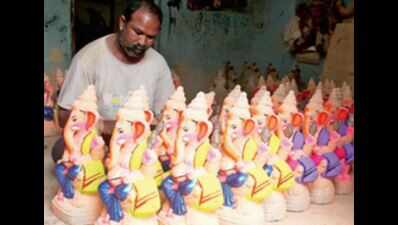
Artists give finishing touches to their works of art. (Photo by Md Asad)
BENGALURU: The festival of the elephant-headed god is here and so are the idol makers. Come Ganesh Chaturthi and the streets of Pottery Town are lined with rows and rows of idols of Lord Ganesha.
Almost every family in the area, many of whom still live in the homes they grew up in, is involved in the creation of these beautiful idols in some way or other - be it painting of idols, transporting clay to the makers and other small processes.

But like any other profession, theirs too is getting challenging. A third-generation idol maker, Chamaraj, 65, says the quality of idols today has deteriorated due to the entry of unskilled potters into the market.
"Nowadays, everyone's starting making idols, which is bad for our reputation. Inexperienced workers are getting involved in this profession, when they don't even know the basics. The hand or thumb of the statue may come off and they wouldn't know how to fix it. Our well-preserved tradition has been reduced to mere business," he says.
The lack of good quality clay is another problem faced by idol makers, who rue the loss of lakes. Anand S, secretary of the 120-strong Kumbara Karakushala Kaigarika Sahakara Sangha or potters' association, says it costs more to sculpt an idol today than it did during his father's and grandfather's time.
"About 30 years ago, we used to pay Rs 30-40 for an entire bullock cart of mud because we got it from a nearby pond. All the lakes have been cleared for BDA layouts to come up. We now have to go farther and farther away as there are rules against lifting mud from nearby lakes, unless we pay some royalty."
The community is also plagued by a lack of labourers to keep up with the demand for Ganesha idols. Earlier generations would hire up to 70 persons during peak season but that is no longer a possibility with most workers migrating to neighbouring Tamil Nadu to benefit from the multiple schemes operating there. This is an interesting inversion, as workers from Tamil Nadu would flood Pottery Town during festival time, in anticipation of work.
"During the season, I sell 5,000 to 6,000 pieces in wholesale. I used to employ labourers and have four to five persons from Tamil Nadu working for me. But now, they receive all kinds of benefits like the Amma canteen, courtesy their chief minister, so everyone's gone to work in Tamil Nadu, resulting in a huge deficit here," adds Anand.
Willing workers would rather make idols on their own, given the returns it generates. Sarvana Kumbhar, who has been helping his father make idols since he was seven, says it's difficult to hire people as coolies for even a few hours.
"All the work is done by my family, primarily my wife and myself. People are more willing to be their own bosses and start their own businesses rather than work for somebody else, though we are willing to pay them competitive rates," he says.
The entry of idols made from plaster of Paris (PoP) and paper have further eaten into the business of these traditional craftsmen. The largest clay idol measures 2-3 feet and takes almost a week to make, from start to finish. By contrast, 10-ft tall idols made of PoP and paper can be prepared in five days. Districts across Karnataka, like Mysuru and Belagavi, are also full of idol makers threatened by new entrants.
"For a while, we were threatened by PoP idols. They are in demand due to their finish, though it costs more. Thankfully, they are now banned, so hopefully, our sales will pick up again. We only make eco-friendly Ganesha idols which fulfil a cycle. When clay idols are immersed in water, they dissolve and accumulate in the water bed only to be collected again. This is how it is meant to be. With PoP, there is no reuse value as they have to be destroyed after use. "
But city idol makers say they don't see their children carrying forward their age-old tradition and express no interest in learning the traditional craft of their community. "I have two daughters who are doing very different things. My elder daughter designs clothes and is well settled. Effectively, I am the last generation in this trade," says Chamaraj, whose family has been making these idols for 130 years. Claiming he doesn't feel too bad about the tradition coming to an end, he said, "I knew this trade had to die sometime. It is the natural flow of things. The new generation will do what suits and appeals to them."
Anand agrees. He is happy his two grown-up daughters have also chosen alternative careers. "My children have completed their education, my second daughter is in final year B.Com. With my generation, it will come to an end, there is nobody left to continue our traditional profession. After us, I think the trade will see some major changes. Nothing can stay the same forever," he said.
End of Article
FOLLOW US ON SOCIAL MEDIA






Hot Picks
TOP TRENDING
Trending Stories
In City
Entire Website
- 'We were treated like slaves, made to work for 15 hours a day': Tricked into Ukraine war, 3 from Karnataka return home
- 'My father was on the flight': Jaishankar opens up about 1984 Air India hijack
- Airtel CEO Gopal Vittal sends letter to Reliance Jio, Vodafone-Idea, Tata Tele and BSNL CEOs; here's what he said
- Prince Harry to celebrate 40th birthday away from Meghan Markle
- Haitian immigrant pet-eating row: Ohio woman accused of eating cat is US citizen, video is not from Springfield
- Kejriwal out of jail; 'CBI arrest only to frustrate ED case bail': SC judge
- Donald Trump reveals what Laura Loomer is to his campaign: 'I don't control her'
- Hamster Kombat Daily Cipher Codes and Combo Cards for September 14, 2024: Unlock up to 1 million coins
- Laura Loomer's photo with Donald Trump viral. People ask where's Melania, where's wedding ring
- Garena Free Fire MAX redeem codes for September 13: Win in-game goodies and rewards
- 'Were ready for no recording but ... ': Docs leave Mamata's home as another meet fails
- CBI adds rape-murder charges against Kolkata ex-principal: Report
- Will Germany’s suspension of Schengen entry end the Europe dream?
- 'Nafrat ki dukaan pe ...': PM Modi attacks Congress over 'brutality' in US
- 'Look at Virat Kohli': Ex-Pak captain wants Babar to...
- Blast in central Kolkata leaves 1 person injured, area cordoned off
- Why you should not be fooled by ‘20-year SIP crorepati’ dream
- Bengaluru woman sparks controversy with comments about Swiggy delivery executive
- Trump defends 'loony' Laura Loomer amid MAGA meltdown
- Prashant Kishor vows to end Bihar liquor ban within 60 mins of taking office

Popular Categories
Hot on the Web
Top Trends
Trending Topics
World Largest HorseEID WishesGreen Apple BenefitsPriyanka Chopra TattooKottukkaali OTT ReleaseNarendra ModiGhaziabad Juice SellerHair LossSudha MurtyMalayalam ProducersIndia's Best Dancer 4Simi GarewalDilli BabuIndian National ParksLaung BenefitsVikas SethiApple iPhone 16Donald TrumpAadhar Card UpdateWordle Answer
Living and entertainment
Latest News
Kaun Banega Crorepati 16: Can you guess the answer for this Rs 3,20,000 question on Navy, which contestant Naman Jain incorrectly answered?Ananya Panday urges all industries to form Hema Committee': 'Clearly, no one else is doing it but women'Nine arrested on charges of assaulting a Dalit woman at Kallukunta village in Kurnool district'Calling all Swifties for Trump': Donald's new campaign merch imitates Eras Tour shirtsWWE Hall of Famer Watches 15 Hours Of Wrestling Each WeekDallas Cowboys Set to Defend AT&T Stadium in Week 2 Clash with New Orleans SaintsTovino on training for Kalaripayattu in ‘ARM’: I practiced every single day, even if I had a hectic day on set8 animals that reproduce without matingDelhi Police Files FIR for Firecracker Celebration Outside CM Kejriwal's ResidenceThrowback: When Alia Bhatt responded to insecurity questions about Ranbir Kapoor, shut down gossipIndia's T20I captain Suryakumar Yadav turns 34: A glimpse into his stellar T20 careerThe 3 Strongest Zodiac Signs: Powerhouses of the Zodiac WheelRakul Preet Singh reveals Bollywood stylists charge from Rs 15000 to Rs 1 lakh for one event, one outfit: 'Living in Mumbai requires a lot of PR'Dhruv Kapila's health setback shatters Indian pair's Vietnam Open semifinal hopesFormer Titans Cheerleader Danielle Sekelsky Begins WWE NXT Training"Birthday aapka hug aur paari I am getting...": Tahira Kashyap pens adorable b'day wish for hubby Ayushmann KhurranaRecord-Breaking Viewership for NFL’s 2024 Season KickoffAshish Vidyarthi delves into vocal artistry behind his role as Doctor Doom
Copyright © 2024 Bennett, Coleman & Co. Ltd. All rights reserved. For reprint rights: Times Syndication Service