
- News
- City News
- bengaluru News
- CITY NEGLECTS ITS TEMPLE TANKS
Trending
This story is from June 11, 2017
CITY NEGLECTS ITS TEMPLE TANKS
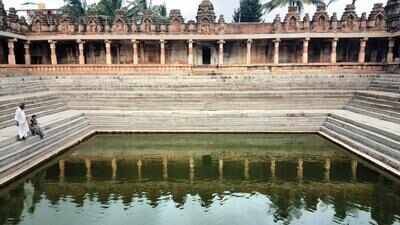
BENGALURU: There’s a small lane next to the Sri Vasavi Kanyakaparameshwari Temple on Raja Rammohan Roy Road, just opposite the Kanteerava Stadium. Walk past the Kitturu Rani Chennamma Auto Drivers’ Kannada Yuvakara Sangha (established 2008), and you find yourself in the crowded warren of backstreets and bylanes of Sampangi Ramanagar. Take a left at the Mysore Silk shop at the end of the lane, and you’ll soon find yourself near a fenced-off structure, something that looks like a cross between an old fashioned temple yard and an amphitheatre.
“There used to be a famous kalyani (temple tank) there,” says Hita Unnikrishnan, a post-doctoral scholar at the Azim Premji University.

As you walk down the steps of what remains of the tank today, you notice a sculpture of a woman being carried on a platform, by another woman. Older locals will tell you that it’s a representation of Kempegowda’s wife, being carried down to the water for her cure.
Kalyanikere nagara
“Not many people know this, but Bengaluru was once called ‘Kalyanikere Nagara,” says columnist and historian Suresh Moona. “The area around Majestic was full of kalyanis. Ronald Ross had written about Bengaluru as the city of springs. When Swami Vivekananda visited Bengaluru back in 1892, it’s said that he meditated by the side of the kalyani of a Benne Krishna temple in that area. Of course, there’s nothing there now, and where the kalyani once stood, there’s a place where the workers on the metro station keep their construction material,” he says.
If you go to the Vasantha Vallabharaya temple complex in Vasanthapura, you’ll find the temple in bad shape. But shocking as the condition of the temple is, it’s nothing compared to the state of its kalyani, which looks like construction site after heavy rain. The water is brown and muddy, more like a large puddle than a kalyani. The green fencing, the pile of mud and the earth, and the earthmover, parked near a pile of rocks, give the impression that the place will soon transform into yet another soulless set of apartments.
The tank has been at the centre of several controversies, dating back to 2013, when BBMP engineers allegedly squandered Rs 50 lakh earmarked for the restoration of the kalyani. The tank, believed to have been constructed by none other than Shahaji Raje, father of the illustrious Shivaji, was back in the news last month when press reports revealed an attempt to turn three quarters of the kalyani space into a road that would favour a private developer. Since then the authorities have backtracked, and promised to restore the kalyani, but on the ground, there’s nothing happening, despite furious protests by civic groups and police complaints by eminent citizens.
Symbiosis
A kalyani is not a standalone water structure, says Shubha Ramachandran, an environmental consultant with Biome, a city-based design firm focused on ecology, architecture and water. “If you look at traditional temples, you’ll usually find a well inside the temple premises, and the kalyani outside. The water from temple well was usually used for religious duties and for consumption, the kalyani, which also served as a social centre, was used for bathing, washing clothes and so on,” she says. “And the two water sources also had a symbiotic relationship, as one would help recharge the other.”
In 1885, according to Unnikrishnan, there were close to 1,500 wells in Bengaluru. “Today, we have been able to trace fewer than 50. And many of those wells are dry, or boarded over. The ones that are still functional are either associated with temples – or are being used in slum areas where alternative sources of water are either unhealthy or unavailable,” she says.
The problem faced by most kalyanis – and open wells – is one that all of Bengaluru faces, in terms of falling groundwater levels. “The only way to revive these kalyanis in the long term is to raise the aquifer,” says S Vishwanath, noted water researcher. “And that can be done by boring a number of wells in the neighbourhood – wells with a diameter of 2-3 feet and a depth of around 10 feet, with soft earth floors. It will take a while for the groundwater level to rise, though – anywhere from five years to a decade,” he says.
On the steps
As you enter the Bhoganandeeswara temple in Nandi village, you’ll find, just past the main gate, faded signs put up by the Archaeological Society of India, stating that you are in a protected monument, and that construction is prohibited within a 100 meters of the location. Outside, though, nobody cares, but inside, the temple retains a serene beauty. There’s a small kalyani in the courtyard, and there’s another one inside the main temple complex.
Visit the temple in the morning, and you may meet 80-year-old Anjaneyappa, who comes there every day. “This part of the temple,” he says, gesturing to the wooden doors leading to the inner kalyani, “goes back to the time of Krishnadevaraya.” “That side,” he says, waving at the main temple complex, “goes back to the time of the Gangas and the Cholas”. He finishes his prayers at the temples various shrines, and makes his way to the kalyani.
The kalyani itself is beautiful, a little like one of those stepped Mayan pyramids you see in pictures of Chichen Itza, only going down instead of up. At the base is a square pool of water. Anjaneyappa climbs down the stairs, slowly, until he’s at the water’s edge. As he approaches, fat koi fish – black, gold, and white – rise up to greet him. There’s a gentle breeze in the air. The water ripples. And suddenly, you understand, at some emotional level, that it is holy.
End of Article
FOLLOW US ON SOCIAL MEDIA





Hot Picks
TOP TRENDING
Trending Stories
In City
Entire Website
- 'Osama's 'dead son' is alive, leading al-Qaida in Afghanistan and has terrifying plans'
- Diljit Dosanjh’s Dil-Luminati India Tour: Check dates, venue, how to book concert tickets online
- Hamster Kombat Daily Cipher Codes and Combo Cards for September 13, 2024: Unlock up to 1 million coins
- Narayana Murthy faces backlash for parenting remarks on social media; users say, "after working 72 hours a week, there’s barely time left to have babies…”
- Shreyas Iyer comes out to bat wearing sunglasses, falls for a duck in Duleep Trophy
- iPhone 16 will be available for Rs 54,900 on Apple website; here's how you can grab the deal
- iPhone 16 to go on pre-order today: Pre-booking details, time, sale date and more
- Vande Metro launch date, schedule: PM Modi to flag off Bhuj-Ahmedabad Vande Metro train; check timings, stoppages of new Indian Railways train
- Why around 40,000 TCS employees have received tax demand notices for Rs 50,000 to over Rs 1 lakh
- Bill meant to usurp Waqf land, JPC told
- Despite debate win, Kamala Harris makes no dent in battleground states
- 2 Army soldiers killed in ongoing encounter in J&K's Kishtwar
- 'I was molested in ambulance in which my husband was fighting for life'
- 'Osama's 'dead son' is alive, leading al-Qaida and has terrifying plans'
- Sunita Williams, Butch Wilmore to vote for US election from Space: 'Very important duty'
- Preschools turn nursing homes, retirement age raised: China's demographic crisis explodes
- Are drone and rocket attacks the new normal in Manipur?
- Jhumka Gira Re ...: American woman's Instagram post on India goes viral
- Assam CM reveals how his 'doubt' unearthed multi-crore trading scam
- Vande Metro first look: Top 10 features of new train for common man

Popular Categories
Hot on the Web
Top Trends
Shannon Sharpes Net WorthVande MetroAadhaar Card UpdateTech LayoffsArvind Kejriwal BailShannon SharpeUPSC Mains Admit CardKristina JoksimovicTCS Employee Tax NoticesWay Chatgpt can be your Study PartnerAir Taxi IndiaAyushman Bharat SchemeKolkata Doctor Rape CaseDonald TrumpShreyas IyerDiljit DosanjhLive Cricket Score
Trending Topics
Alia BhattMalaika Arora Father DeathArbaaz KhanNatasa StankovicMr Bachchan OTT ReleaseNational Parks In IndiaSelena GomezGOAT CollectionVikas Sethi DeathMalayalam ProducersIndia's Best Dancer 4Simi GarewalDilli BabuIndian National ParksLaung BenefitsVikas SethiApple iPhone 16SpaceXAadhar Card Update By Sept 14Wordle Answer
Living and entertainment
Latest News
7. Hindi becomes officialKitchen Tips: How to elevate home cooking to Michelin levelJulie Chen to miss Big Brother live eviction for first time, taps Jerry O'Connell to hostTragic road accident on Mogili ghat road claims seven lives in Chittoor districtRaveena Tandon apologizes to fans for not photo snub in London: "It was not my intention to offend"Bonedi baris hope for a peaceful start to PujoPreschools turn nursing homes, retirement age raised: China's demographic crisis explodesTovino Thomas praises Prithviraj Sukumaran as director: "One of the brilliant directors I have ever worked with"Man shot near Delhi's Greater Kailash-I gym, gang war suspected'Cops stood as mute spectators': Protesting doctors write to President over RG Kar impasseFatal crash in Australia's Netherby claims life of ToddlerNASA to establish New Lunar Time Standard with Coordinated Lunar Time (LTC) initiativeDivya Bansal explores themes of human resilience, love and positive transformation in debut poetry bookWWE Superstar Cody Rhodes and his Wife Brandi Rhodes Share Special Messages on Their 11th AnniversaryAnupamaa: Anuj and Anu to go legal against Ankush and Barkha'Dead cat hanging from a tree': Origin of Haitian immigrants row. Everyone heard itTop 5 least private zodiac signsPerfect comfort foods for every zodiac sign
Copyright © 2024 Bennett, Coleman & Co. Ltd. All rights reserved. For reprint rights: Times Syndication Service