
- News
- Business News
- India Business News
- TCS scrip hits new peak, m-cap at $70bn
Trending
This story is from October 16, 2013
TCS scrip hits new peak, m-cap at $70bn
Owning a Harley Davidson or a Prada may add the necessary bling to your lifestyle, but owning Tata Consultancy Services (TCS) shares will add the necessary zing to your bank account.

It is now closing in on German marquee brand BMW‘s market cap of $73 billion.
TCS market cap is four times bigger than that of fashion brand Gap’s $18 billion, is twice of Christian Dior’s $35 billion and has sprinted ahead of Nike’s $66 billion. Its stock price, which zoomed more than 6% to Rs 2,218 on Tuesday, has also rubbed off on the Tata Group’s market cap, which is now $110 billion. India’s leading conglomerate’s market cap is much more than the value of famed Wall Street bank Goldman Sachs’s $75 billion, American Express’s $83 billion, planemaker Boeing’s $90 billion and miner Rio Tinto’s $92 billion. TCS accounts for almost 64% of Tata Group’s market cap, powering the conglomerate to the $100-billion market cap club under chairman Cyrus Mistry. When Mistry took over at the helm of the group in December 2012, the group’s market cap was $90 billion. The Tata Group, which earns more than half of its revenues outside India, is now inching towards Facebook’s market cap of $120 billion. The group is spread across seven sectors and has 27 listed companies under its fold.
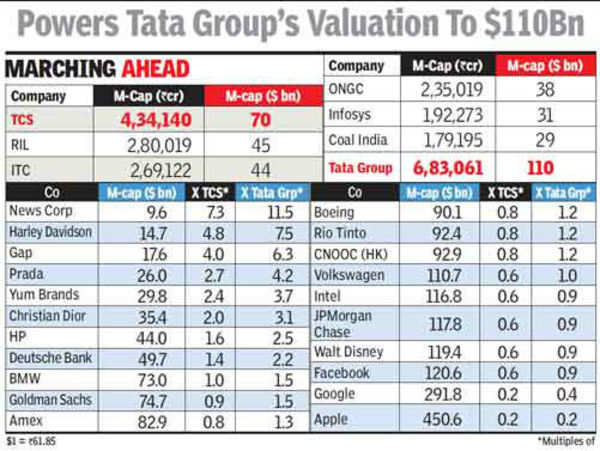
In recent times, the 3.9 million investors of the Tata Group have gained significantly mainly because of TCS’s listing in 2004. The software services pioneer has emerged as a favourite among IT investors. The best part of it is that some of the foreign companies mentioned above are clients of TCS contributing to its revenue, profit and market cap. No wonder, today the TCS scrip is a Rolls Royce on the bourses. With due apologies to the late David Ogilvy, the loudest noise you would hear at $70-billion m-cap is the hum of efficiency.

About the Author
Reeba ZachariahEnd of Article
FOLLOW US ON SOCIAL MEDIA










Photostories
Hot Picks
TOP TRENDING
Trending Stories
In Business
Entire Website
- Will banks open only for 5 days a week? Here’s what you should know about IBA’s proposal
- India set to be third largest economy, says S&P Global
- Dalal Street bull run continues! BSE Sensex crosses 69,000 for the first time; Nifty above 20,800
- Byju’s reduces notice period for employees as troubles mount
- Sensex surges over 900 points, Nifty above 20,550 as BJP state election wins bolster Modi's Lok Sabha 2024 prospects
- UltraTech to buy building materials business of Kesoram in 7,600 crore deal
- Tata Technologies stock debuts at a bumper 140% premium; share price at Rs 1200 on BSE
- Tata Technologies share allotment: How to check IPO allotment status, listing date, GMP
- BSE m-cap rides rally in Adani stocks, tops $4 trillion
- Charlie Munger, who helped Warren Buffett build Berkshire, dies at 99
- Bahraich violence: ‘Husband was subjected to torture in last moments’
- SCO must root out terrorism, respect territorial integrity: Jaishankar
- Mr Trudeau, beware of nurturing deadly snakes in your backyard
- No bilateral but India, Pak ‘break the ice’ with Jaishankar visit
- Remove page on earlier order in 36 hrs, Delhi HC tells Wikipedia
- Nayab Singh Saini gets backing of Haryana MLAs, to take oath as CM today
- Chinese docs have reversed diabetes in a patient. How is India placed?
- Bishnoi wants aapka address…: Viral memes after Canada targets India
- Muda chief, an aide of Sidda, quits citing health grounds
- PK fields Army ex-vice chief Krishna Singh for Bihar bypoll


Popular Categories
Hot on the Web
Top Trends
Justin TrudeauIND vs NZ HighlightsRohit SharmaPakistan Bomb BlastAnil KumbleJharkhand Election ScheduleVaranasi Rail Road BridgeAkasa Air Flight Bomb ThreatMaharashtra Election Full ScheduleBengaluru FloodJohn Cena RelationshipsBaba SiddiqueAshes ScheduleRBI Summer InternshipMaharashtra Election ScheduleJharkhand Election ScheduleLive Cricket Score
Trending Topics
Diwali WishesJigra Movie ReviewFake PaneerDevara OTT ReleaseVettaiyan CollectionRam GopalLawrence BishnoiCow GheeBigg Boss 18Salman KhanShraddha KapoorRatan Tata Passed AwayNana PatekarSharad Purnima Moonrise TimeSwatantrya Veer SavarkarSharad Purnima 2024Top Load Washing MachinesBest Premium LaptopsNonstick Cookware SetsWordle Answer
Living and entertainment
Latest News
'Most Special': Examining Andrew Garfield and Amelia Dimoldenberg past embracing conversations amid buzzing chicken shop date promotionOnly 26.8% of Indian youth in the academic age group have internet browsing skills: Can this impact quality education?Ex-Indian cricketer Ajay Jadeja now wealthier than Virat KohliCameron Diaz opens up about husband Benji Madden's support in her acting comebackSunny Deol finds tranquility in the mountains, shares the breathtaking view'Test cricket is nothing but...' - Indian players reveal what the red-ball format means to them8 Creative millet-based sweets that are a must try this festive seasonSomen Mishra sets record straight on Alia Bhatt and Vasan Bala 'Jigra' controversy: We were DYING to get Alia on boardBigg Boss Tamil 8 Preview: Arun accuses Arnav of being fake, says ' You're playing a double game 'SpiceJet receives 'bomb' threat for two flights on social media handle, pax disembarked'If we can keep Bumrah quiet': Pat Cummins outlines strategy for Australia in Border-Gavaskar TrophyBengaluru Weather Update: Will rain play a spoilsport on Day 2 of India vs New Zealand first Test?Jennie of BLACKPINK performs 'Mantra' on Jimmy Kimmel live!October Full Moon 2024: When and How to Watch Hunter's Moon Tonight?New Sebi norms to improve FPI, bond investors' liquidityReady for internet services in India: Elon MuskUK's weight loss jab Mounjaro might help people get back to work: All about itRG Marathon: Akshay, Ankitaben steal the show
Copyright © 2024 Bennett, Coleman & Co. Ltd. All rights reserved. For reprint rights: Times Syndication Service