
- News
- Business News
- India Business News
- Banks’ bad loans may rise again, warns RBI
Trending
This story is from December 28, 2019
Banks’ bad loans may rise again, warns RBI
The RBI warned that bad debts may rise again in the next nine months, mainly due to a weak macro situation, higher slippages and low credit growth. It added that large corporates that are flush with cash and don’t need loans now are one of the reasons for the current muted rate of growth of credit off-take in the banking system.
MUMBAI: The Reserve Bank of India (RBI) warned on Friday that bad debts may rise again in the next nine months, mainly due to a weak macro situation, higher slippages and low credit growth. RBI’s financial stability report (FSR), published biannually in June and December, also pointed to suspected cases of ratings shopping by mid-rated entities.
It added that large corporates that are flush with cash and don’t need loans now are one of the reasons for the current muted rate of growth of credit off-take in the banking system.
Indian banks’ capital adequacy ratio improved significantly to 15.1 per cent in September 2019 after recapitalisation of public sector banks (PSBs) by the government, the RBI warned. The provision coverage ratio (PCR) also rose to 61.5 per cent from 60.5 per cent a year earlier, implying increased resilience of the banking sector.

“Macrostress tests for credit risk show that under the baseline scenario, SCBs’ gross non-performing asset (GNPA) ratio may increase from 9.3 per cent in September 2019 to 9.9 per cent by September 2020, primarily due to change in macroeconomic scenario, marginal increase in slippages and the denominator effect of declining credit growth," RBI’s FSR noted.
It pointed out that state-run banks’ GNPA ratio may increase to 13.2 per cent by September 2020 from 12.7 per cent in September 2019, whereas for private banks it may climb to 4.2 per cent from 3.9 per cent, under the stress scenario. On the other hand, foreign banks’ GNPA ratio may increase to 3.1 per cent from 2.9 per cent. The central bank said that Indian banks’ net non-performing assets (NNPA) ratio declined in September 2019 to 3.7 per cent due to increased provisioning.
The report also pointed out that bank-wise distribution of asset quality showed that while 24 banks had GNPA ratios of under 5 per cent, four banks had GNPA ratios higher than 20% in September 2019. The asset quality of agriculture and services sectors, as measured by their GNPA ratios, deteriorated to 10.1% from around 8% a year earlier.
However, for the industry sector, slippages fell sharply to 3.8 per cent from around 5 per cent. The report showed that the share of large borrowers (between Rs 100 crore and Rs 5,000 crore) in banks’ total loan portfolios fell to 51.8 per cent from 53 per cent while their share in GNPAs improved to 79.3 per cent from 82.2 per cent earlier. It noted that the top 100 large borrowers accounted for 16.4 per cent of banks’ gross advances and 16.3 per cent of GNPAs.
It added that large corporates that are flush with cash and don’t need loans now are one of the reasons for the current muted rate of growth of credit off-take in the banking system.
The report said banks’ credit growth remained subdued at 8.7 per cent during the year ended September 2019, though the number for private banks was 16.5 per cent.


Indian banks’ capital adequacy ratio improved significantly to 15.1 per cent in September 2019 after recapitalisation of public sector banks (PSBs) by the government, the RBI warned. The provision coverage ratio (PCR) also rose to 61.5 per cent from 60.5 per cent a year earlier, implying increased resilience of the banking sector.
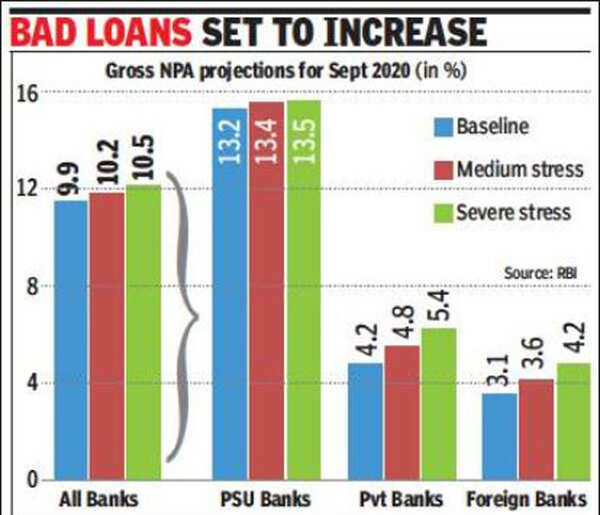
“Macrostress tests for credit risk show that under the baseline scenario, SCBs’ gross non-performing asset (GNPA) ratio may increase from 9.3 per cent in September 2019 to 9.9 per cent by September 2020, primarily due to change in macroeconomic scenario, marginal increase in slippages and the denominator effect of declining credit growth," RBI’s FSR noted.
It pointed out that state-run banks’ GNPA ratio may increase to 13.2 per cent by September 2020 from 12.7 per cent in September 2019, whereas for private banks it may climb to 4.2 per cent from 3.9 per cent, under the stress scenario. On the other hand, foreign banks’ GNPA ratio may increase to 3.1 per cent from 2.9 per cent. The central bank said that Indian banks’ net non-performing assets (NNPA) ratio declined in September 2019 to 3.7 per cent due to increased provisioning.
The report also pointed out that bank-wise distribution of asset quality showed that while 24 banks had GNPA ratios of under 5 per cent, four banks had GNPA ratios higher than 20% in September 2019. The asset quality of agriculture and services sectors, as measured by their GNPA ratios, deteriorated to 10.1% from around 8% a year earlier.
However, for the industry sector, slippages fell sharply to 3.8 per cent from around 5 per cent. The report showed that the share of large borrowers (between Rs 100 crore and Rs 5,000 crore) in banks’ total loan portfolios fell to 51.8 per cent from 53 per cent while their share in GNPAs improved to 79.3 per cent from 82.2 per cent earlier. It noted that the top 100 large borrowers accounted for 16.4 per cent of banks’ gross advances and 16.3 per cent of GNPAs.
End of Article
FOLLOW US ON SOCIAL MEDIA










Hot Picks
TOP TRENDING
Trending Stories
In Business
Entire Website
- Will banks open only for 5 days a week? Here’s what you should know about IBA’s proposal
- India set to be third largest economy, says S&P Global
- Dalal Street bull run continues! BSE Sensex crosses 69,000 for the first time; Nifty above 20,800
- Byju’s reduces notice period for employees as troubles mount
- Sensex surges over 900 points, Nifty above 20,550 as BJP state election wins bolster Modi's Lok Sabha 2024 prospects
- UltraTech to buy building materials business of Kesoram in 7,600 crore deal
- Tata Technologies stock debuts at a bumper 140% premium; share price at Rs 1200 on BSE
- Tata Technologies share allotment: How to check IPO allotment status, listing date, GMP
- BSE m-cap rides rally in Adani stocks, tops $4 trillion
- Charlie Munger, who helped Warren Buffett build Berkshire, dies at 99
- 'Message for Modiji': Opposition takes jab at BJP over Nitin Gadkari's 'PM post' claim
- Kejriwal says he will resign in 48 hrs: Does this mean early polls in Delhi?
- Why it is so easy to quench ‘sadiyon ki pyas’ in dry Bihar
- 'He never listened ...': Anna Hazare reacts to Kejriwal's 'will quit' decision
- Taylor Swift's endorsement fails to move needle for Kamala Harris: Survey
- Kohli at his destructive best, shatters Chepauk wall with six
- Will Germany’s suspension of Schengen entry end the Europe dream?
- Melinda Gates reveals the 'best part' of not working with ex-husband Bill Gates
- 'Even Britishers didn't expect ruler more cruel in India': Kejriwal attacks BJP govt
- 'PR stunt ... gimmick': How BJP, Cong reacted to Kejriwal's shock announcement



Popular Categories
Hot on the Web
Top Trends
Trending Topics
World Largest HorseEID WishesOnam WishesPriyanka Chopra TattooKottukkaali OTT ReleaseEngineers Day WishesGoat CollectionHair LossSudha MurtyMalayalam ProducersIndia's Best Dancer 4Simi GarewalDilli BabuIndian National ParksLaung BenefitsVikas SethiApple iPhone 16Donald TrumpAadhar Card UpdateWordle Answer
Living and entertainment
Latest News
PM Modi's Sunday roadshow in Jamshedpur cancelled due to heavy rain4 types of tea to improve gut health and ease digestive issuesFour Zodiac Signs That Are Hard to Control'Message for Modi': Opposition takes jab at BJP over Nitin Gadkari's 'PM post' claimNetflix denies filmmaker Soham Shah’s plagiarism allegations over Squid Games, says claim holds 'no merit''Virat bhaiya's passion and dedication for the game is...': Sarfaraz KhanFather rapes and murders 8-year-old daughter in Madhya Pradesh, throws body in wellWeekly Career Horoscope, September 15 to September 21, 2024: Read your weekly astrological work predictions for all zodiac signsZodiac Signs That Crave a Luxurious LifestyleRain washes out England-Australia T20I series finale"Miami Dolphins Owner Stephen Ross Eyes Multi-Billion Dollar Deal: The $7 Billion Power Play"Rajkummar Rao hails Kareena Kapoor Khan's The Buckingham Murders as a 'gripping thriller'MoS Finance likely to be convenor of GoM on GST compensation cessRole Rewind: Did you know Ranveer Singh and Deepika Padukone's love story has a strong Kareena Kapoor Khan connection?Coin Master free spins and coins for 15 September, 2024: Earn 7 million coins using today’s linksHow to set up partner sharing in Google PhotosIndia, Pakistan players involved in heated exchange during Asian Champions Trophy. WatchNoida authority fraud: 2 arrested in Rs 3.9 crore scam linked to fake bank accounts
Copyright © 2024 Bennett, Coleman & Co. Ltd. All rights reserved. For reprint rights: Times Syndication Service