
- News
- India and Canada draw daggers
This story is from September 20, 2023
India and Canada draw daggers
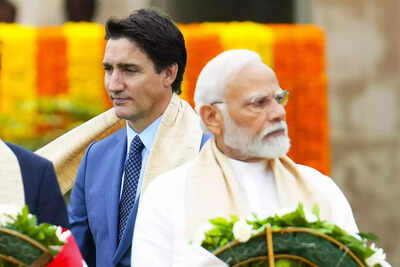
File Photo: Narendra Modi and Justin Trudeau
- India on Wednesday told its citizens to avoid travelling to parts of
Canada . This follows after Canadian PMJustin Trudeau alleged the involvement of "agents of the Indian government" in the killing of a prominentSikh separatist leader in Surrey in June, claims outrightly rejected by New Delhi as "absurd" and "motivated". - "Threats have particularly targeted Indian diplomats and sections of the Indian community who oppose the anti-India agenda," a foreign ministry statement said, advising citizens to "avoid travelling to regions and potential venues in Canada that have seen such incidents".
- In a further blow to already frosty bilateral ties between Canada and India, the two countries have expelled a senior diplomat each after Canadian PM Justin Trudeau alleged the involvement of "agents of the Indian government" in the killing of a prominent Sikh separatist leader in Surrey in June, claims outrightly rejected by New Delhi as "absurd" and "motivated".
- The Canadian government has also updated its travel advisory asking its citizens to avoid all travel to Jammu and Kashmir “due to the unpredictable security situation”.
Trudeau's speech
- "Over the past number of weeks, Canadian security agencies have been actively pursuing credible allegations of a potential link between agents of the Government of India and the killing of a Canadian citizen,
Hardeep Singh Nijjar ," Trudeau said Monday in a speech to the House of Commons. Updates here.
A G-20 snub
- India's snub to Trudeau during the G-20 summit could be the immediate trigger for the current diplomatic crisis between the two countries. Unlike in the case of other global leaders, PM Modi did not post any "welcome note" for his Canadian counterpart after the latter landed in India.
- Also, Trudeau and Modi didn't hold a formal bilateral meeting at the summit, instead having a brief conversation on the sidelines. Trudeau claims to have brought up Nijjar's killing, while Modi criticised Canada for allegedly allowing Sikh secessionist groups to operate in the country, according to the MEA.
Who's Nijjar?
- Hardeep Singh Nijjar, 45, the chief of the banned
Khalistan Tiger Force (KTF) and one of India's most-wanted terrorists who carried a cash reward of Rs 10 lakh on his head, was shot dead by two unidentified gunmen outside a gurdwara in Surrey in the western Canadian province of British Columbia on June 18.
Who's the Indian diplomat?
- Canadian foreign minister Melanie Joly confirmed that she has ordered the expulsion of "a senior Indian diplomat".
- The expelled Indian official was identified as Pavan Kumar Rai, a 1997-batch IPS officer, who was handling, according to the Indian high commission, economic, coordination and community affairs.
- Joly called him India's external intelligence agency RAW's point man in Canada.
'A diversionary tactic'
- In response, India said Trudeau's unsubstantiated and absurd allegations were only meant to shift focus from Canada's support to Khalistan terrorists.
What Five Eyes say
- Trudeau was reported to have briefed US President Joe Biden, UK PM Rishi Sunak and French President Emmanuel Macron about Canada's action.
- In its first reaction to the controversy over Canada's allegations, Australia has called the reports "concerning" and said it has raised the issue with its "Indian counterparts".
- The US has said it was 'deeply concerned about allegations referenced by Canadian Prime Minister Justin Trudeau'. White House National Security Council spokesperson Adrienne Watson said, "We remain in regular contact with our Canadian partners. It is critical that Canada’s investigation proceed and the perpetrators be brought to justice.”
Also read
Just what’s going on, Justin?
The Trudeau government’s allegation has no credibility and seems part of a concerted attempt to target India. It’s likely that Khalistani extremist Nijjar, who was involved in gang wars, fell victim to his own criminal associates, writes security expert Ajai Sahni.
Why Khalistani extremism thrives in Trudeau’s Canada
Justin Trudeau’s survival as PM hinges on support from the New Democratic Party, whose leader Jagmeet Singh backs a referendum on Khalistan and has attended pro-Khalistan rallies, writes TOI+ columnist Minhaz Merchant.
End of Article
FOLLOW US ON SOCIAL MEDIA
Hot Picks
TOP TRENDING
Trending Stories
In Section
Entire Website
- Cracking CAT: Why Math Skills Alone Won’t Get You Into an IIM
- Did you know there's a 5,000-year-old Boat older than the Pyramids? 10 facts
- Charles did not like Diana's surprise Billy Joel dance, 'it was early sign of doomed marriage'
- PM Modi heads back to India without handing MAGA supremo a 'trump card'
- 'Jahil log': Pakistan's Basit Ali slams home curators after India's win over Bangladesh
- 'Keep him quiet': Pat Cummins warns Australia about India's game-changer ahead of Border-Gavaskar Trophy
- Hong Kong to Delhi flight makes emergency landing in Kolkata airport
- WB ANM, GNM result 2024 out: Direct link to download rank card here
- 1,200 of 1,440 seats vacant: Vande Bharat on Secunderabad-Nagpur route operating at 20% occupancy
- Patna-Tatanagar Vande Bharat to run on 2 routes
- 'Not this time ...': CM Siddaramaiah claims BJP, JD(S) 'conspiracy' after HC order on Muda case
- Spycams in toilet, bedroom: Delhi man held for recording woman tenant
- These are the fastest-growing small-caps in the last four years
- 'Don’t drag us into your agenda’: SC slams NCPCR over SIT probe plea
- 'Virat Kohli shuru hoga Australia se'
- 'I am Kejriwal's Hanuman': After Atishi & Sisodia, AAP's Gahlot invokes Ramayana
- After flirting with China, is Maldives back to loving India?
- Apple cuts price of iPhone 15 & iPhone 14 models, here's new price list
- Meet Haryana Police DSP who guided India to 2007 T20 WC glory
- Is AI Friend or Foe? 5 game-changing strategies to thrive in evolving job market

Popular Categories
Hot on the Web
Top Trends
Trending Topics
Living and entertainment
Latest News
CG Vyapam admit cards released for HELT24 and FF124 exams at vyapam.cgstate.gov.in: Direct link to download here'Virat shuru hoga Australia se': Basit Ali says Kohli's low scores vs Bangladesh not an issueSEBI fines Anil Ambani’s son Rs1cr for loan approvals without 'due diligence'Swara Bhasker-Fahad Ahmad's daughter Raabiyaa turns one; see how the doting parents celebrated the special day with cake, balloons and moreTest | War 2: Hrithik Roshan, Kiara Advani's romantic chemistry grabs attention in viral picsFamily kills rape survivor, frames 'rapist' out on bailEC to have 'zero tolerance' towards use of money power in Jharkhand assembly pollsThrowback: When Parineeti Chopra shined in yellow during her joyful haldi ceremony celebrationsAPPG pushes for Ayurveda integration in UK’s healthcare systemBorder Gavaskar Trophy: When Steve Smith had a 'brain fade' moment against IndiaICAI CA Final Exam for Nov 2024 postponed due to Diwali, new exam date announced: Check official notice hereEpic Last 'Monster' Standing match and more exciting matches announced for WWE RAW (9/30)Best Time To Upgrade To 4G & 5G Tablets: Lightning-Fast Performance At Unbeatable PricesEssential tips for building and maintaining a happy marriageWhen and where to watch England vs Australia 3rd ODI: Date, time, venue, squad, broadcast detailsThe Luckiest Zodiac Signs: Who's Got the Midas Touch?BJP plans protests over reopening of ‘old cases’When Remo D'Souza opened up about his heart attack and revealed how Salman Khan stayed in constant touch with his wife over the phone
Copyright © 2024 Bennett, Coleman & Co. Ltd. All rights reserved. For reprint rights: Times Syndication Service