
- News
- World News
- US News
- Why Wall Street might be getting sick of Trump victory
Trending
Why Wall Street might be getting sick of Trump victory
Following Donald Trump’s election victory over Vice President Kamala Harris, there was an initial surge in stock prices, especially in sectors like financials and industrials, which were expected to benefit from his economic policies. However, as the market adjusts to the realities of a Trump presidency, concerns are emerging about potential policies that could negatively impact growth and stability.
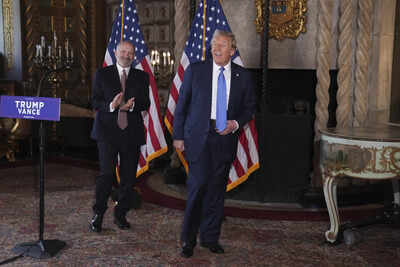
President-elect Donald Trump leaves a news conference at Mar-a-Lago, Monday, Dec. 16, 2024, in Palm Beach, Fla., as Commerce Secretary nominee Howard Lutnick follows. (AP Photo/Evan Vucci)
Historic Losing Streak
The Dow Jones Industrial Average has entered troubling territory, experiencing its longest losing streak since February 1978, with nine consecutive days of declines. This sharp downturn contrasts with the broader market, where the S&P 500 and Nasdaq Composite remain near record highs. The Dow’s decline, closing 267 points (0.6%) lower on Tuesday, underscores a shift in investor sentiment.
Following Donald Trump’s election victory over Vice President Kamala Harris, there was an initial surge in stock prices, especially in sectors like financials and industrials, which were expected to benefit from his economic policies. However, as the market adjusts to the realities of a Trump presidency, concerns are emerging about potential policies that could negatively impact growth and stability.
Reasons for the Fall
- Narrow Market Breadth: Analysts have noted that many stocks are failing to keep pace with gains in technology and other sectors. This divergence has led to a rotation away from traditional blue-chip stocks, which dominate the Dow, towards tech stocks that have shown greater resilience.
- Policy Concerns: Investors are increasingly wary of Trump’s proposed economic policies, including
potential trade uncertainties , rising interest rates, and risks tied to healthcare reforms. These factors are prompting questions about whether the post-election rally was overly optimistic.
The S&P 500 and Nasdaq Remain Strong
Despite the Dow’s prolonged decline, the S&P 500 and Nasdaq have shown resilience, with the S&P 500 recently hitting a new high and the Nasdaq maintaining strong investor interest. This divergence suggests that while the Dow is underperforming, other sectors of the market remain robust, highlighting a complex and evolving economic landscape. The Dow’s nine-day losing streak serves as a stark reminder that market dynamics can shift rapidly. What initially seemed like a bullish trend post-election has taken a bearish turn. Investors on Wall Street are reassessing the implications of Donald Trump’s presidency, revealing growing concerns about the sustainability of market gains in the face of policy uncertainty.

About the Author
TOI World DeskEnd of Article
FOLLOW US ON SOCIAL MEDIA











Hot Picks
TOP TRENDING
Explore Every Corner
Across The Globe
Popular Categories
Hot on the Web
Top Trends
Trending Topics
Allu ArjunMerry Christmas WishesPushpa 2 ReviewChristmas 2024Optical illusionMufasa: The Lion King CollectionUI The Movie Twitter ReviewPushpa 2 OTT ReleaseUI Movie Box Office CollectionBaba Vanga Predictions for 2025Mufasa OTT ReleaseAishwarya RaiSkincare Tips for WinterWeight Loss TipsHair FallNYT ConnectionsKia Syros SuvElon Musk
Living and entertainment
Latest News
Windsors' Christmas at Sandringham: Harry and Megan Markle to receive royal invites?Will Giannis Antetokounmpo play against the Chicago Bulls tonight? Latest update on the Milwaukee Bucks star's injury report (December 23, 2024)Saved after suicide bid, man gets death sentence for killing 3 of his familyTelangana minister Komatireddy Venkat Reddy asks Allu Arjun to pay Rs 20 crore to the stampede victim's family- Report500 years on, Vasco da Gama hailed in Lisbon, ignored in KochiAP Dhillon pays visit to his 'crush' Malaika Arora's restaurant after concert in Mumbai - WATCH video3 of pro-Khalistan group killed in UP encounterMatt Gaetz reacts to ethics report: 'Giving funds to someone you...'Delhi HC denies anticipatory bail to former IAS probationer Puja KhedkarTop 5 Much Awaited Sneakers For The 2024 Christmas DayWe gave jobs to 10 lakh youth in 18 months: PM ModiStephen Curry Steals The Show At The Sneaker Con, Unveils New Under Armour ShoesWill LaMelo Ball play against the Houston Rockets tonight? Latest update on the Charlotte Hornets star's injury report (December 23, 2024)Nordstrom to go private in $6.25 billion deal with family and Mexican partnerKarl-Anthony Towns' Girlfriend, Jordyn Woods Reps New York Knicks at Epic Girls Holiday Pajama PartyYouTuber N3on Damaged The Unreleased Shoe Line By NBA Star LeBron James Worth $30,000In U-turn, Telangana lets two-child policy stayPunjab beefs up security at thanas, posts
Copyright © 2024 Bennett, Coleman & Co. Ltd. All rights reserved. For reprint rights: Times Syndication Service